

Africa already owns one trillion dollar technology wave outright. The next one is bigger, more capital hungry, and for now belongs mostly to someone else.
In 2025, Africans moved $1.4 trillion through their phones, more than twice as much as flowed through every mobile wallet on every other continent combined. No Silicon Valley company owns the rail that money runs on. No import licence controls it, no foreign bank clears it, and no venture backed platform in San Francisco can switch it off. It was built, licensed, priced and scaled inside Africa, for a market the global financial system had already decided wasn’t worth the trouble. Two decades ago, mobile money was an experiment run by a mobile operator in Kenya to let friends move airtime credit between phones. Today it is the financial plumbing for hundreds of millions of people a bank branch was never built for.
That fact deserves more attention than it usually gets, because it has happened only once. Everywhere else Africa has taken part in the last three decades of global technology, it has mostly rented the infrastructure and built on top of it, using handsets, cloud servers and fibre backbones manufactured, financed and priced somewhere else. Mobile money is the exception that proves what is possible. As a new, much larger technology wave now gathers around artificial intelligence, data infrastructure, digital identity and programmable capital, the question worth asking plainly is whether Africa is about to repeat that trick, or whether this is the wave it simply watches happen to it.
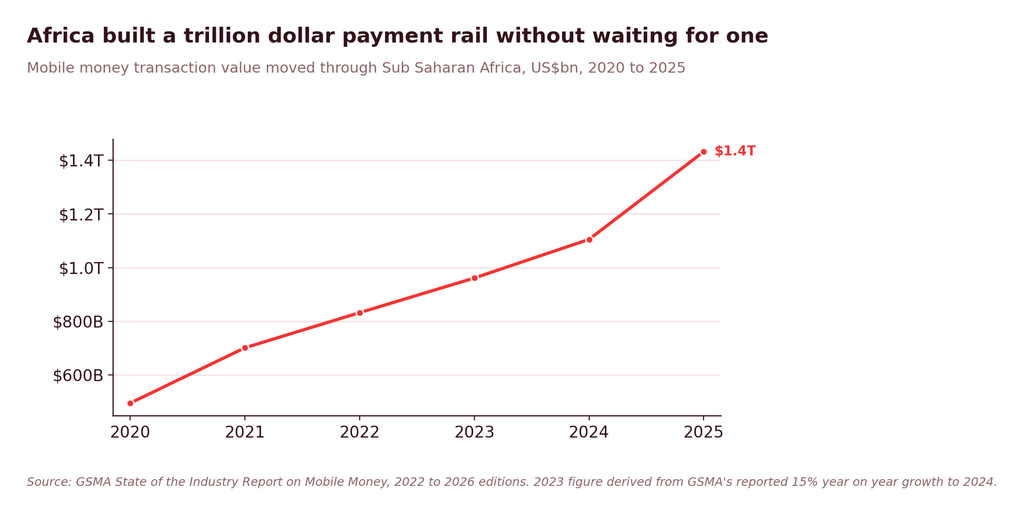
$1.4 trillion moved through Sub Saharan Africa’s mobile wallets in 2025, on rails no outsider owns. GSMA, State of the Industry Report on Mobile Money 2026.
The pattern hiding inside four earlier waves
Strip away the marketing and Africa’s digital history breaks cleanly into stages. Banks and ATMs built the first formal financial rails. GSM licences built connectivity. The smartphone turned a single device into a bank branch, a marketplace and a newsroom at once. Fintech, mobile money first and card and API based payments after it, turned money itself into software. Two of those four moments reward walking through in detail, because they show exactly how the pattern that matters here actually forms.
How Africa learned to own a telecom network
The clearest early example took shape in South Africa in 1993, when the government awarded two cellular licences to break the state telecom monopoly. One went to Vodacom, a joint venture between state owned Telkom, Vodafone of the United Kingdom and a local investment firm linked to businessman Johann Rupert. The other went to a consortium that became MTN. Vodacom switched on its network on 1 June 1994, weeks after the country’s first democratic election, and MTN followed within days. Both companies were part foreign owned from the start, but the licence, the spectrum and the obligation to build towers across South African soil sat with locally registered companies answerable to a local regulator, not with a network beamed in from abroad. When Vodacom launched prepaid airtime in 1996, removing the need for a credit check or a bank account most South Africans didn’t have, it turned mobile telephony from a luxury product into a mass one, and set a template mobile money would later copy.
Nigeria repeated the pattern on a larger and messier scale in 2001. The Nigerian Communications Commission auctioned four digital mobile licences at $285 million each, and the process survived a last minute attempt inside government to derail it. MTN and a consortium called Econet Wireless, backed by Zimbabwean entrepreneur Strive Masiyiwa and a group of Nigerian banks and state governments, paid up and launched within months. A third bidder missed its payment deadline and forfeited its licence, which was eventually rebid and won by Mike Adenuga, a Nigerian businessman whose company Globacom launched in 2003 as the country’s first fully indigenous network operator. The government collected more than $800 million in licence fees for what had, months earlier, been a state monopoly running a few hundred thousand phone lines. Within two decades Nigeria had close to 300 million connected lines.
The decision that turned a phone into a bank
Mobile money’s origin is usually flattened into a one line legend: a Kenyan telecom operator let people send money by text message and it changed the continent. The more interesting story is regulatory. In 2005, Safaricom, then part owned by Vodafone and by the Kenyan government, used a grant from the United Kingdom’s Department for International Development to pilot a system meant to help borrowers repay small loans by phone. Within months the pilot’s users had repurposed it. They were using it to send money to relatives rather than repay loans, and Safaricom rebuilt the product around that discovery. The company had no banking licence, and Kenya had no law written for what M-Pesa was about to become.
The Central Bank of Kenya could have required Safaricom to partner with a licensed bank, structure the product as a regulated deposit account, or wait for parliament to write mobile money into law. Instead, in a decision now studied internationally, the acting governor issued a short letter of no objection. The central bank would not block the launch, provided Safaricom kept customer funds in insured commercial bank accounts and met basic safeguards against fraud. M-Pesa launched in March 2007 with the backing of Kenya’s finance and communications ministers. Two years later, after a banking industry lobbying campaign accused the service of operating as an unlicensed bank, the central bank audited M-Pesa and declared it sound. By then it had 9 million users, roughly 40% of Kenya’s adult population.
Vodafone’s other big African market shows how much that single regulatory choice mattered. When Vodacom tried to launch the same product in Tanzania, regulators required a more conventional banking structure, and the company found it needed roughly 40,000 agents to match the density Safaricom had achieved by repurposing its existing airtime resellers, against barely 4,000 it actually had. Fourteen months after launch, Kenya’s service had reached 2.7 million users. Tanzania’s had reached 280,000 in the same span. Safaricom ended up controlling 79% of Kenya’s mobile market, against Vodacom’s 39% in Tanzania. The technology was identical. The regulatory environment was not, and that difference was worth the gap between a national payment rail and a niche product.
The ownership of the M-Pesa brand itself completed a fifteen year journey in 2020, when Safaricom and Vodacom jointly bought the M-Pesa brand and technology outright from Vodafone, moving full control of the product, not just its operation, onto African registered balance sheets. It is the closest thing Africa’s technology history has to a founding myth for the pattern this report keeps returning to: a regulator that chose to let a company build first and ask permission later, a market that rewarded density over convenience, and, eventually, full ownership following usage rather than the other way round.
Why the smartphone counted differently
The smartphone era never produced an equivalent story, and the gap is instructive. Handsets branded Tecno, Infinix and itel are the phones most Nigerians, Kenyans and Ghanaians actually carry, and together the three brands hold close to half of Africa’s smartphone market. All three belong to Transsion, a company headquartered in Shenzhen that designed its devices specifically for African conditions, with longer battery life, dual SIM slots and cameras calibrated for darker skin tones, and built a distribution network to match. The localisation is real. The ownership, the manufacturing and the profit are not African. It is the clearest illustration of the pattern’s other half. Adoption without ownership, however deep and however well suited to the market, is still renting.
Four eras, one pattern. South Africa’s and Nigeria’s telecom licences, and Kenya’s regulatory forbearance toward M-Pesa, each gave a local or pan-African company the right to build and operate the actual rail. Transsion’s phones, and the smartphone app economy built on foreign clouds, did not. Call the difference the owned-rail pattern. It appears whenever three conditions line up. The technology can be licensed and built at national or regional scale. The capital required is within reach of local banks, development finance institutions or telecom balance sheets. And a regulator is willing to let a local or pan-African company build the thing rather than simply wave through an import or an off the shelf foreign product. Where those conditions are absent, chiefly when the up front capital dwarfs what local balance sheets can supply, Africa has historically ended up a customer of someone else’s infrastructure rather than an owner of its own. That is the test the wave now forming has to pass.
The rail forming now is not another app layer
What is arriving next is not a new layer of consumer software sitting on infrastructure that already exists. It is the infrastructure itself, several layers of it at once. The data centres and compute that run AI models. The fibre and satellite links that feed them. The energy that keeps them running. The digital identity systems that let people and machines transact with each other. And, newer still, the tokenisation of real assets into instruments that can move like software. Every earlier wave could be adopted piecemeal, a phone here, an app there. This one behaves more like plumbing. Either a country has somewhere to compute and secure its own data, the power to run it on, and a legal identity system to plug it into, or it is, by default, a permanent tenant of whoever does.
Nineteen percent of humanity, a rounding error of the world’s computers
The scale of that dependency is easiest to see rather than describe.
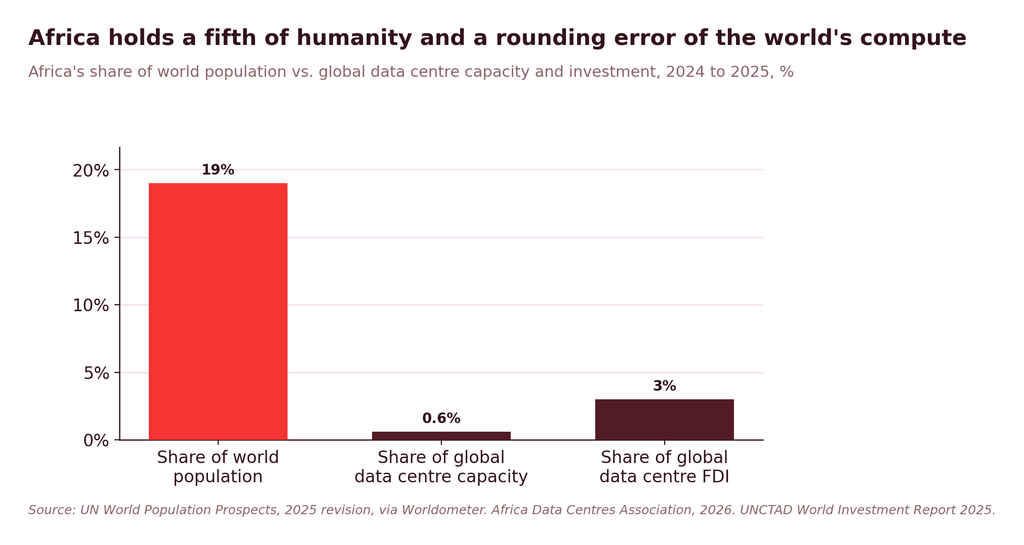
Home to roughly a fifth of the people on Earth, Africa hosts under one percent of the planet’s data centre capacity and attracted just 3% of global data centre investment in 2024, according to UN Trade and Development. The continent’s roughly 220 to 230 operational data centres are also heavily concentrated. South Africa, Kenya and Nigeria alone account for around 40% of them, and Africa’s entire data centre market, worth an estimated $1.9 to $3.5 billion depending on the count used, sits against a global market valued in the hundreds of billions of dollars. This is not simply a story about money arriving slowly. It is a story about where the physical machinery of the next economic wave is being poured in concrete, and it is mostly not being poured in Africa.
The Africa Finance Corporation has been explicit that fibre, internet exchange points and regional data centres are now questions of digital sovereignty as much as of commerce, the infrastructure that decides whether African data, and the value extracted from it, has to leave the continent to be processed at all. The Broadband Commission’s own 2025 assessment points to submarine cables, IXPs and satellite links expanding across the continent, evidence that the connectivity side of the gap is narrowing even as the compute side remains stark.
The African AI paradox
Africa’s clearest comparative advantage in AI may be linguistic rather than industrial, and it is exactly the advantage the current infrastructure gap makes hardest to capture. The continent is home to more than 2,000 living languages, over 30% of the world’s total, yet the large language models now shaping how billions of people work and communicate are trained overwhelmingly on a handful of high resource languages. The GSMA reports that even state of the art AI models lose roughly 30 percentage points of accuracy on African languages compared with major world languages, a gap that six of the continent’s largest mobile operators, working with the GSMA, are now trying to close with shared language identification models and safety benchmarks covering dozens of African languages.
There are early signs that some operators want to own more of the stack behind that effort rather than simply rent it. In April 2026, MTN took part in a $45 million funding round for ODC, a startup building network technology designed around Africa’s mix of equipment vendors and patchy power supply, a small early bet on the technology layer rather than on capacity leased from a global cloud provider. It is worth being honest about scale. A $45 million round is a rounding error against a global data centre industry valued in the hundreds of billions. The signal is real. The gap it is closing is not.
The identity layer already being built
There is a rail Africa is already constructing for the next wave, and it rarely gets named alongside AI or tokenisation because it looks unglamorous. Nearly every African fintech, bank and crypto exchange has to confirm who a customer actually is before it can move their money, and the infrastructure doing that work at scale was built in Lagos, not California. Smile ID, founded in 2017 and headquartered in Lagos and Nairobi, connects directly into national identity systems across the continent, among them Nigeria’s NIN and BVN, Kenya’s national ID and KRA PIN, Ghana Card, South African ID and Rwandan ID, and has processed more than 150 million identity verifications for clients including Paystack, Paga, ChipperCash, KudaBank and Binance. Rival providers such as Youverify and Dojah compete for the same business across the continent.
This is the owned-rail pattern operating in its purest form. Building a verification layer took a working relationship with government identity authorities and a database of African faces and documents accurate enough to succeed where the generic tools described in the AI paradox above fail. It did not take a data centre or a spectrum auction. Every fintech built on Nigeria’s, Kenya’s or Ghana’s payment rails quietly depends on this identity layer to function, which makes it one of the few pieces of the next wave Africa has already substantially built rather than merely proposed.
Capital learns to speak software before it learns to speak compute
The clearest evidence that Africa’s capital markets are already probing the next owned-rail opportunity sits, not coincidentally, with a regulator rather than an infrastructure builder. Nigeria’s Securities and Exchange Commission has, since 2023, been licensing a small cluster of companies inside its regulatory sandbox to tokenise real assets. Hashgreed and Trovotech are licensed for real world and digital asset tokenisation. HXafrica and DreamCity Capital are licensed to tokenise real estate. Wrapped CBDC’s cNGN is licensed as a stablecoin offering, and Blockvault is licensed to custody digital assets. None of this is yet close to fintech’s scale. A handful of sandboxed pilots is a rounding error next to $1.4 trillion in annual mobile money flows.
But the shape of the pattern is the interesting part. This is not African fintechs adopting someone else’s tokenisation protocol. It is a domestic regulator building the legal rail, licences, sandboxes and custody rules, that the rest of the stack can plug into, the same sequence that preceded mobile money’s scale up a decade earlier, and the same sequence already at work in the identity infrastructure described above. Tokenising an asset is regulatory and legal work before it is a capital intensive one. It needs a willing regulator and a trusted identity layer to verify who owns what, more than it needs a data centre. Of the technologies now forming the next wave, programmable capital is the one that most closely fits the conditions under which Africa has previously won.
The constraint the earlier waves never had to solve
Telecom licensing needed spectrum and towers. Fintech needed a licence, an agent network and a smartphone in enough pockets. Compute needs all of that plus something neither wave depended on at scale, uninterrupted and heavy electricity. Nigeria’s roughly seventeen data centres already require an estimated 137 megawatts of power capacity, in a country where the grid provides only a few hours of reliable electricity a day in many places, forcing operators onto diesel generators that raise costs and emissions alike. The African Energy Chamber forecasts the continent’s data centre power demand growing at 9% a year to reach 2 gigawatts by 2030, respectable growth, but slower than the roughly 11% annual growth forecast for global data centre capacity, which is expected to reach 249 gigawatts over the same period. Africa’s compute footprint, on current trajectories, is not catching up. It is holding its share.
This is the honest difference between this wave and the ones Africa has already won. A fintech licence and a smartphone could scale a payment rail to a billion people without anyone laying a single new power line. A data centre cannot. Whoever solves the economics of reliable, affordable African electricity is not just building an energy business. They are removing the one constraint that makes every other layer of this wave possible.
Where the next rail could still be won
None of this argues that Africa is locked out of the next wave, only that the wave has to be read correctly to be won. Three places already look winnable. Blended finance structures of the kind the Africa Finance Corporation is assembling, bundling renewable power generation directly with data centre and internet exchange development, address the sequencing problem head on. Compute does not have to wait for a grid that may not arrive this decade if the power is built alongside it. Digital identity and asset tokenisation infrastructure, the layer Smile ID has already built and Nigeria’s SEC sandbox is now licensing, is the nearer and cheaper owned-rail opportunity, because it depends on regulatory will and trusted local data more than on capital expenditure, and other African regulators and founders can copy both models faster than any country can build a hyperscale campus. And the language model effort GSMA and its operator partners have started is only as valuable as the data pipelines and compute feeding it. Funding the unglamorous work of collecting, cleaning and hosting African language data locally is a smaller and more fundable bet than competing to build the next frontier model.
For founders and investors, the practical implication is a change of question. What app should we build on top of AI is the smartphone era question, asked of a data centre era problem. The version of that question that has actually paid off for Africans before is closer to this. What licence, what regulatory sandbox, or what piece of physical infrastructure is about to become a layer that a thousand other companies will have to build on top of, and can it be owned rather than rented.
The pattern is already written But The ownership isn’t
Nobody asked Silicon Valley for permission before building the rails that now move $1.4 trillion a year through African hands. That decision was made by a handful of regulators, telecom operators and fintech founders across roughly two decades, mostly before anyone outside the continent was paying close attention. The infrastructure now being poured for the next wave, literally in concrete, power lines and licensing frameworks, is being decided in boardrooms, central banks and finance ministries over the next few years, not the next few decades. Africa has already shown it knows how to own a rail when the conditions line up. Whether they line up again, or whether this becomes the first wave the continent mostly watched from the outside, is not a technological question. It is a financing and regulatory one. It is being answered now, one data centre and one sandbox licence at a time.