



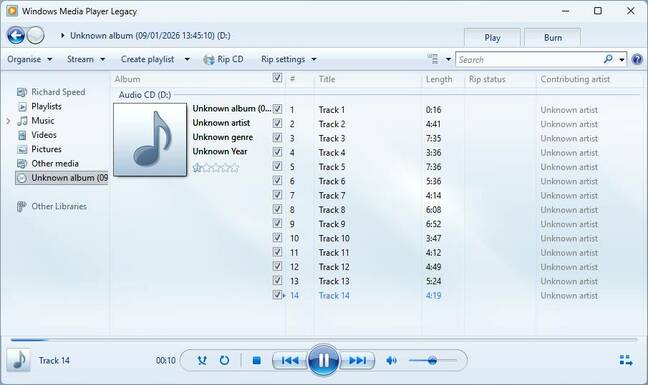

The digital music era’s favorite workhorse just lost a piece of its magic. Windows Media Player can no longer identify the CDs you slip into your drive, leaving users staring at generic “Track 1, Track 2, Track 3” listings where album art and artist names once appeared automatically.
The metadata service powering this feature, which queries the endpoint musicmatch-ssl.xboxlive.com, appears to have gone offline around mid-December 2025, according to a wave of user reports flooding Microsoft’s support forums. What was working smoothly on December 14 suddenly failed the next day, with users seeing connection errors instead of the track listings and cover art they’d come to expect over two decades of use.
Microsoft hasn’t publicly confirmed the shutdown or explained what happened. The company didn’t respond to media inquiries about whether this represents a permanent retirement of the service or merely an extended outage. But the silence speaks volumes, especially when viewed against the backdrop of broader changes Microsoft announced earlier in 2025.
For Windows users of a certain vintage, the ritual was simple and satisfying: insert a CD, watch Windows Media Player spring to life, and see album information populate within seconds. Behind that seamless experience sat a metadata lookup service that matched a disc’s table of contents to an online database, pulling down track names, artist information, and album artwork automatically.
The current service, hosted at musicmatch-ssl.xboxlive.com, has been the backbone of this feature since around 2018, when Microsoft migrated away from an earlier endpoint at fai.music.metaservices.microsoft.com. That transition itself was rocky, users reported sporadic failures and misidentified albums, but the service eventually stabilized and continued serving CD metadata for years.
Until December 15, 2025, when it apparently didn’t anymore.
User reports across Microsoft’s Q&A forums, Windows enthusiast sites, and Reddit paint a consistent picture: both Windows Media Player Legacy and the newer Media Player app in Windows 11 now fail to retrieve any CD information. Error messages reference the musicmatch endpoint and report connection failures. Users attempting to manually trigger “Find album info” lookups see blank results or timeout errors.
The timing is particularly frustrating for those who received boxed sets or music CDs as holiday gifts and discovered their preferred ripping workflow had suddenly broken.
While Microsoft hasn’t drawn a direct line between the CD metadata outage and other service retirements, the circumstantial evidence is compelling. In May 2025, Microsoft announced the shutdown of Windows Metadata and Internet Services (WMIS), a broader infrastructure that delivered device metadata to Windows clients.
That announcement focused primarily on hardware device metadata, the system that provided custom icons, manufacturer logos, and descriptive information for peripherals in Windows interfaces. Microsoft stated that WMIS would stop delivering new metadata packages as of May 2025, with partners able to view and download previously signed packages through December 2025.
The official documentation makes no specific mention of music metadata or Windows Media Player’s CD lookup functionality. But WMIS represented Microsoft’s general approach to delivering metadata from cloud services to Windows clients, and the music database appears to have followed the same fate.
The pattern suggests a systematic retirement of legacy metadata services rather than a targeted shutdown of CD information specifically. Microsoft has been signaling this direction for years, branding Windows Media Player as “Legacy” while pushing users toward newer apps and cloud-based services.
For casual listeners who occasionally rip a CD, this is an annoyance. For music archivists, radio producers, DJs, and others who work with physical media regularly, it’s a workflow disruption that forces them to either manually tag everything or migrate to different software.
One user on Microsoft’s forums described needing CD metadata access for their job in radio production, where they regularly rip discs for broadcast use. Another mentioned having seven large boxed sets to process and discovering the service failure partway through. Users report that even CDs they’d successfully ripped years ago no longer trigger automatic metadata lookups when re-inserted.
The accessibility implications are also significant. Windows Media Player’s simple, automatic metadata retrieval was particularly valuable for users with limited dexterity or those who aren’t comfortable with more technical alternatives. Now they face either repetitive manual typing for every track or a learning curve with unfamiliar software.
For those affected, several third-party options remain available. Apple’s iTunes continues to successfully retrieve CD metadata through its own service (Gracenote), according to testing by The Register. Free CD ripping tools like fre:ac, dbPoweramp CD Ripper, Foobar2000, and Exact Audio Copy all maintain their own metadata lookup capabilities, typically querying databases like FreeDB or MusicBrainz.
These alternatives often provide more features than Windows Media Player—including error correction, multiple format support, and more comprehensive metadata editing—but they also represent a migration hurdle for users who’ve built workflows around WMP over the past 20-plus years.
Some users report success with manual workarounds, including downloading album artwork from Amazon and typing in track information themselves, though this obviously defeats the convenience that made automatic metadata retrieval valuable in the first place.
The likely explanation is straightforward: Microsoft looked at usage data and concluded too few people still play CDs to justify maintaining the infrastructure. Physical media drives have become increasingly rare in modern PCs, with many laptops shipping without optical drives for years. Streaming services dominate music consumption, and even users who prefer local files often purchase digital downloads rather than ripping CDs.
From a pure business calculus, the decision makes sense. Maintaining a metadata service requires servers, bandwidth, database licensing (if using third-party providers like Gracenote), and ongoing support—all for a feature whose user base steadily shrinks each year.
But the shutdown also illustrates how cloud-dependent features create fragility in what users might assume are local, permanent capabilities. Windows Media Player itself still exists, CDs still spin, and the software can still rip audio files perfectly well. But without the metadata service, a core part of the user experience—the part that made CD ripping feel effortless—simply vanishes when Microsoft decides maintaining it isn’t worthwhile.
The company could have given users advance notice or provided migration guidance to alternative tools. Instead, the service appears to have gone dark with no announcement, leaving users to discover the failure organically and scramble for solutions on community forums.
For now, Windows Media Player will continue to play and rip CDs. It just won’t know what it’s playing anymore—not unless you tell it yourself, one track at a time.


 English
  简体中文
简体中文  Čeština
  Deutsch (Sie)
  Français


