


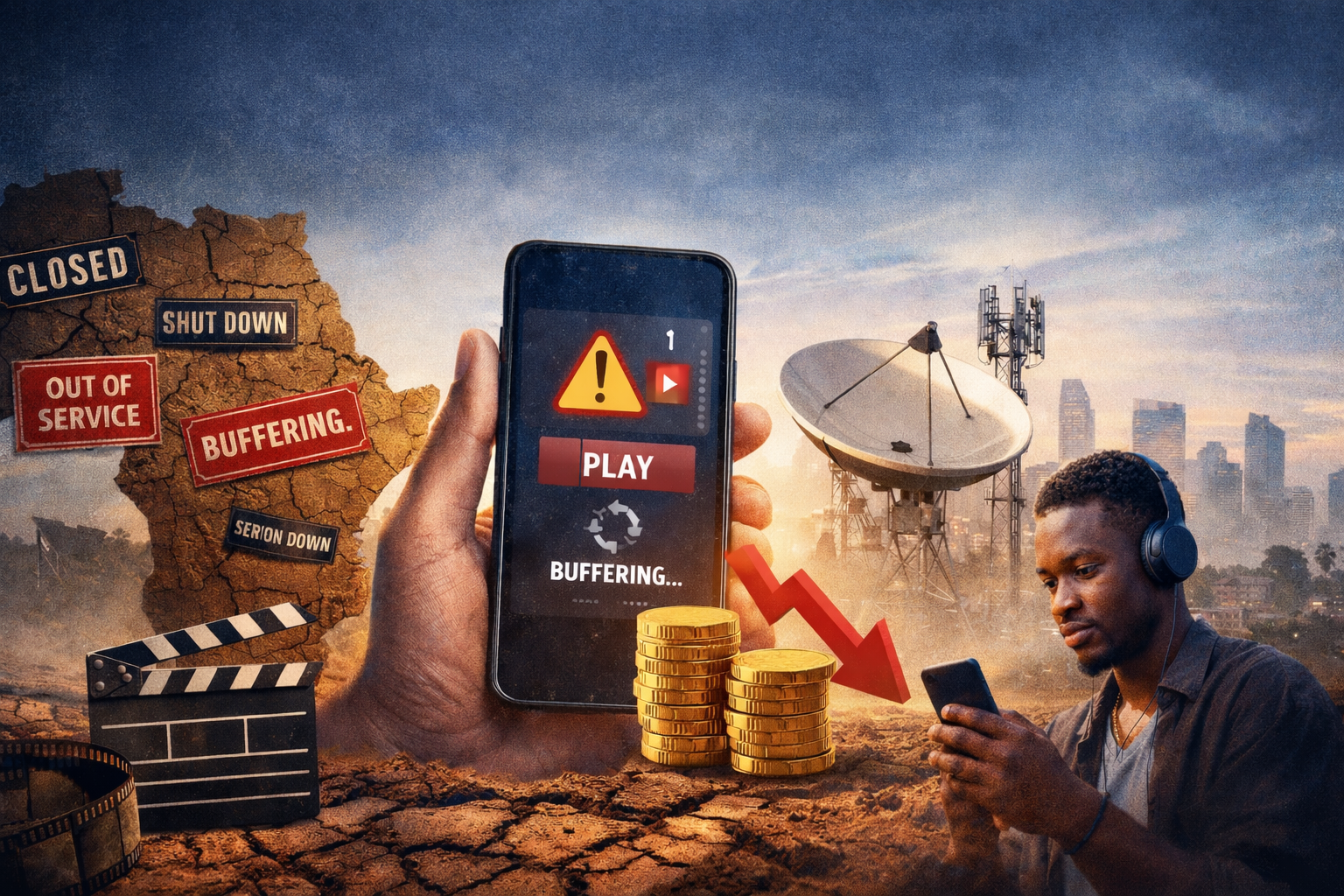

For more than a decade, Africa has looked like the next great frontier for streaming.
A young population.
Hundreds of millions of smartphones.
A growing appetite for local stories.
On paper, it’s the kind of market that global streaming platforms dream about.
In practice, it has been far more complicated.
Over the past fifteen years, a surprising number of streaming ventures have either shut down, pivoted, or quietly faded from the market. The list is long: iFlix, Afrostream, iROKOtv, Kwese Play, TelkomONE, and several telecom-backed experiments from operators like MTN Group and Vodacom. Even newer platforms have struggled to build sustainable economics.
The pattern raises an uncomfortable question: why has a region with so much apparent demand proven so difficult for subscription streaming?
The answer lies in a set of structural contradictions.
A market that looks perfect, until the economics appear
Africa’s demographics are frequently cited as a reason for optimism. The continent has the world’s youngest population and a rapidly expanding digital user base. Smartphone adoption has surged, with estimates suggesting there are now roughly 600 million smartphones in use across Africa.
But streaming video doesn’t run on demographics alone.
It runs on infrastructure.
High-quality streaming requires stable broadband connections and large amounts of data. In many African markets, internet access still relies heavily on mobile networks rather than fixed broadband. Industry estimates suggest that only around 4–5% of electrified households with televisions have access to fibre broadband, limiting the reliability and affordability of streaming services.
That matters because video streaming is extremely data-intensive. Watching an hour of high-definition video can consume between 1GB and 3GB of data, meaning the cost of data can sometimes exceed the cost of the streaming subscription itself.
For companies trying to scale subscription platforms, that equation is brutal.
The first wave of African streaming
Some of the earliest experiments were local.
One of the most prominent was iROKOtv, often described as the “Netflix of Africa.” Founded by Nigerian entrepreneur Jason Njoku, the company spent years trying to build a paid streaming model focused on Nollywood films.
After reportedly burning through roughly $100 million in investment, the company eventually shut down its streaming operations as the subscription model struggled to work in its home market.
Other platforms faced similar challenges.
Pan-African projects backed by telecom operators launched with significant ambition but struggled to convert viewers into paying subscribers. Some were undercut by piracy. Others ran into the fundamental problem that subscription streaming is a scale business, and scale can be hard to achieve when disposable income is limited.
Even the strongest players face difficult math
Today, two companies dominate Africa’s subscription streaming market: Netflix and Showmax, the latter owned by MultiChoice.
Showmax has at times led the regional market. By late 2023, it had about 2.1 million subscribers across Africa, surpassing Netflix’s estimated 1.8 million regional subscribers, according to research cited by industry reports.
But scale hasn’t automatically translated into profitability.
MultiChoice has invested heavily in Showmax’s technology and content strategy, including partnerships with international studios and the development of local original programming. Yet the platform has continued to generate large losses as the company pours money into infrastructure and content libraries.
The economics of streaming are difficult even in mature markets. In Africa, where infrastructure costs are high and consumer purchasing power varies widely, those economics become even tougher.
Also read: Spotify is finally launching support for lossless music streaming
The Silicon Valley model may not translate
Another challenge is strategic.
Many streaming platforms entering Africa have tried to replicate the same subscription model that worked in North America and Europe: monthly subscriptions, heavy spending on exclusive content, and global-scale technology platforms.
But consumer behavior in many African markets often looks different.
Free or ad-supported platforms such as YouTube remain hugely popular, while piracy and informal distribution networks continue to shape how audiences access video. In some markets, telecom bundles or ad-supported streaming may prove more viable than pure subscription models.
Some companies are already experimenting with those alternatives. Telecom operators, including MTN Group, have begun exploring hybrid platforms that combine subscription content with ad-supported streaming and mobile-first distribution models.
The opportunity is still there
Despite the setbacks, the demand for video content across Africa is real.
Local audiences are increasingly interested in stories that reflect their own cultures and languages. Streaming has already created new opportunities for African filmmakers and production companies, even if the business models behind the platforms remain unsettled.
In other words, the market isn’t rejecting streaming.
It’s rejecting the assumption that the same streaming playbook that worked in Silicon Valley can be copied wholesale into vastly different economic environments.
Africa’s streaming future may still arrive, just not in the form many companies initially expected.
Whoever ultimately succeeds on the continent will likely build something different: a platform designed around Africa’s infrastructure realities, pricing sensitivities, and content ecosystems rather than a direct clone of Western streaming services.
Credit: This article was inspired by a discussion started by Luke Rous on LinkedIn about the challenges facing streaming platforms across Africa.





 English
  简体中文
简体中文  Čeština
  Deutsch (Sie)
  Français


