



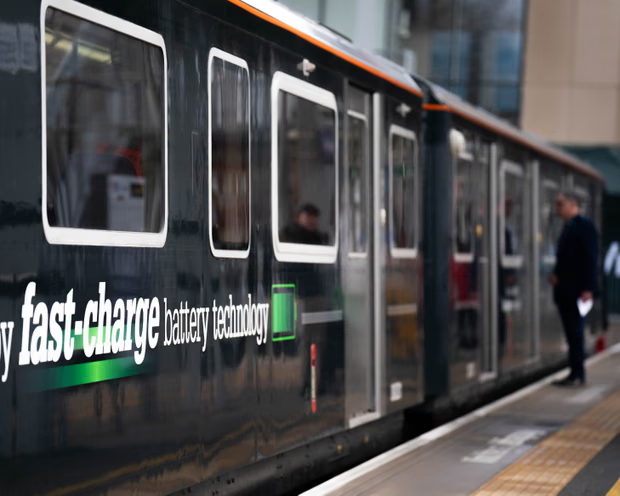

Great Western Railway is ushering in a greener era for UK rail with the debut of the nation’s first rapid-charging battery-only passenger train, set to whisk commuters along a west London branch line starting this weekend and potentially spelling the end for diesel on tricky-to-electrify routes.
The Class 230 train, a repurposed former London Underground District line unit converted by the now-defunct Vivarail, kicks off passenger service on January 31, 2026, with the inaugural run departing West Ealing for Greenford at 5:30 a.m. Covering a 2.5-mile branch with four stops and a 12-minute journey each way, the three-car train can carry up to 273 passengers and recharges its batteries in just 3.5 minutes at West Ealing using a 2,000kW fast-charger connected to short electrified rails that activate only when the train is positioned overhead. Initially operating on Saturdays to gather performance data, GWR plans to expand if trials prove successful, aiming to replace diesel units on non-electrified lines where overhead wires are impractical or costly.
This milestone follows a 22-month trial on the Greenford line since May 2024, during which the train set a world record by traveling 200.5 miles on a single charge, surpassing the previous mark of 139 miles. GWR acquired the intellectual property, rolling stock, and charging tech after Vivarail’s administration in December 2022, ensuring the pilot could proceed. A July 2025 white paper from GWR outlined the trial’s success, demonstrating how discontinuous fast-charging could eliminate reliance on expensive overhead line equipment (OLE) and cut emissions on regional fleets facing end-of-life in the next 7-10 years.
“Our fast-charge trial has successfully demonstrated that battery technology offers a reliable and efficient alternative to power electric trains, in cases where overhead lines aren’t possible or desirable,” GWR noted in its findings. The project aligns with the UK’s net-zero goals, potentially transforming branch lines and supporting sustainable travel amid rising demand.
While dubbed the “UK’s first battery-only” train, clarifications emphasize it runs solely on batteries for all operations, including traction, control, heating, and lighting, distinguishing it from hybrids or earlier prototypes.
The UK’s rail sector is buzzing with electrification pushes, but battery tech offers a bridge for the 40% of lines without wires; competitors like Hitachi and Siemens are testing similar systems, while international efforts in Germany and California highlight global momentum. As GWR’s battery train chugs into service, it could accelerate the shift from diesel, but scaling to longer routes will test whether this rapid-charge pioneer truly electrifies the future of British rail.


 English
  简体中文
简体中文  Čeština
  Deutsch (Sie)
  Français


