


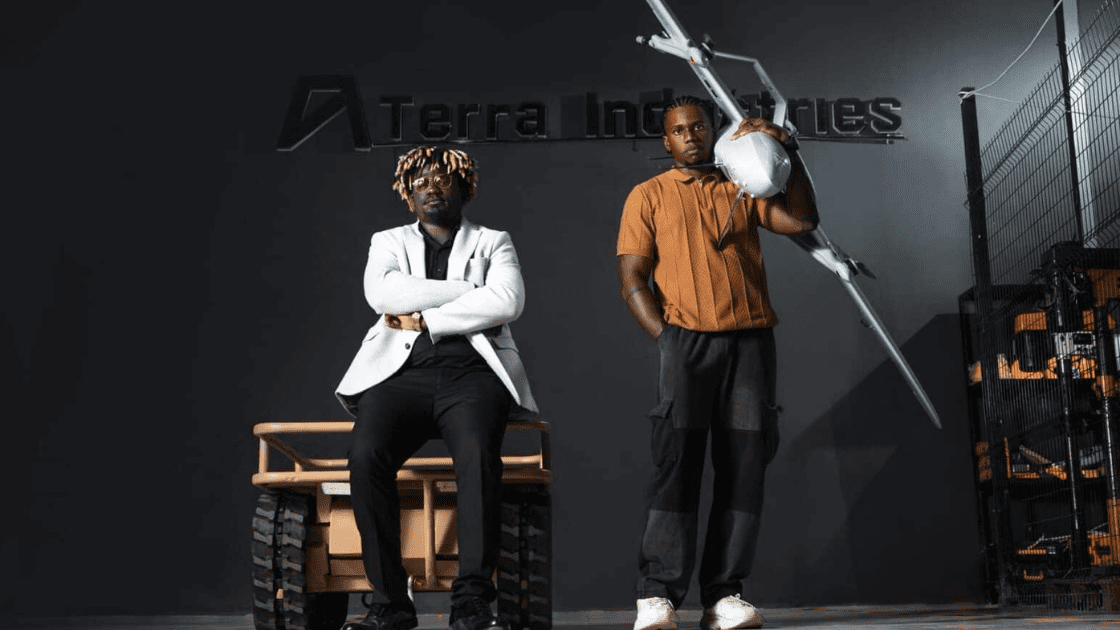

Africa’s infrastructure build-out has accelerated in recent years. New power plants, mining operations, logistics corridors and offshore assets are coming online across the continent. But as investment rises, so does exposure. Pipelines are sabotaged, transmission lines vandalized, ports targeted, and remote facilities left dependent on patchwork security systems often sourced from outside the continent. These growing terror threats fuel the powerful $34M Terra Industries defense surge in Africa.
That vulnerability has quietly shaped a new generation of African defense technology companies.
This week, Nigeria-founded Terra Industries announced it has raised an additional $22 million, extending its earlier $11.75 million round to a total of $34 million. The new capital was led by U.S. venture firm Lux Capital, with participation from 8VC, Nova Global, and Resilience17 Capital (launched by Flutterwave CEO Olugbenga Agboola). The raise values the company at over $100 million.
Founded in 2024 by 22-year-old Nathan Nwachuku and 24-year-old Maxwell Maduka, Terra Industries is building autonomous security systems designed to protect critical infrastructure across land, air, and maritime environments. The company designs and manufactures drones, unmanned ground vehicles, sentry towers, and a proprietary operating platform known as ArtemisOS, which integrates surveillance feeds, threat detection, and coordinated response into a single command layer.
Read more: Terra Industries Raises $11.75M to Build Africa’s First Homegrown Defense Tech Prime
The additional funding comes unusually fast. According to the founders, Terra initially planned to raise about $5 million but expanded the round as demand for its systems increased and production requirements grew. The company says it is already generating commercial revenue and has deployed its technology across multiple African countries to secure infrastructure assets valued at roughly $11 billion.
The context matters. Across parts of West and Central Africa, terrorism and organized criminal activity continue to strain state capacity. Energy infrastructure and extractive assets are particularly exposed, often located in remote terrain with limited rapid-response capability. Governments and private operators have historically relied on imported hardware and foreign intelligence systems frequently sourced from China, Russia, Europe, or the United States to manage these risks.
Terra’s thesis is that Africa’s infrastructure expansion requires locally designed, vertically integrated defense systems built with regional realities in mind.
Rather than selling standalone drones or monitoring software, Terra positions itself as a full-stack security manufacturer. Its drones provide aerial surveillance; unmanned ground vehicles patrol sensitive zones; autonomous sentry towers create fixed monitoring nodes; ArtemisOS aggregates the data and enables coordinated response. The aim is reducing reliance on manual monitoring and fragmented systems.
The company says its systems are currently protecting power plants, mines, and other high-value industrial facilities. In markets where physical security failures can shut down national grid assets or halt mineral exports, the economic stakes are significant.
For investors, the appeal lies in both timing and category. Defense technology has become a renewed focus globally, with venture capital firms increasingly backing dual-use hardware and autonomy platforms. Lux Capital, which led Terra’s round, has a history of investing in frontier technologies spanning defense, robotics, and advanced manufacturing. Terra’s positioning within Africa; a market often overlooked in global defense venture flows, adds a geographic angle to the bet.
The capital will be used to expand manufacturing capacity in Nigeria, accelerate deployments across African markets, and grow engineering and commercial teams in London, San Francisco, and across the continent.
Manufacturing is central to the strategy. Hardware-driven companies face significantly higher capital intensity than software startups. Scaling production requires supply chain resilience, regulatory approvals, export compliance, and technical talent. For Terra, building domestically in Nigeria signals an attempt to localize value creation rather than relying purely on imports and assembly.
At the same time, risks are inherent. Defense procurement cycles can be slow and politically sensitive. Government contracts; particularly military agreements are often subject to shifting budget priorities and regulatory oversight. Cross-border expansion introduces additional compliance complexity. And as Terra grows, it may face competition from established global defense contractors seeking African partnerships or market entry.
There is also the broader geopolitical dimension. Security technology sits at the intersection of sovereignty, data control, and strategic alignment. African governments must weigh domestic capability development against foreign dependency, a tension Terra’s founders have openly acknowledged.
Still, the speed of Terra’s fundraising suggests investor confidence that the company occupies a structural gap.
Africa’s industrial growth has outpaced its security modernization in many regions. Energy corridors, ports, mining zones, and telecom networks represent billions of dollars in capital expenditure but remain exposed to threats that can erode returns and destabilize growth. If Terra can deliver integrated, locally manufactured systems at scale, it could anchor a new category of African defense manufacturing.
For now, the company’s trajectory is early but closely watched. A $100 million valuation within a year of founding reflects both ambition and expectation. Delivering on that valuation will require execution in manufacturing, disciplined contract acquisition, and proof that autonomous systems can operate reliably in complex field conditions.
As Africa builds more infrastructure, the question increasingly shifts from how fast assets can be constructed to how securely they can be protected. Terra Industries is betting that defense technology will become as critical to the continent’s growth story as fintech or logistics and that building those systems locally will matter as much as building them at all.






 English
  简体中文
简体中文  Čeština
  Deutsch (Sie)
  Français


