



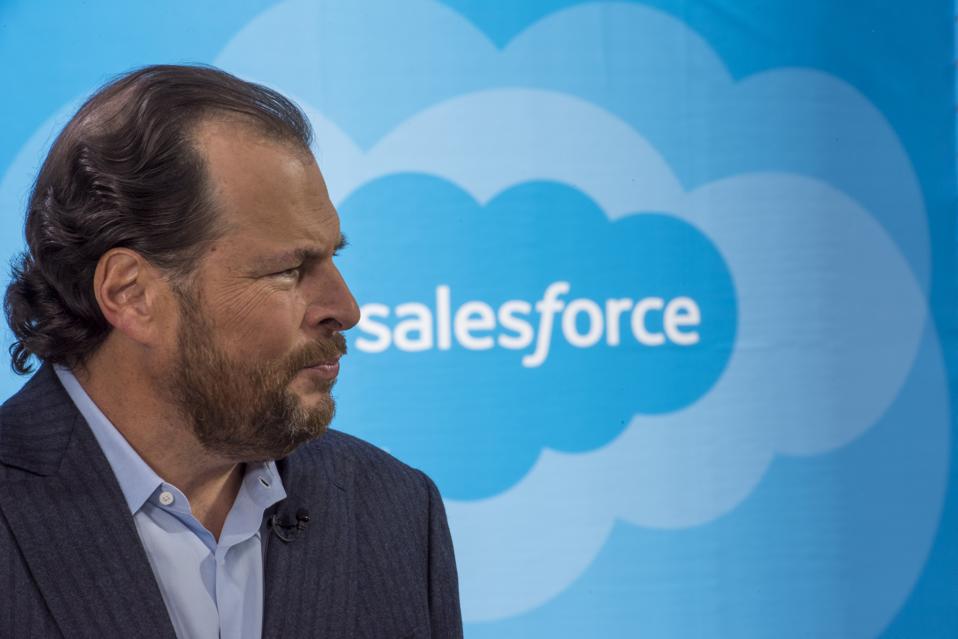

Salesforce CEO Marc Benioff is crediting AI for supercharging his engineering team’s output, revealing that the company’s developer productivity has surged 20% in the past year, enough to pause hiring in the division as existing staff handles the load with generative tools.
Benioff dropped the insight during Salesforce’s fiscal Q3 2026 earnings call on December 3, 2025, touting AI’s role in streamlining code generation, testing, and deployment while emphasizing that the boost hasn’t led to layoffs but rather a hiring freeze for engineers. “Our developers are 20% more productive than they were a year ago, and we really haven’t hired any developers in the last year,” Benioff said, attributing the gains to internal adoption of AI agents like Agentforce, which automates workflows and code reviews. He clarified that the company isn’t shrinking its workforce but reallocating resources, with AI enabling engineers to focus on higher-value innovation rather than routine tasks.
The remarks come amid Salesforce’s aggressive AI pivot, including the launch of Agentforce in October 2025—a platform for building custom AI agents that integrate with CRM tools, and a $2 billion investment in AI infrastructure over the past year. Despite the productivity wins, Salesforce’s headcount has hovered around 72,000 employees since early 2025, following a 10% reduction in January 2023 that cut about 7,900 jobs amid economic headwinds. Benioff noted that while engineering hires are on hold, the company continues recruiting in sales, marketing, and other areas to fuel growth.
Also Read: Salesforce Expands AI Alliances with OpenAI and Anthropic to Strengthen Agentforce 360 Ecosystem
Financially, the strategy appears to be paying off: Salesforce reported Q3 revenue of $9.44 billion, up 8% year-over-year, beating analyst expectations and prompting a 10% stock surge in after-hours trading. Operating margins hit a record 33.1%, bolstered by AI efficiencies, and the company raised its full-year revenue guidance to $37.7-$38 billion. Benioff highlighted AI’s broader impact: “AI is transforming every company, every customer, and every industry. And we’re just getting started.”
This isn’t the first time Benioff has sung AI’s praises for internal gains; in August 2025, he shared that Salesforce’s own use of generative AI had accelerated product development cycles by 25%, allowing faster rollouts of features like predictive analytics.
Salesforce’s approach mirrors a tech industry trend where AI tools like GitHub Copilot and Amazon CodeWhisperer are reshaping engineering roles, with surveys showing up to 30% productivity lifts but sparking debates over job displacement. Rivals like Microsoft, which integrated Copilot into its Azure DevOps, report similar efficiencies, while Oracle has paused engineering hires amid AI-driven automation. As AI maturity accelerates, Salesforce’s hiring halt could signal a new normal for tech giants, fewer bodies, more bots, but it also raises questions about innovation’s human element in an increasingly automated future.


 English
  简体中文
简体中文  Čeština
  Deutsch (Sie)
  Français


