


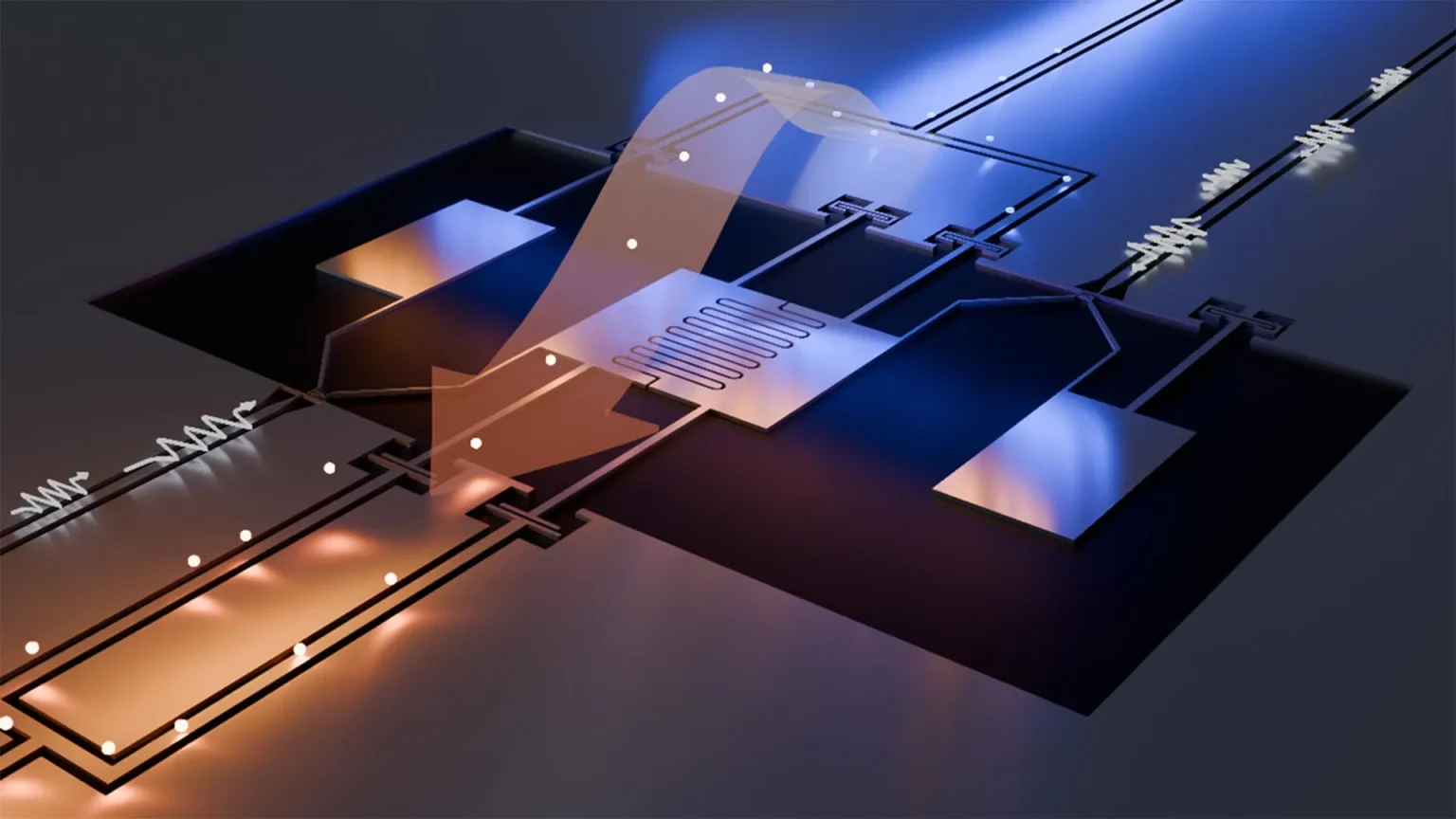

Scientists at Chalmers University of Technology in Sweden have turned a longstanding quantum computing headache into a breakthrough, unveiling a tiny quantum refrigerator that harnesses noise—typically the bane of fragile qubits—to actively cool systems, potentially paving the way for more stable and efficient quantum devices.
The innovation, detailed in a study published January 29, 2026, in Nature Communications, flips conventional wisdom by using controlled microwave noise as a driving force for refrigeration rather than battling it as an unwanted interference. Quantum computers require near-absolute zero temperatures to maintain coherence, but traditional cooling methods often introduce thermal noise that disrupts qubits—the building blocks of quantum processing. This new approach, dubbed a “minimal quantum refrigerator,” leverages that noise to extract heat, acting paradoxically as a cooling agent.
At the heart of the device is an artificial molecule made of two superconducting qubits, coupled to heat reservoirs via microwave channels. By injecting precisely controlled microwave noise—random signal fluctuations in a narrow frequency band—the team can direct heat flow, enabling the system to function not just as a refrigerator but also as a heat engine or energy amplifier depending on the configuration. This builds on theoretical concepts like Brownian refrigeration, where thermal fluctuations are harnessed for cooling, but realizes it in a practical quantum setup.
“Physicists have long speculated about a phenomenon called Brownian refrigeration; the idea that random thermal fluctuations could be harnessed to produce a cooling effect,” the researchers noted in their paper. Lead author Jukka Pekola, a visiting professor at Chalmers from Aalto University, added that the system demonstrates “how noise can be a resource rather than a nuisance in quantum thermodynamics.”
The breakthrough could address a key bottleneck in scaling quantum computers, where maintaining ultra-low temperatures without introducing decoherence is a constant battle. Traditional dilution refrigerators, which chill systems to millikelvin ranges, generate vibrations and electromagnetic noise that can scramble quantum states. By integrating noise-driven cooling directly into quantum circuits, this method might enable more compact, on-chip refrigeration for larger qubit arrays.
This isn’t the first noise-as-resource idea; earlier concepts like quantum batteries have explored energy recycling in quantum systems, but this marks a practical demonstration in refrigeration.
Quantum cooling innovations are heating up elsewhere: CSIRO in Australia proposed quantum batteries to power and chill qubits internally, potentially quadrupling density, while global efforts focus on cryogenic alternatives to liquid helium. As quantum tech races toward fault-tolerant machines—Google and IBM aim for 1,000+ qubits by decade’s end, Chalmers’ noise-driven fridge could redefine how we keep the quantum cool, turning adversaries into allies in the quest for scalable computing.





 English
  简体中文
简体中文  Čeština
  Deutsch (Sie)
  Français


