

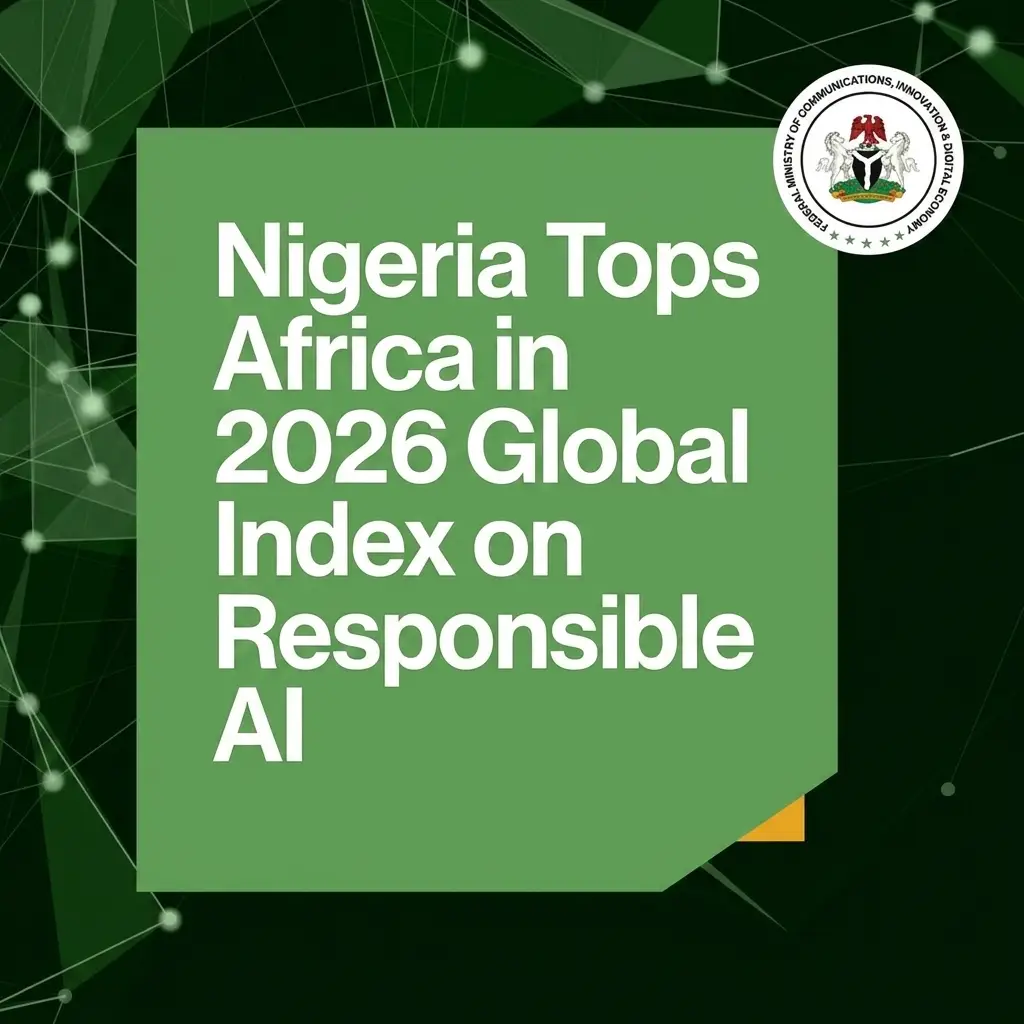
Nigeria has emerged as Africa’s highest-ranked country in the 2026 Global Index on Responsible AI (GIRAI), a global assessment of how governments are preparing for the opportunities and risks of artificial intelligence through policy, regulation and public governance.
The ranking, highlighted by Nigeria’s Federal Ministry of Communications, Innovation and Digital Economy, places the country ahead of every other African nation assessed in the report. However, the study also concludes that governments worldwide, including many of the strongest performers, are struggling to keep AI governance aligned with the pace of AI development and adoption.
Unlike rankings that measure AI research, startup activity or investment, the Global Index on Responsible AI evaluates whether countries have established the legal frameworks, institutions and safeguards needed to ensure AI systems are developed and deployed responsibly. The second edition of the index assesses 135 countries and jurisdictions using more than 68,000 data points collected by country-level researchers.
Nigeria’s ranking reflects governance, not AI industry size
The report makes a distinction between AI capability and AI governance.
Rather than measuring which countries build the most advanced AI models or attract the largest AI investments, GIRAI examines whether governments have created policies, oversight mechanisms and public institutions that protect citizens as AI becomes more integrated into public services, workplaces and the digital economy.
The assessment is built around five dimensions:
- Inclusion and diversity
- Ethics and sustainability
- Labour and skills
- Trust and safety
- AI use in public service
Within those areas, researchers evaluate issues such as transparency, human oversight, labour protections, AI literacy, cybersecurity, public-sector procurement, access to redress, environmental considerations and the participation of civil society in AI governance.
The global picture remains mixed
Although Nigeria topped the African rankings, the report paints a cautious picture of AI governance worldwide.
Researchers found that AI technologies are spreading much faster than governments can regulate them. According to the report, around 53% of the global population has used generative AI tools, while global corporate investment in AI reached $581.7 billion in 2025, nearly tripling within two years.
Yet governance has not kept pace.
The average global GIRAI score is approximately 35 out of 100, suggesting that most countries have only partially developed the institutions required for responsible AI governance. Even where governments have adopted AI frameworks, evidence of implementation exists in only 55% of cases worldwide and falls to 45% among Global South countries.
The report argues that many governments have announced AI principles and national strategies but have yet to establish the oversight bodies, monitoring systems and enforcement mechanisms needed to translate those commitments into practice.
Progress in the Global South, but enforceable rules remain limited
One of the report’s central findings is that countries in the Global South have significantly expanded their responsible AI frameworks since the first edition of the index.
However, most of those frameworks are advisory rather than legally binding.
The report states that 78% of responsible AI framework cases in Global South countries are non-binding, compared with 42% in Global North countries. Researchers warn that this limits governments’ ability to enforce protections when AI systems create risks for citizens.
Transparency and public-sector AI remain weak
The report also identifies significant weaknesses that extend beyond Africa.
While transparency and explainability are among the strongest-performing governance areas globally, governments have been slower to apply similar standards to their own use of AI.
Only 18% of countries assessed require public disclosure of government algorithmic systems, making it the weakest-performing indicator in the entire index. Likewise, only 26% have frameworks governing the public procurement of AI systems.
Researchers argue that governments should hold themselves to the same or higher standards they expect from private-sector AI developers because public-sector AI can directly affect access to healthcare, education, welfare, policing, and other essential services.
AI literacy is improving, but worker protections lag
The report identifies AI literacy as one of the fastest-growing areas of governance.
It found evidence of AI literacy initiatives in 106 countries, while 71 countries have formal frameworks supporting AI education and awareness.
By contrast, labour protections have not advanced at the same pace.
Only 39 countries have frameworks addressing labour protections related to AI, despite growing concerns about automation, algorithmic management and the impact of AI on employment.
Environmental governance also remains limited. Just 27% of countries have frameworks addressing AI’s environmental impact, and most of those are non-binding.
From commitments to implementation
The report concludes that responsible AI governance has reached what it describes as the end of its “framework-building phase.”
It argues that future progress should be measured not by the number of AI strategies governments publish, but by whether they establish enforceable protections, independent oversight bodies, public transparency, accessible mechanisms for redress and meaningful public participation in AI governance.
For Nigeria, leading Africa in the 2026 Global Index on Responsible AI signals recognition of progress in AI governance within the continent. At the same time, the report indicates that continued implementation, stronger institutional oversight and legally enforceable safeguards will be critical as AI adoption accelerates across both the public and private sectors.
Source

Adams, R., Adeleke, F., Alayande, A., Abdella, S.E., Florido, A., Junck, L., & Grossman, N. (2026). Global Index on Responsible AI 2026 (2nd Edition). South Africa: Global Center on AI Governance.