


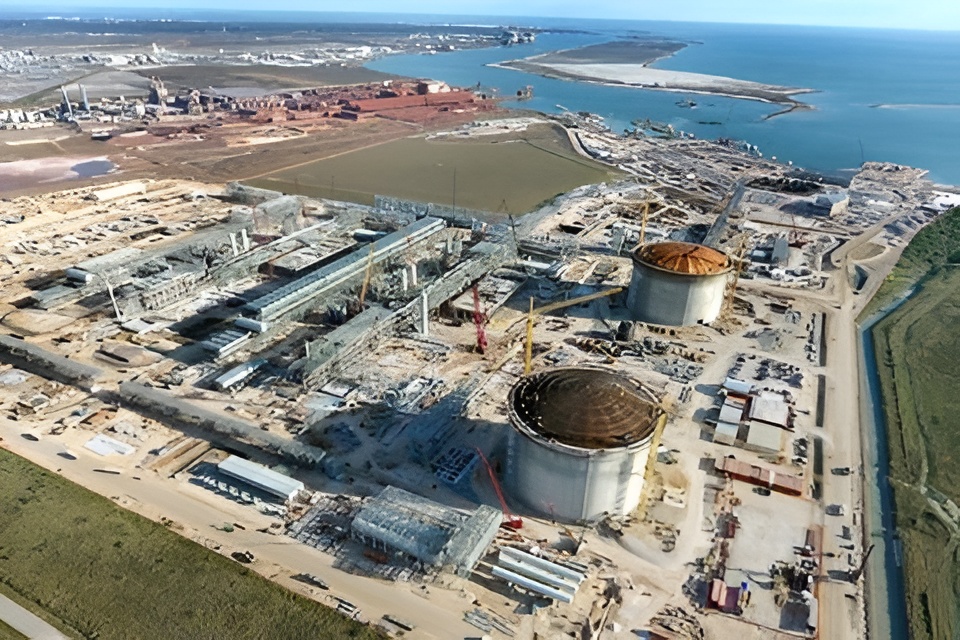

For nearly five years, Mozambique LNG stood frozen in time – a half-built megaproject stranded by violence, uncertainty, and controversy. In late January 2026, TotalEnergies finally pressed restart.
Construction is resuming at the Afungi site in northern Cabo Delgado, marking one of the most closely watched restarts in global energy. It is not just a return to work. It is a test of whether a project scarred by conflict, legal battles, and human rights allegations can still deliver on its original promise and whether it ever truly had a choice.
From the start, Mozambique LNG was never meant to be small. When TotalEnergies acquired Anadarko’s African assets in September 2019, paying $3.9 billion for a 26.5% stake, it became operator of Area 1 in the Rovuma Basin; one of the largest natural gas discoveries of the last two decades. The vision was ambitious: two liquefaction trains capable of producing around 13 million tonnes of LNG per year, supplied by the Golfinho and Atum offshore fields, and sold almost entirely under long-term contracts.
By the time the final investment decision was taken in June 2019, nearly 90% of production had already been locked into agreements with buyers in Asia and Europe. The project was designed to plug Mozambique into global gas markets for decades. Walking away was never part of the plan.
Read also: China Names Nigeria’s $24.6 Billion Ogidigben Gas Park Its Top Belt and Road Project in 2025
Momentum accelerated quickly. In July 2020, the project secured a $14.9 billion senior debt package, one of the largest ever arranged for an African energy project. Export credit agencies, commercial banks, and an African multilateral lender all lined up. Total investment was estimated at around $20 billion. Thousands of workers were deployed. Equipment was ordered. Supply chains were activated.
Then Cabo Delgado exploded. Armed attacks had been rising since 2017, but by 2020 the violence was no longer peripheral. Insurgents moved closer to the Afungi site, threatening both workers and surrounding communities. In March 2021, attacks on the nearby town of Palma killed civilians and sent shockwaves through the industry.
TotalEnergies evacuated staff. On April 26, 2021, it declared force majeure and suspended all activities. At that moment, Mozambique LNG was about 40% complete – too advanced to abandon easily, yet too risky to continue.
What followed was a long, uneasy pause. Security slowly improved after Mozambique invited regional and international forces to help stabilise the province. But stability never fully returned. At the same time, the project became entangled in legal and human rights controversies that reached far beyond Mozambique.
In 2023, survivors and relatives of victims of the Palma attack filed a complaint in France, accusing TotalEnergies of failing to protect subcontractors and civilians. In March 2025, French prosecutors opened a preliminary investigation into allegations of involuntary manslaughter and failure to assist people in danger.
More serious accusations emerged later. Reports published in 2024 and 2025 alleged that Mozambican security forces committed abuses near the Afungi site in mid-2021, including killings and enforced disappearances. In November 2025, the European Center for Constitutional and Human Rights filed a criminal complaint in France, accusing TotalEnergies of complicity in war crimes, arguing that the company provided logistical support to security forces despite alleged abuses.
TotalEnergies has consistently denied all allegations, saying it had no knowledge of the events described and rejecting claims of complicity. In response to growing scrutiny, the company commissioned an independent assessment of the Cabo Delgado situation. The resulting report, published in May 2023, led to a $200 million social investment initiative and the creation of the Pamoja Tunaweza foundation, aimed at community development and recovery. Even so, the cloud never fully lifted.
Behind the scenes, financial pressure kept building. Contracts remained in force. Equipment sat idle but paid for. Partners faced difficult choices. In December 2025, TotalEnergies acknowledged that some public-backed financing support had not been renewed after the force majeure, but said the gap had been filled by additional equity from the project partners.
By then, the logic was becoming unavoidable. Too much had already been spent. Too many commitments had been made. Too many long-term buyers were waiting.
On January 29, 2026, TotalEnergies announced the full resumption of onshore and offshore activities. Thousands of workers returned. The industrial clock restarted. Mozambique’s political leadership moved quickly to support the decision. President Daniel Chapo publicly rejected claims of widespread abuses by security forces, calling international reports inaccurate and stressing that national institutions were examining the facts. For the government, Mozambique LNG remains central to long-term economic hopes – a source of revenue, foreign exchange, and international relevance.
Yet the risks have not disappeared. Cabo Delgado remains fragile. Legal proceedings in France are ongoing. Environmental and social concerns continue to draw scrutiny. And the project timeline has already stretched far beyond its original vision. First LNG is now expected in 2029; a full decade after the final investment decision.
Mozambique LNG’s restart is not a victory lap. It is a calculated return to a project that became too large, too expensive, and too politically entangled to abandon.
In global energy, some projects fail loudly. Others simply become unavoidable. Mozambique LNG belongs firmly in the second category moving forward not because the path is clear, but because turning back is no longer an option.
 English
  简体中文
简体中文  Čeština
  Deutsch (Sie)
  Français


