

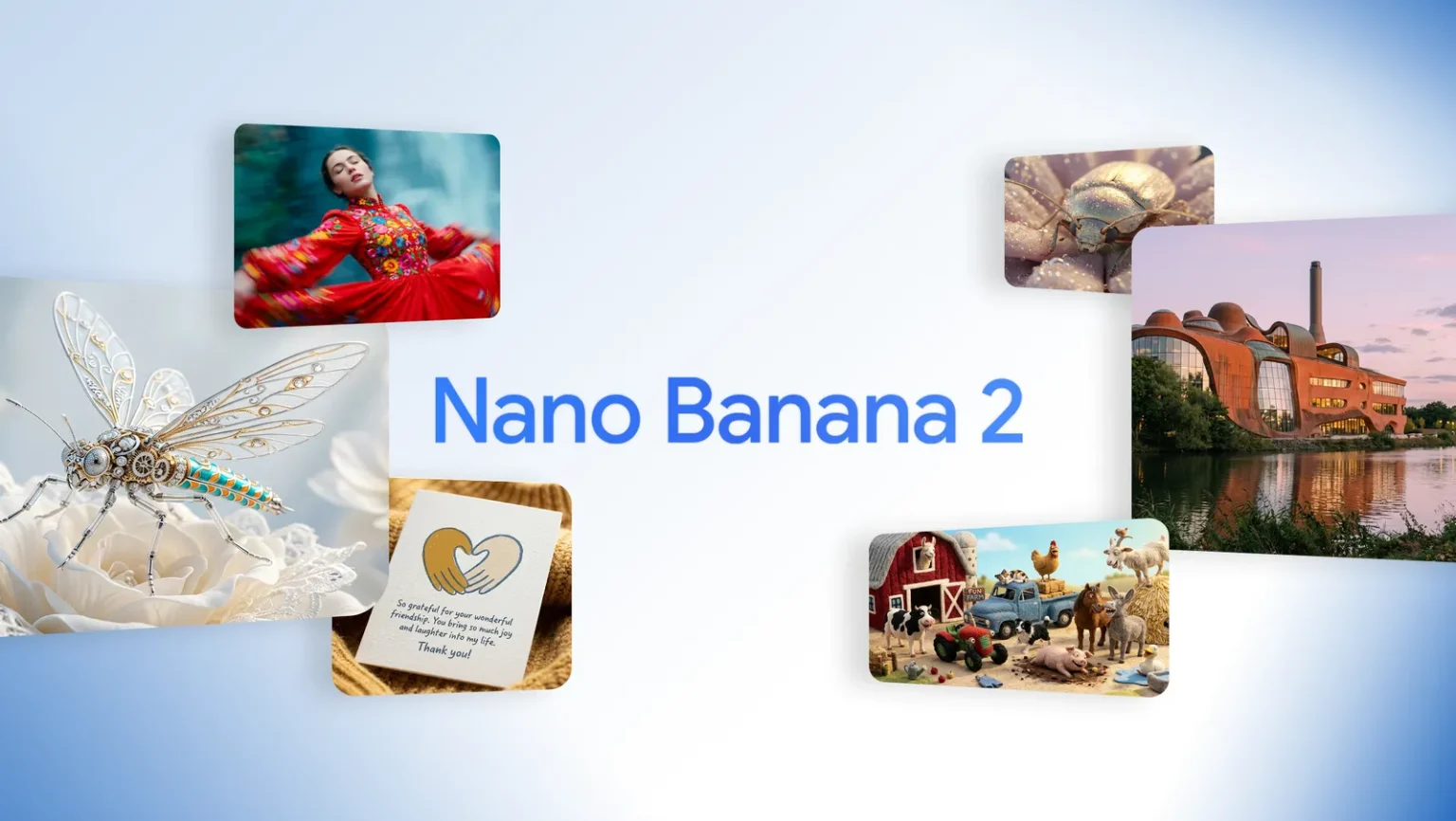

Google is doubling down on one of the hardest trade-offs in generative AI: speed versus sophistication. With the launch of Nano Banana 2, officially branded as Gemini 3.1 Flash Image, the company is attempting to collapse that divide entirely, delivering enterprise-grade image intelligence at the lightning-fast performance tier previously reserved for lighter models.
When Google first introduced its Gemini Image model, nicknamed Nano Banana, it quickly gained viral traction for redefining how users generated and edited images. A few months later, Nano Banana Pro pushed things further, offering studio-quality creative control and deeper reasoning capabilities for professional workflows. But users still had to choose: high-end capability with slower performance, or rapid iteration with fewer advanced features.
Nano Banana 2 is Google’s answer to that compromise. Built on the Flash architecture, the new model integrates the high-speed responsiveness of Gemini Flash with the deeper intelligence previously limited to the Pro tier. The result, according to Google, is advanced world knowledge, improved reasoning, and production-ready image output delivered at speeds suitable for real-time creative workflows.
At the core of Nano Banana 2’s upgrade is its enhanced contextual understanding. The model pulls from Gemini’s broader knowledge base and integrates real-time web information to render more accurate subjects. That means when users generate highly specific visuals, whether historical scenes, branded infographics, or technical diagrams, the system has a deeper awareness of real-world references. Google says this also improves its ability to generate data visualisations, convert notes into diagrams, and produce structured infographics with greater precision.
Text rendering has also seen a significant improvement. One of the persistent weaknesses across generative image platforms has been legible typography. Nano Banana 2 promises sharper, more accurate text output for marketing mockups, greeting cards, and social visuals. It also enables in-image translation and localisation, allowing users to adapt creative assets across languages without rebuilding them from scratch, a feature particularly valuable for global brands and multinational campaigns.
Beyond intelligence, Google is positioning Nano Banana 2 as a creative control breakthrough. The model significantly narrows the historical gap between speed and visual fidelity. It delivers photorealistic imagery with richer textures, sharper details, and improved lighting without sacrificing Flash-tier responsiveness.
One of the most notable upgrades is subject consistency. Maintaining character likeness or object stability across multiple outputs has been a persistent challenge in generative design. Nano Banana 2 can reportedly preserve up to five characters and maintain fidelity for up to fourteen objects within a single workflow. For creative teams building storyboards, brand mascots, or campaign sequences, that consistency could reduce hours of manual correction.
Instruction adherence has also improved. The model now follows complex prompts more strictly, capturing nuanced requests and layered creative directions. In commercial settings where brand guidelines are rigid, tighter prompt compliance could translate directly into workflow efficiency.
Production specifications are another major focus. Users can generate assets across multiple aspect ratios and resolutions, from 512 pixels up to full 4K. Whether the output is intended for vertical social media formats, widescreen digital billboards, or high-resolution presentations, the system is designed to produce ready-to-use visuals without additional resizing or enhancement steps.
The rollout strategy signals Google’s broader platform ambition. Nano Banana 2 is being integrated across the Gemini app, Google Search’s AI Mode and Lens, AI Studio, the Gemini API, Vertex AI in Google Cloud, Flow, and even Google Ads. For advertisers, the model will power creative suggestions directly inside campaign-building tools. For developers, preview access via API opens pathways for custom integration into enterprise products.
Google is also reinforcing its provenance strategy. As AI-generated media becomes more difficult to distinguish from human-created content, the company continues to expand its SynthID watermarking technology alongside interoperable C2PA Content Credentials. Since launching in the Gemini app, SynthID verification has reportedly been used more than 20 million times to identify AI-generated images, video, and audio. The company says C2PA verification will soon be added to further strengthen transparency.
Strategically, Nano Banana 2 arrives amid intensifying competition in generative AI. Rivals are racing to reduce inference costs and optimise deployment speeds while maintaining output quality. By merging Pro-level capabilities with Flash performance, Google is making a clear statement: production AI must be both intelligent and instantaneous.
For enterprises moving from experimentation to scaled deployment, latency is no longer a minor inconvenience, it’s a cost centre. Marketing teams iterating on campaign creatives, e-commerce platforms generating product visuals at scale, and developers embedding AI into user-facing applications all require near-instant results. Nano Banana 2 is designed to meet that operational demand without compromising visual sophistication.
Whether Google has fully solved the speed-versus-quality tension will ultimately be tested in real-world usage. But the direction is clear. In the evolving AI economy, the winners would simply be the smart ones who deliver intelligence at production speed. With Nano Banana 2, Google is betting that the future of image generation belongs to systems that can think deeply and move fast at the same time.






 English
  简体中文
简体中文  Čeština
  Deutsch (Sie)
  Français


