




The Statement That Sparked This Report

“Africa should not depend on distant refineries for what it consumes daily. That model is fragile. Local capacity is the shift.”

— Dangote Industries Limited, LinkedIn, May 7, 2026
#The Paradox
A Continent That Exports Crude and Imports Fuel
For decades, Nigeria lived an energy paradox that became Africa’s defining shame: exporting millions of barrels of crude oil daily while importing nearly every litre of refined petroleum it consumed, at inflated global prices, in foreign currency, through supply chains stretching thousands of kilometres across oceans.
As Aliko Dangote himself put it bluntly at a public forum in Lagos: “At one point, we were exporting 2.4 million barrels per day and not processing even one barrel. Every single product we used, gasoline, jet fuel, everything, was imported. I said no, this cannot continue.”
This was not merely an inconvenience. It was a structural economic trap. Foreign exchange drained out on fuel imports. Supply disruptions abroad became crises at home. Fuel queues stretched for blocks. And the price of petrol, when the government abruptly ended fuel subsidies in May 2023, jumped from approximately ₦185 per litre to over ₦600 per litre overnight, not because Nigeria lacked oil, but because it lacked the infrastructure to refine it.
The principal question is stark: why, when the continent is a major producer of crude oil, must African nations depend on foreign refining, with the price of processed fuels constantly fluctuating and subject to political developments overseas? The answers lie in the same inertia that made African leaders complacent with guaranteed profits from the sale of raw minerals, easy returns prioritised over the demanding task of developing an industrial sector capable of turning local natural resources into value-added products.
| 650K Barrels/day Current capacity | 1.4M Barrels/day Target by 2028 | $20B Total investment in the refinery | 70M L Petrol + diesel produced daily |
#The Routes Problem
Mapping the Fragility: Global Refinery Routes and What They Cost Africa
The graphic published by Dangote Industries on LinkedIn is not merely decorative, it is a diagnosis. It illustrates the absurdity of Africa’s current fuel supply model: refined products travelling 500 km, 950 km, even 2,100 km from refineries in Europe, the Middle East, and Asia, back to a continent that sits on vast reserves of the very crude oil those facilities process.
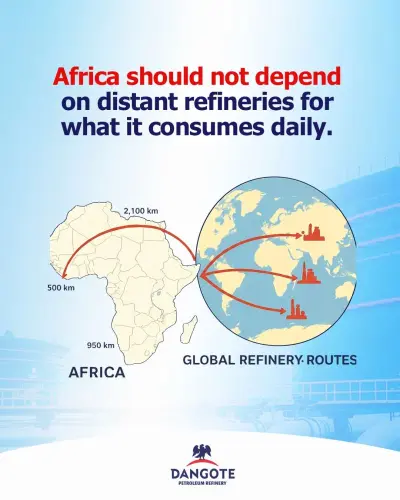
Global Refinery Route Distances to West Africa
| 500 km Closest regional refinery route | 950 km Mid-range supply chain distance | 2,100 km Long-haul imports from distant refineries |
Each kilometre of that supply chain carries a cost: shipping fees, insurance, forex exposure, time delays, and vulnerability to geopolitical disruptions. When a pipeline closes in the Middle East, or a storm disrupts Atlantic shipping lanes, or sanctions reshape trade flows — Africa feels it first and hardest.
Expanding local refining capacity can stabilise supply, reduce costs linked to shipping and foreign exchange, and strengthen industrial development across the region. The continent’s current model of sourcing refined petroleum products from overseas is, in the words of Dangote Industries, “fragile” and unsustainable for long-term energy security.
“If I don’t invest my own money, I cannot go anywhere and convince others to invest. But now we have demonstrated that these things are possible.”
— Aliko Dangote, President, Dangote Petroleum Refinery & Petrochemicals FZE
#The Shift
From Net Importer to Regional Exporter: The Refinery’s Journey
The Dangote Petroleum Refinery, located in the Lekki Free Trade Zone, Lagos, was officially inaugurated on May 22, 2023, by then-President Muhammadu Buhari, an event attended by five sitting African heads of state from Ghana, Togo, Niger, Senegal, and Chad. With a design capacity of 650,000 barrels per day, it is the largest single-train refinery in the world and the largest refinery in Africa.
The refinery received its first cargo of crude oil on December 7–8, 2023, one million barrels of Agbami-grade crude from Shell’s trading arm. Diesel and aviation fuel production began in January 2024, and Premium Motor Spirit (petrol) production commenced in September 2024.
By the close of 2025, the refinery was producing over 45 million litres of petrol and 25 million litres of diesel daily, exceeding Nigeria’s domestic demand. The country that once imported virtually all its refined products now exports a surplus. Dangote’s refinery is already exporting gasoline to the United States.
On fuel prices, the impact has been direct and measurable. The average pump price of petrol fell from approximately ₦1,030 per litre in September 2024 to ₦841–851 per litre by September 2025. Diesel prices tumbled even more steeply, from ₦1,400–1,700 per litre at the peak to around ₦1,020 per litre by September 2025, as local supply replaced costly imports.
Timeline of the Dangote Petroleum Refinery
2013 — CONCEPTION:
Aliko Dangote publicly announces plans for a mega-refinery in Lekki, Lagos, in September 2013, securing approximately $3.3 billion in initial financing. Early cost estimates stood at around $9 billion.
2017 — CONSTRUCTION BEGINS:
Ground is broken, with major structural construction commencing four years after the project’s announcement. Construction delays would follow due to logistics, financing, and the COVID-19 pandemic.
MAY 22, 2023 — INAUGURATION:
President Muhammadu Buhari officially commissions the refinery in a ceremony attended by five African heads of state from Ghana, Togo, Niger, Senegal, and Chad. This marks the refinery’s formal commissioning as Africa’s largest.
DEC 7–8, 2023 — FIRST CRUDE:
The refinery receives its first delivery of crude oil, one million barrels of Agbami-grade crude from Shell International Trading and Shipping Company (STASCO). Six cargoes totalling six million barrels arrive by January 8, 2024.
JAN 2024 — DIESEL PRODUCTION:
Diesel and aviation fuel (jet A1) production begins, with products meeting Euro V specifications. The refinery begins supplying fuel to the Nigerian market.
SEPT 2024 — PETROL PRODUCTION:
Premium Motor Spirit production commences. Average petrol pump price at this point stands at approximately ₦1,030 per litre. Nigeria’s reliance on imported petrol begins its structural decline.
OCT 2025 — POLICY SHIFT:
President Bola Tinubu approves a 15% import duty on refined fuel, formally signalling a policy turn towards domestic refining protection. Nigeria is redefined — not merely a crude exporter, but a refining nation.
NOV 25, 2025 — EXPANSION:
Dangote signs agreement with Honeywell to supply advanced technology to double refining capacity from 650,000 to 1.4 million barrels per day by 2028, which would make it the largest refinery on Earth by any measure.
MAY 7, 2026 — THE MESSAGE:
Dangote Industries publishes its LinkedIn statement crystallising the continental argument. The post draws 438 reactions and wide regional discussion, prompting this special report.
#The Continental Argument
One Refinery, or a New Industrial Logic for Africa?
The more important question is not how the Dangote Refinery was built, but what its existence now makes possible, and how it begins to change the underlying economics and strategy for national and continental stability. For decades, Nigeria sat at the centre of this vulnerability, despite being Africa’s largest crude oil producer. The emergence of the Dangote Refinery signals a decisive shift from that exposure toward infrastructure-led resilience.
Nigeria has three state-owned refineries in Port Harcourt, Warri, and Kaduna, none of which are operational. This is despite the Nigerian government spending approximately $18 billion on their maintenance and rehabilitation over the past two decades. Nigeria’s House of Representatives constituted an investigation committee into this expenditure in October 2025, describing the outcome as “a national scandal.” By contrast, a single private-sector actor has built a superior facility at comparable cost, and it works.
The continent is watching and beginning to move. Zambia’s state-owned Industrial Development Corporation has committed $1.1 billion to a new energy complex in Ndola, its refinery designed to process 60,000 barrels per day, enough to meet Zambia’s domestic fuel needs and enable exports to Botswana, the Democratic Republic of Congo, and Zimbabwe, beginning in 2026.
As Dangote said: “People always said this refinery will never happen. But today, we have shown that as an African company, we can deliver. That gives us a voice to tell others, come and invest in Africa.” ⚠ CRITICAL TENSIONS TO WATCH
► Crude supply paradox: Securing sufficient local crude remains a challenge. Nigeria’s “willing seller, willing buyer” policy often prioritises exports, at times forcing Dangote to import crude from abroad — a costly irony for Africa’s leading oil producer.
► Monopoly risk: Critics warn that the 15% import duty on refined fuel could stifle competition. “If not properly managed, it could edge out importers and create a monopoly,” said Billy Harry, President of the Petroleum Products Retail Outlets Owners Association of Nigeria.
► Energy transition: Built in an era of gradually slowing global fossil-fuel consumption, the refinery remains a long-term strategic bet. However, Africa’s rapidly growing population and accelerating industrialisation suggest robust domestic fuel demand for decades ahead.
#Analysis
What Dangote’s Statement Really Means
When Dangote Industries posts three sentences on LinkedIn, “Africa should not depend on distant refineries for what it consumes daily. That model is fragile. Local capacity is the shift.”, it is not corporate social media content. It is a thesis statement for a continent’s industrial future, delivered by the man who staked $20 billion on proving it.
The graphic that accompanied the post, arrows arcing from European, Middle Eastern, and Asian refineries back to the African continent across 500 km, 950 km, and 2,100 km of ocean, makes the absurdity visual. This is not an argument for Dangote’s business interests alone. It is an argument for every African government, every African development bank, and every African entrepreneur weighing whether the continent can build the industrial capacity it has long been told it cannot.
The Dangote Refinery does not eliminate volatility, nor does it insulate Nigeria entirely from global market forces. But it has already begun to alter the structure of that exposure in meaningful ways. And once structure changes, outcomes tend to follow.
The real lesson of this LinkedIn post, and of the refinery that backs it, is not about petroleum. It is about who gets to add value to Africa’s natural resources, who captures that value, and whether the next generation of Africans will inherit a continent that processes what it produces or one that continues to ship raw materials out and buy finished goods back.
“Stability is not secured by reacting to shocks. It is secured by building the capacity to avoid them.”
— Vanguard Nigeria, analysis of the Dangote Refinery’s strategic significance, April 2026
See Sources and Fact-Check References
This report was prepared by Villpress on behalf of Dangote Industries Limited’s LinkedIn publication (May 7, 2026). All statistics and claims have been independently verified against the following sources:

1. Honeywell Press Release (Nov 25, 2025) — Capacity expansion to 1.4M bpd
Wikipedia: Dangote Refinery (verified May 2026) — Inauguration date, timeline, crude delivery

2. C&EN / American Chemical Society (Jan 7, 2026) — Operational output, export data

3. African Leadership Magazine (Nov 3, 2025) — Policy data, 15% import duty, production figures

4. Vanguard Nigeria (Apr 2026) — Strategic impact analysis

5. Nairametrics (Nov 1, 2025) — Production volumes and fuel price data

6. MMS Plus / Punch Nigeria (May 7, 2026) — Dangote quotes verified from original speech

7. Vanguard Nigeria / Channels TV (May 22, 2023) — Inauguration date and attending heads of state

8. inonafrica.com (Aug 20, 2025) — Zambia $1.1B refinery complex in Ndola7.


 English
  简体中文
简体中文  Čeština
  Deutsch (Sie)
  Français


