



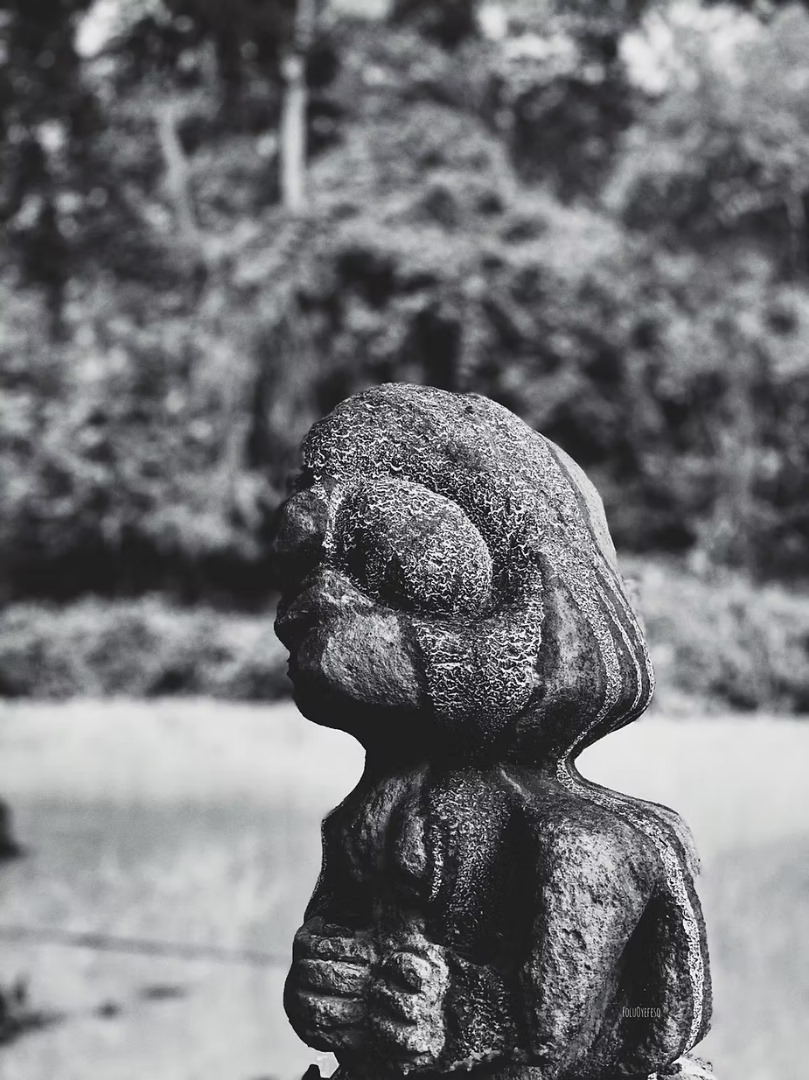

The story of Esu, the primordial trickster Orisha in Yoruba spirituality, is not merely a cultural tale; it’s a mirror reflecting the very nature of choice, accountability, and human duality. Yet, Esu has long been misunderstood, largely due to colonial and missionary influences that distorted his essence.
Before we dive into how this happened, let’s ask the crucial question
Many people, especially within Christianized communities, have been led to believe that Esu is the devil. This misconception couldn’t be further from the truth.
In Yoruba cosmology, Esu is a divine messenger, a powerful Orisha who serves as an intermediary between humans and the heavens.
He’s often called the “trickster”, not because he is evil, but because he challenges humankind with choices that shape destiny. In Yoruba myths, Esu stands at the crossroads, symbolizing the decisions we must make every day in our life’s journey.
“Life is a sum of all your choices.” — Albert Camus
Like the philosopher’s words, Esu reminds us that life isn’t random; it’s the product of our conscious decisions.
According to scholar Funso Aiyejina, Esu is “simultaneously short and tall, hard and soft… an androgynous deity, divine messenger, linguist, interpreter, and divine enforcer of the will of Olodumare.”
This description perfectly captures Esu’s fluidity, both in form and function.
Known by the praise name Elagbara, meaning “the one with many manifestations,” Esu represents the divine principle of free will.
His essence is neither strictly good nor bad; it is balance, teaching us that every human action carries both potential and consequence.
Within Yoruba cosmology, Orunmila is the Orisha of wisdom, the knower of fate, and guardian of divine truth. Esu works closely with Orunmila, acting as the messenger, enforcer, and interpreter between heaven (Orun) and earth (Aye).
This relationship reflects a profound truth: wisdom without communication is powerless, and communication without wisdom is dangerous. Esu ensures the divine order is maintained through proper balance and accountability.
“With great power comes great responsibility.” — Voltaire
And that, in essence, is the heart of Esu’s message: responsibility for one’s choices.
The philosophy of choice, embodied by Esu, speaks to us in the simplest of moments.
Every morning, we face crossroads:
- Do I stay in bed or get up to chase my purpose?
- Do I procrastinate or create something meaningful today?
- Do I react in anger or respond with wisdom?
Esu, in this sense, isn’t far away; he’s in every decision you make. Keeping Esu “close” means staying conscious, self-aware, and accountable.
“We are our choices.” — Jean-Paul Sartre
Every decision we make, no matter how small, shapes our destiny. That is Esu’s teaching: be intentional with your path.
Interestingly, many other cultures have similar figures:
- Among the Igbo, there’s Ekwensu, a deity of war, strategy, and negotiation, often misunderstood as evil.
- In Ghanaian folklore, there’s Anansi the Spider, symbolizing wit, cunning, and wisdom through storytelling.
- In Norse mythology, we find Loki, the shapeshifting god who disrupts order to reveal hidden truths.
These archetypes mirror Esu’s essence, not evil, but necessary agents of reflection and change. They challenge humanity to grow, to choose, and to evolve.
The demonization of Esu is one of the greatest cultural misunderstandings imposed on African spirituality.
When Bishop Samuel Ajayi Crowther translated the Bible into Yoruba, he used “Esu” to represent Satan, a translation that changed the cultural narrative forever.
It’s possible that Crowther’s experience as a freed slave influenced his rejection of traditional beliefs. Yet this single act equated a divine messenger of balance with pure evil, distorting generations of Yoruba consciousness.
“The most dangerous thing about distortion is when the lie becomes tradition.”
Through colonial teachings, Africans were taught to fear their gods, reject their heritage, and outsource accountability — blaming “the devil” for every misstep instead of reflecting inward.
In truth, there is no Satan in traditional Yoruba cosmology.
Good and bad exist as two sides of the same coin, a continuous interplay within human experience.
By reclaiming the wisdom of Esu, we reclaim our power to choose, our responsibility for outcomes, and our connection to ancestral truth.
Esu isn’t the enemy, he’s the reminder that life is shaped by the courage to choose consciously.
“Until you make the unconscious conscious, it will direct your life and you will call it fate.” — Carl Jung
This is the essence of Esu: self-awareness, choice, and accountability.
Esu teaches that every crossroads in life is sacred. The question isn’t whether choices will come, they always do. The real question is whether we will make them with clarity and purpose.
In rediscovering Esu, we rediscover our power to think, choose, and act responsibly.
Perhaps, in a society eager to blame external forces, Esu is the reminder we need to embrace accountability and walk our chosen path with courage.
So next time life brings you to a crossroads, pause, listen, and choose wisely.
Esu stands there, not to deceive, but to guide.

 English
  简体中文
简体中文  Čeština
  Deutsch (Sie)
  Français


