



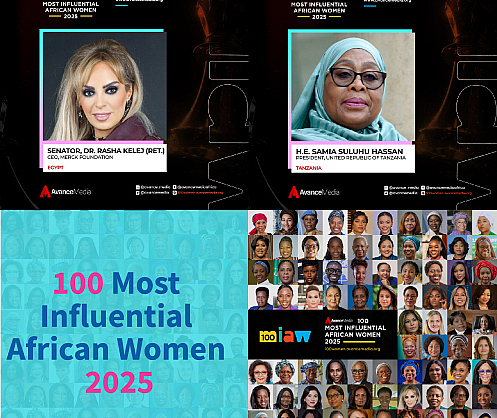

Dr. Rasha Kelej, CEO of Merck Foundation, has been named one of Africa’s 100 Most Influential Women for the seventh consecutive year by Avance Media, recognising her role in addressing critical gaps in medical training and advancing gender equity through health initiatives.
The ranking highlights leaders shaping policy, business, and social change across the continent. Kelej, a pharmacist turned philanthropist and former Egyptian senator, stands out for her work in building long-term healthcare infrastructure rather than relying on short-term interventions.
“I am deeply honored to be recognized as one of the 100 Most Influential African Women for the seventh consecutive year,” Kelej said. “It is a privilege to be named alongside Africa’s esteemed leaders, including the Presidents of Tanzania and Namibia, and so many inspiring change-makers.”
Scaling Specialised Care
Since taking the helm of Merck Foundation in 2017, Kelej has overseen more than 2,600 scholarships for African healthcare professionals across 52 countries in 44 underserved specialties, including oncology, cardiology, fertility care, diabetes, and endocrinology. The foundation partners with ministries of health, medical associations, and First Ladies to ensure trained specialists return to strengthen public systems.
Her flagship “More Than a Mother” campaign, now marking its 10th year, tackles infertility stigma while promoting girls’ education, women’s empowerment, and community health awareness. The initiative uses media, fashion, arts, and policy dialogue to shift cultural narratives around reproductive health and gender roles.
Kelej also drives the Merck Foundation First Ladies Initiative, working directly with African First Ladies to design and implement country-specific programmes in preventive care and non-communicable diseases. These efforts address a dual burden: persistent infectious diseases alongside a rising tide of chronic conditions in rapidly urbanising populations.
Context of Persistent Gaps
Africa continues to face severe shortages of specialised healthcare workers, particularly in rural areas and secondary cities. WHO data consistently shows the continent bears a disproportionate disease burden relative to its health workforce. In this environment, private-sector-led capacity building programmes like Merck Foundation’s have become vital complements to strained government budgets.
Kelej’s repeated recognition reflects growing appreciation for leaders who combine technical expertise, high-level advocacy, and measurable delivery. Her background — including an MBA and experience across commercial and philanthropic arms of Merck — informs a pragmatic approach focused on sustainability and local ownership.
Broader Impact and Challenges
Beyond scholarships, the foundation supports media recognition awards, research grants for women scientists through the MARS Awards, and community campaigns against child marriage, FGM, and gender-based violence. These interconnected efforts aim to create ripple effects across health, education, and economic participation.
Critics of philanthropy in Africa often question long-term sustainability and dependency risks. Kelej’s model attempts to mitigate this by tying support to government co-ownership and requiring beneficiaries to serve in public institutions. Still, challenges around infrastructure, retention of trained professionals, and consistent funding remain.
As Africa’s population grows and its disease patterns evolve, initiatives that strengthen human capital in healthcare will be central to both health security and economic productivity. Kelej’s work sits at the intersection of these priorities.
The coming years will test the depth of impact from these scaled training programmes. With consistent recognition across multiple platforms — including recent nods as one of the 100 Most Impactful Voices 2026 by ABCD Africa Dr. Rasha Kelej’s profile continues to underscore the value of persistent, targeted investment in Africa’s health systems and its women leaders.

 English
  简体中文
简体中文  Čeština
  Deutsch (Sie)
  Français


