



In the Rift Valley, an hour north-west of Nairobi, steam escapes the ground on its own. Olkaria sits on one of the largest geothermal fields in Africa, and for decades Kenya has drilled it for electricity that is cheap, clean and, rare for the continent, almost always on. In 2024, that steam acquired a new purpose. Microsoft and the Emirati firm G42 chose Olkaria for a billion-dollar data centre: a machine planted beside a volcano because few other places in the region could reliably feed it.
That detail is the whole story in miniature. Talk of African artificial intelligence is conducted almost entirely in the language of strategy, national visions, readiness indices, policy frameworks, and summits. But a model does not run on a strategy. It runs on electricity, on capital, and on racks of specialised chips that each cost more than a car. The countries pulling ahead are not, for the most part, those with the best documents. They are those that already had power, money and cities, and AI is following those old lines, not drawing new ones.
The scoreboard everyone is watching
Start with the conventional picture, the one almost every account offers. Since 2017, Oxford Insights has ranked nearly two hundred countries on their readiness to put AI to work in the public sector. In its 2024 index, Sub-Saharan Africa came last of any world region, scoring 32.7 against a leader, North America, above 82.
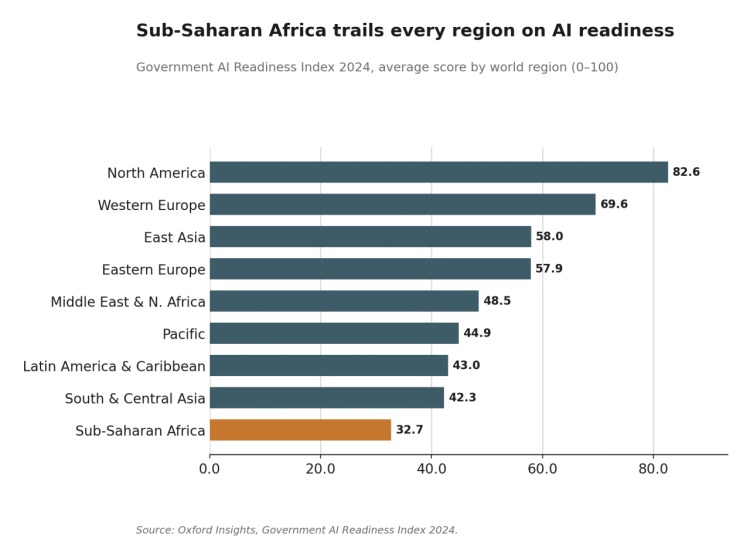
Source: Oxford Insights, Government AI Readiness Index 2024.
Zoom in and a familiar leaderboard appears. Mauritius leads at 53.9, then South Africa at 52.9 and Rwanda at 51.3, with Senegal and Benin completing the top five. South Africa alone clears the global average on the technology-sector pillar; Mauritius owes its place to an early, well-run government strategy. Then comes the detail most accounts rest on. The gap between the region’s best and worst performers is narrower than in most parts of the world, and more African governments publish AI plans each year. Africa is behind, this telling concludes, but catching up. This a comforting story, at this time measuring the wrong thing.
The map the money actually draws
Capital does not read the readiness index. Follow the money into African AI and it does not fan out. It collapses onto a handful of countries.
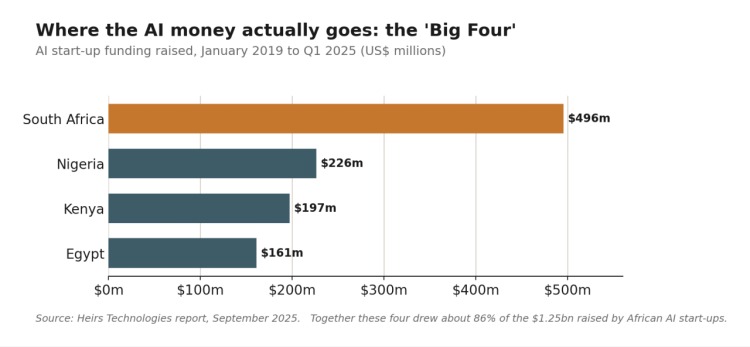
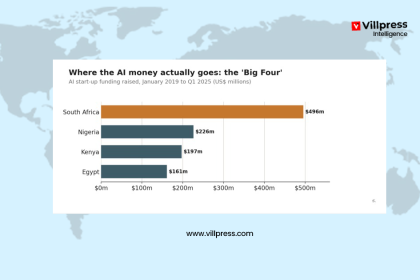
Source: Heirs Technologies report, September 2025.
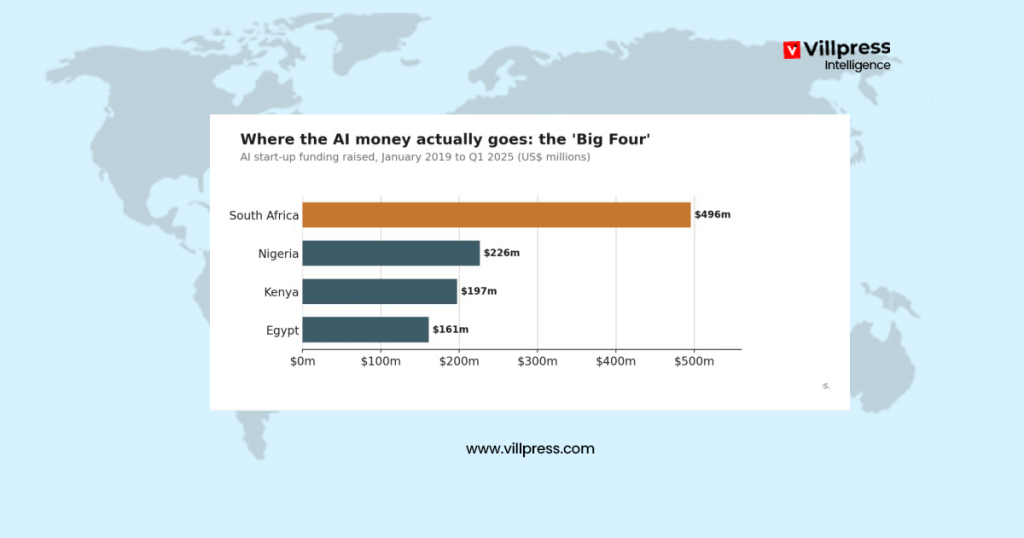
Between January 2019 and the first quarter of 2025, African AI start-ups raised about $1.25 billion, according to a 2025 Heirs Technologies report. Four countries, South Africa, Nigeria, Kenya and Egypt, the ‘Big Four’ of African tech, took roughly 86% of it. South Africa alone drew close to $500 million, more than the other three combined. The concentration is not a one-off: separate trackers put the four countries’ share at about 83% in early 2025.
Treat the totals with care; here honesty matters more than a tidy number. Trackers count differently. One widely used database records closer to $800 million over the same period, and ranks Tunisia, home to InstaDeep, the continent’s biggest AI exit, among the leaders. They disagree on the size of the pie. They agree, emphatically, on how few hands hold it. The global backdrop is starker still: in a single quarter of 2025, African start-ups drew an estimated 0.02% of the world’s AI venture funding.
Now set this map against the readiness scoreboard, and the two come apart. Rank is a poor guide to where the money goes. The index’s pioneers are, strikingly, poor countries: Rwanda, Senegal and Benin, all low- or lower-middle-income, wrote the first national AI strategies in mainland Sub-Saharan Africa. Almost none of the capital follows them. It follows market size and ecosystem depth instead. That is why South Africa, strong on both, leads the money as well as the index, while Nigeria draws hundreds of millions on a middling readiness score. Capital and readiness are not opposites; they are decoupled. The document a country writes says little about the cheque it will receive.
Africa accounted for an estimated 1.8% of the global AI market in 2025. Although the continent’s AI market was worth about $4.5 billion and growing rapidly, it remained small relative to the global industry because it started from a very low base.
Why the strategies are the easy part
If readiness is converging while money concentrates, the readiness measure must be capturing something cheap to spread. It is. What it mostly captures is intent, and in AI, intent is the cheapest thing on the shelf.
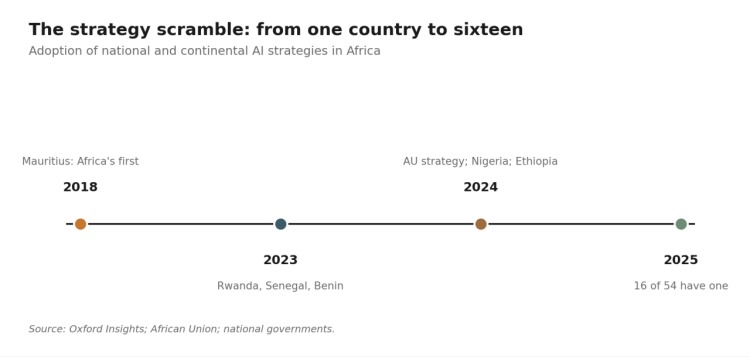
Source: Oxford Insights; African Union; national governments.
For half a decade after 2018, Mauritius stood alone with a national AI strategy. Then the dam broke. In 2023 Rwanda, Senegal and Benin published the first strategies in mainland Sub-Saharan Africa, most with European donor support. Nigeria and Ethiopia followed in 2024. That July, in Accra, the African Union endorsed a Continental AI Strategy to give the bloc a shared blueprint. By mid-2025 at least sixteen of Africa’s fifty-four countries had a plan, with more announced since.
This is real progress, and it earns the credit it gets. But consider what a strategy is: a document, often drafted with donor money and outside expertise, that commits a government to intentions rather than to spending. A poor country can enter this race — and even win it — precisely because entry is nearly free. That is why the gap is closing. It is closing on the one layer of the AI stack that costs almost nothing to reach. Shared intent is easy to celebrate, and easy to mistake for shared capacity.
Intent is the cheapest thing in artificial intelligence. Capacity is the dearest.
The layer that decides who actually builds
Beneath strategy and money lies the constraint that binds everything above them: compute. Modern AI runs on specialised graphics chips, clustered in large numbers and drawing enormous power. Here Africa has been not merely behind but close to absent.
5% Share of Africa’s AI practitioners with reliable access to the computing power their work requires, by one widely cited estimate.
Until 2025 there were, in practice, no large clusters of AI chips anywhere on the continent. A model an engineer elsewhere could train overnight might take an African researcher days, if it was feasible at all. That was a quiet tax on every ambition above it. The picture is finally changing. But the revealing question is not whether the compute is arriving; it is where it is allowed to land.
Consider the two flagship build-outs. In 2025 Cassava Technologies, working with Nvidia, switched on what it billed as Africa’s first ‘AI factory’ in South Africa: three thousand chips to start, with twelve thousand more planned across five countries in a rollout worth some $720 million. The Microsoft–G42 data centre sits at Olkaria. New facilities are rising in Egypt. Set them side by side and the pattern is hard to miss.
| Country | Landmark AI-compute build | Why it landed there |
| South Africa | Cassava–Nvidia ‘AI factory’, 3,000 GPUs (2025) — first in Africa; Microsoft cloud & AI, ~R5.4bn (~$300m) to 2027 | Strongest grid and deepest capital markets; the continent’s default compute hub |
| Kenya | Microsoft–G42 data centre, ~$1bn; a new Azure East Africa region | Geothermal power at Olkaria (100MW, scalable to 1GW), rare reliable, clean electricity |
| Egypt | New data centres announced; a node in Cassava’s five-country GPU rollout | State-backed build-out and proximity to European investors and cables |
| Nigeria | Included in Cassava’s 12,000-GPU, five-country rollout | Largest economy and the biggest fintech-AI market on the continent |
| Morocco | The fifth Cassava rollout country | North-African connectivity and links to European markets |
Every one lands in a country that was already a Big Four economy or an established hub. Cassava’s five markets, South Africa, Egypt, Nigeria, Kenya and Morocco, are almost exactly the names that dominate the funding chart. The compute is not widening the map; it is deepening the grooves already cut in it. Twelve thousand chips, five countries, the same five, again.
The cloud was supposed to make this moot
There is a sharp objection here, and it deserves a straight answer. Africa has leapfrogged before. Mobile money skipped the bank branch, reaching hundreds of millions who never held an account. Why can’t AI skip the local data centre the same way? A developer in Lusaka needs no server farm down the road; she can rent a slice of one in Johannesburg by the hour. Cassava’s own headline product is exactly that, graphics processing as a cloud service, a bet that access can be prised apart from location.
It is a real force, and it will widen access. But it does not dissolve the divide, for three reasons. First, leapfrogging has never meant skipping infrastructure, only riding a layer already built. Mobile money worked because the networks were there. AI’s foundation is compute, power and bandwidth, and that is precisely what is scarce. Second, renting compute separates use from location, but not from ownership. The machines must still sit somewhere with reliable power and a balance sheet deep enough to buy them; as access widens, the hardware, the rents and the control stay concentrated. Third, cloud AI presumes a connection. By the GSMA’s count, only about 28% of Africans use mobile internet. Nearly three-quarters of the continent is offline, and close to a billion people live within range of a network they do not use. The leapfrog is real, but bounded, and it cannot reach the majority who are not yet online.
An old divide, wearing a new name
Return to Olkaria, and ask the question the steam answers. Why must a billion-dollar data centre be built beside a volcano? Because most of the continent cannot promise one the uninterrupted power it needs. As of 2024, by the International Energy Agency’s reckoning, some 600 million people in Sub-Saharan Africa, nearly half its population, still lived without electricity. The continent held roughly three-quarters of the world’s unelectrified people. Olkaria was chosen for geothermal power that is clean and, unusually, reliable, a hedge against the outages that would choke a machine of that size. It was, in one plain phrase, a bet on a continent plagued by power outages.
Even Olkaria is not settled. By 2026 the project was reported to be stalling over whether Kenya can generate power fast enough to run it; the government has pledged to more than double national capacity by 2030 to keep such machines fed. The boldest attempt to decentralise African compute is itself waiting on megawatts. The same gravity governs the money for power. The record energy investment now flowing into Africa lands disproportionately where the grids are already strongest, the very places least likely to hold those 600 million in the dark.
This is the quiet argument beneath the whole story. AI did not arrive on a blank map. It came to a continent already divided, by electricity, capital markets, cities and the undersea cables that bring the internet ashore, and it runs, as water does, along the channels already cut. Mauritius leads on readiness because it started early and governs a small, wired island. South Africa leads on money and compute because it has the grid and the markets. Kenya can host a data centre because it has geothermal steam. AI made none of these advantages. Every one is older than it.
AI is not drawing a new map of Africa. It is inheriting the old one.
The danger, then, is not that Africa lacks ambition. The strategies, the continental framework, the crowded summits, ambition is abundant, and it is reaching the very countries once written off. The danger is subtler. It is that Africa, and the world watching it, will keep score on the layer that was always going to even out, the documents, while the decisive layers harden into a hierarchy: the capital, the chips, and the power to run them.
A strategy can be written in a year; a grid takes a generation. In the Rift Valley the steam keeps rising, waiting for the machine it was promised, and the real map of African AI is being drawn not in the strategies that make headlines, but in the megawatts that do not.


 English
  简体中文
简体中文  Čeština
  Deutsch (Sie)
  Français


