



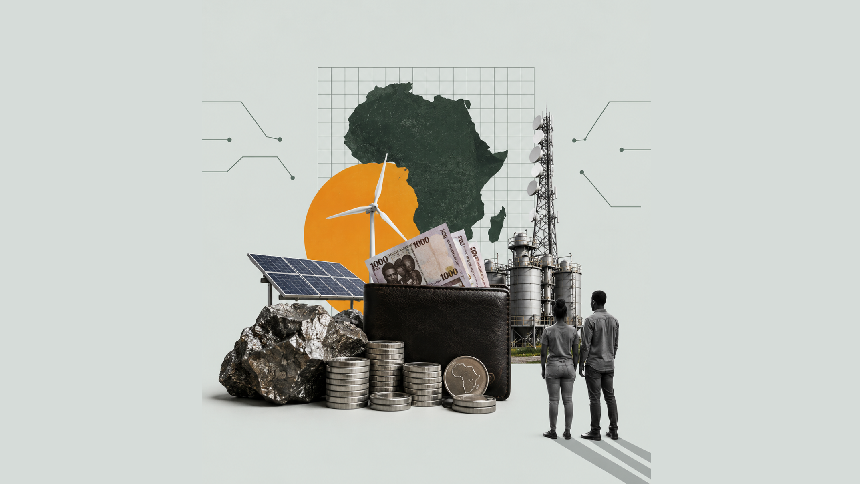

In 2025, roughly $1.4 trillion moved through mobile money wallets in sub-Saharan Africa , about two-thirds of every mobile-money dollar transacted on the planet. A continent that most of the world still files under “unbanked” now runs the most advanced consumer payments system on earth, one that the United States and Europe are quietly studying rather than teaching. That is not a story about poverty being solved. It is a story about a value layer that Africans built, own, and control.
Now hold that fact next to another one. The same continent supplies around 70% of the cobalt in every electric-vehicle battery, laptop, and AI server being manufactured today , and captures almost none of the battery’s value. The cobalt leaves the Democratic Republic of the Congo as hydroxide, gets refined in China, becomes a cathode in Asia, and returns to Africa embedded in a phone that costs a month’s wages. Two industries, one continent, opposite outcomes. In one, Africa is the world’s leader. On the other hand, it is the world’s quarry.
The difference between those two outcomes is the entire subject of this report. Nearly every list of “the industries that will define Africa’s future” , minerals, energy, agriculture, fintech, artificial intelligence , is really a list of raw ingredients. Ingredients don’t define a future; they get processed into someone else’s. The question that actually decides Africa’s economic destiny is not which sectors are biggest but which sectors let Africans own the layer where the value accumulates. This report is about that test, why mobile money passed it and cobalt keeps failing it, and what has to be true for the next generation of industries to break the oldest pattern in African economic history.
What we actually know
Start with the demographic engine, because every other industry is downstream of it. Africa’s population reached roughly 1.55 billion in 2025 and is projected, under the UN’s medium-variant scenario, to hit about 2.5 billion by 2050 and continue toward 3.8 billion by 2100. The median age is under 20. Most consequentially for business: by 2040, Africa’s working-age population (15–64) is projected to exceed that of China and India combined, making the continent the largest single labor pool on earth. Around 12 million young Africans enter the labor market every year. This is verified and load-bearing. What is genuinely uncertain is whether that cohort becomes a “demographic dividend” (as East Asia’s did) or a demographic liability; the difference is entirely jobs, and jobs come from industries that add value locally.
On fintech, the numbers are unambiguous. The GSMA’s 2026 industry report put sub-Saharan African mobile-money throughput at about $1.4 trillion in 2025 , 66% of global transaction value , across more than a billion registered accounts. Kenya’s M-Pesa alone processed roughly $450.8 billion in the year to March 2025; MTN’s MoMo platform reported around $500 billion. Mobile money added an estimated $190 billion to sub-Saharan GDP in 2023. This is the one sector where the “Africa leads the world” framing is literally, measurably true rather than aspirational.
On critical minerals, the continent holds a commanding but contested share of the inputs to the global energy transition. Sub-Saharan Africa holds roughly 30% of the world’s reserves of the minerals central to clean technology. The DRC produces the majority of the world’s cobalt , sources cite figures between 70% and 74% , and attracted the highest mineral-exploration investment in Africa in 2024. South Africa holds an estimated 80% of platinum-group-metal reserves. African copper output reached about 4.2 million tonnes in 2025, led by the DRC and Zambia. The precise percentages vary by source and should be treated as directional, not exact; the strategic fact , Africa controls a decisive slice of the physical inputs , is not in dispute.
On energy, the defining number is a deficit. Around 600 million Africans, close to half the continent, still lack reliable electricity , over 80% of the entire global access gap. The World Bank and African Development Bank’s “Mission 300” aims to connect 300 million of them by 2030, backed by roughly $48 billion in committed institutional financing; by late 2025 it had connected over 50 million people across 40 countries. More than half of Africa’s existing generation is already renewable, and distributed solar is projected to account for over half of new connections. The collapse in solar and battery costs is the quiet variable rewriting the whole sector.
On trade, the African Continental Free Trade Area (AfCFTA) is the institutional wager: a single market of 1.4 billion people and roughly $3.4 trillion in combined GDP. Trading began in 2021; by 2025, 25 countries , including the largest markets, Nigeria and South Africa , had completed the process of finalizing tariff schedules, and intra-African trade had climbed past $220 billion. The Pan-African Payment and Settlement System (PAPSS) is live. But rules of origin for the highest-value sectors , automobiles, textiles , remain unfinished, and a trade-finance gap estimated near $100 billion still throttles smaller firms. The promise is real; the plumbing is half-built.
On digital and AI infrastructure, the gap is the story. Africa is home to about 18% of humanity but holds under 1% of the world’s data-center capacity , the top five African markets combined have less capacity than France did in 2024. Tech funding recovered to roughly $3–3.4 billion in 2025 (up ~44% on 2024), but much of it was debt and structured finance rather than equity, and in the third quarter of 2025 clean energy overtook fintech as the continent’s most-funded sector for the first time. That single crossover is one of the most important leadership signals in the data: capital is quietly repricing which industry it believes will define the next decade.
The world that made this possible
None of these industries can be read without the backdrop that shaped them, because in Africa the backdrop is usually the decisive actor.
The first force is the extractive inheritance. The colonial economy was engineered to move raw materials out and finished goods in, and independence rarely rewired that machine , it changed who collected the rent. Oil in Nigeria and Angola, cocoa in Ghana and Côte d’Ivoire, copper in Zambia: each created a state dependent on exporting an unprocessed input and importing the value someone else added to it. This is not ancient history. It is the operating template that every new industry either inherits or escapes.
The second force is leapfrogging. Because Africa had so little legacy infrastructure, it skipped generations of it. There were never enough copper landlines to matter, so the continent went straight to mobile; there were never enough bank branches, so it went straight to phone-based money; in many places there is no reliable grid to extend, so the future is distributed solar rather than giant central power stations. Scarcity of the old system became an advantage in adopting the new one , but only in the sectors where the value layer could be built on the continent.
The third force is the global energy transition, which turned African geology into a geopolitical asset almost overnight. Solar panels, wind turbines, and EV batteries need far more cobalt, copper, lithium, and manganese than the fossil system did. That has drawn a new scramble , Chinese firms dominating DRC cobalt and copper, Gulf sovereign wealth funds financing data centers and mines, US-backed players like KoBold Metals (funded by Bill Gates and Jeff Bezos) chasing lithium in the DRC. Africa is being courted for its inputs the way it was in the 19th century, with better contracts and the same underlying logic.
The fourth force is the retreat of aid. The US, UK, and France have cut foreign-aid budgets, which historically funded much of Africa’s energy and development work. That retrenchment is precisely why initiatives like Mission 300 are structured to crowd in private capital rather than rely on grants , and why the winners of the next decade will be industries that can attract commercial money, not concessional charity.
The system: mapping the machine
Treat Africa’s economy as one interconnected machine and the pattern becomes visible. At the front end sit the inputs: minerals under the ground, sun and wind above it, arable land, and 1.5 billion people. The critical question is what happens at the next node , processing and value-addition , because that is where wealth is created or lost.
For minerals, that node sits almost entirely offshore. Cobalt hydroxide and copper concentrate leave the continent; refining, cathode manufacture, and cell assembly happen in China and East Asia; the finished battery comes back as an import. Every step of value-multiplication occurs where Africa is not. The capital node is dominated by foreign strategic investors and state-backed vehicles; the government node oscillates between welcoming that capital and trying to claw back value through export bans and ownership mandates; and the global-buyer node , automakers, electronics giants, AI-server builders , sits at the top of the chain, capturing the margin.
For mobile money, the same machine runs almost entirely inside Africa. The input is a SIM card and a phone. The processing layer , the wallet, the ledger, the fraud systems , is owned by African telcos and fintechs. Distribution runs through roughly 30 million human agents embedded in every market and village, a physical network no foreign entrant can easily replicate. Capital increasingly comes from within (M-Pesa’s parent Safaricom, MTN, local banks). Government, after early hostility, became an enabler through regulatory sandboxes. The value stays on the continent because every node of the machine is on the continent. That is the single structural fact that separates Africa’s one world-leading industry from all its extractive ones.
Everything else , energy, agriculture, AI , sits somewhere between these two poles, and its future depends on which pole it drifts toward.
First principles: the value-capture test
Strip away the industry labels and the same question governs all of them. Not “how large is the resource?” but “where does the value get added, and who owns that step?”
Cobalt is a scarce, near-irreplaceable input , and Africa captures a sliver of its value because the value is added elsewhere. Data is the new equivalent: every African mobile payment, biometric enrollment, and social post is a raw input that flows to servers owned by Amazon, Microsoft, and Google, under foreign jurisdiction, where the intelligence and the profit accumulate. The March 2024 failure of three undersea cables that plunged much of West Africa into digital blackout was a brutal illustration , even Africa’s own data centers ran on foreign cloud platforms and foreign law. Cobalt and data are the same story in different centuries: Africa supplies the input, someone else owns the value layer.
Mobile money inverts it. The scarce resource there was not a mineral but trust and reach , the ability to move money safely for people the formal banks had written off , and Africans built and own that layer. Controlling a scarce input is worth little if you don’t control the step where it becomes valuable. Controlling the value step is worth enormous amounts even when the input is cheap.
This is the test every candidate “industry of the future” must pass. It reframes the entire question. Minerals will define Africa’s future only to the degree that refining and battery-precursor manufacturing move onshore. Energy will define it only if generation is owned locally and powers local industry rather than exporting electrons or raw megawatts. Agriculture defines it only through processing, not the export of raw beans. AI defines it only if compute, models, and data governance sit on the continent. In every case, the sector is not the answer. The location of the value layer is.
The pattern: naming the Input Trap
The recurrence is consistent enough to name as a distinct strategic pattern rather than a one-off observation.
The Input Trap is the condition in which an economy secures durable control over a globally scarce input while systematically failing to capture the value added downstream of it , and mistakes control of the input for economic power. The trap is seductive precisely because holding the input feels like leverage. It generates real revenue, real foreign exchange, real political rents. But the input’s price is volatile and its margin is thin, while the value-added layers above it are where pricing power, jobs, and compounding wealth live. The trapped economy stays rich in rents and poor in capabilities.
The evidence spans a century. Ghanaian and Ivorian cocoa: the two countries grow the majority of the world’s cocoa and capture a low-single-digit percentage of the chocolate industry’s value. Nigerian and Angolan crude: exported raw for decades while refined fuel was imported, a dependency Nigeria only recently began attacking with domestic refining. Zambian and Congolese copper: dug and shipped, rarely fabricated. And now Congolese cobalt and pan-African data, running the identical logic for the industries of the 21st century.
The conditions under which Africa breaks the trap are equally instructive, and they define the playbook. Mobile money broke it because the entire value chain could be built domestically and network effects locked the value in. The DRC’s 2025 experiments , temporary cobalt export bans and a domestic push into refining cobalt hydroxide into finished metal , are deliberate attempts to force value onshore, echoing Indonesia’s nickel strategy. Zimbabwe has banned raw lithium exports to compel local processing. Morocco has built a genuine automotive manufacturing base rather than exporting phosphate alone. Each is a bet that controlling the next step is worth the short-term pain of disrupting the input trade.
The conditions under which those bets fail are just as clear. When the domestic power, logistics, and skills to run the value-added layer don’t yet exist, an export ban simply strangles revenue without creating an industry , you cannot refine cobalt with 600 million people lacking electricity. When resource nationalism is loud enough to scare off the capital needed to build the very processing plants it demands, the plants never get built. And when regional markets stay fragmented, no single country has enough demand to justify a value-added plant in the first place , which is precisely the gap AfCFTA is meant to close.
The ethical edge matters too. Breaking the Input Trap can be done well (building capability, jobs, and ownership) or badly (nationalizing assets, expropriating partners, and enriching a political elite while the value layer never actually materializes). The pattern describes a strategic logic; it does not excuse the corruption or coercion that often travels with resource control.
Ripple effects
The move to capture value is already sending second-order shocks through the system. Export bans and quotas , cobalt in the DRC, lithium in Zimbabwe , stabilized some prices but also created uncertainty that can deter the multi-billion-dollar processing investment the bans are meant to attract; the intended and unintended effects run in opposite directions. The data-sovereignty push (Nigeria, Kenya, Egypt, and South Africa all drafting AI and data-localization policies since 2025) is a direct descendant of the same instinct applied to a new input, and it is beginning to reshape where cloud infrastructure gets built.
There is also a demographic ripple that cuts against the optimism. If the value-added industries don’t materialize, automation may mean the “largest labor force on earth” arrives just as global manufacturing needs fewer hands , the risk of premature deindustrialization, where economies lose the manufacturing on-ramp that lifted East Asia before they ever climb it. The demographic dividend is not automatic; it is contingent on exactly the value-capture question this report is built around.
What if , a counterfactual
Consider two clearly hypothetical scenarios, offered to sharpen the logic rather than to rewrite events.
Had M-Pesa been forced entirely through the banking system. In several markets, regulators initially insisted mobile money be bank-led, slowing it dramatically. Kenya’s central bank instead let a telco run it. Had the bank-led model won everywhere in 2007–2010, it is plausible the agent-network value layer would have been captured by incumbent banks or foreign card networks rather than African telcos , and the continent might today be a consumer of someone else’s payment rails rather than the global leader. The value layer was won by a regulatory choice as much as a technical one.
Had the DRC built refining capacity from 2010. If Congolese cobalt refining had been forced onshore fifteen years ago , when the EV boom was visible but not yet frenzied , the country might now sit in the battery-precursor value chain the way it sits atop the mineral. The counterfactual is not that it was easy (power and governance were and are binding constraints), but that the window for capturing value opens early and closes as foreign refining capacity gets built and locked in. Timing, in the Input Trap, is a resource as scarce as the mineral itself.
The opportunity map
History here is the laboratory; the opportunities are the payoff. Each below is anchored in the value-capture logic and in present-day facts.
Immediate (0–2 years): Mineral value-addition beachheads. The export bans and local-content mandates in the DRC, Zimbabwe, and Zambia have created protected demand for anything that adds even one step of processing , assay labs, hydroxide-to-metal refining, logistics, and traceability systems that let ethically sourced African minerals command a premium. The opening exists now precisely because policy created it. – Fintech’s next layer, not its first. With basic payments saturated and fintech funding actually falling in 2025, the money has moved to the layer above: embedded finance, regtech, cross-border B2B rails on PAPSS, and merchant credit built on mobile-money data. The consumer wallet was round one; the infrastructure beneath pan-African commerce is round two.
Emerging (2–5 years): Distributed solar as an industrial input, not just a lamp. Mission 300 and the solar cost collapse are usually framed as electrification-for-households. The larger opportunity is powering the value-added plants , cold chains, agro-processing, small-scale refining , that the Input Trap requires. Whoever bundles distributed generation with productive use captures far more than a solar-home-system reseller. – AI compute and sovereign cloud. Africa’s sub-1% share of global data-center capacity is the gap and the opportunity. The NVIDIA-Cassava “AI factories,” iXAfrica–Oracle in Kenya, and the $60 billion Africa AI Fund signal that the value layer for data is being contested right now. GPU-as-a-service models that let African startups access compute without owning it are an especially capital-efficient wedge.
Structural (5–15 years): Regional value chains under AfCFTA. The single largest structural prize is finishing the plumbing , rules of origin for autos and textiles, closing the ~$100 billion trade-finance gap , so that a battery, a car, or a garment can be made across several African countries and sold duty-free to 1.4 billion people. Fragmentation is the reason value-added plants can’t reach scale; integration is the fix. – Agro-processing for the world’s biggest domestic market. Feeding 2.5 billion people by 2050 is a structural certainty. The value is not in exporting raw cocoa and coffee but in processing for African consumption , the demographic guarantees the demand.
Technology-enabled: African-language AI and data. Models trained on local languages and local realities are a value layer foreign providers have little incentive to build well, and data-sovereignty policy is actively clearing the field for local players. – Mobile-money-native services. Every product that plugs into 1.1 billion wallets , insurance, savings, asset-financing, pay-as-you-go anything , rides infrastructure that already exists and is already trusted.
Policy-driven: Local-content and processing mandates are manufacturing opportunities out of thin air for whoever can actually execute the processing step the policy demands. The risk is real (bans without capability strangle revenue), which is exactly why execution capacity is the scarce, valuable thing.
Hidden in current inefficiencies: The trade-finance gap, the fraud problem, and the ~75% of mobile-money accounts that sit inactive monthly are each a large, unglamorous market. Reducing mobile-money fraud alone would unlock enormous latent value, since fraud and transaction taxes are the main forces still pushing users back to cash.
The playbook
Own the value step, not the input
Principle: Durable wealth accrues to whoever controls the step where value is added, not whoever controls the raw ingredient.
Historical example: African telcos built and kept the mobile money value layer and now lead the world, while Congolese cobalt is dug and shipped, capturing little value.
Modern application: A founder or government should ask, of any resource, Which downstream step can I actually own and defend? Then build there, rather than focusing only on extraction.
Common mistake: Treating control of a scarce input as if it were economic power. It is rent, and rent is thin and volatile.
Reflective question: In my business or my country, where does the value actually accumulate, and do I own that node or merely feed it?
For: Governments, founders, investors
Sequence capability before you seize value
Principle: You cannot capture a value-added layer if you lack the power, skills, and logistics to operate it.
Historical example: Export bans succeed where processing capacity can be built, as seen with Indonesia’s nickel industry, and backfire where they cannot. You cannot refine minerals on an electricity grid that fails half the population.
Modern application: Pair every local-content mandate with the enabling infrastructure, power, ports, and workforce training, or it becomes a self-inflicted revenue wound.
Common mistake: Treating resource nationalism as a slogan rather than an industrial strategy, while driving away the capital needed to build processing capacity.
Reflective question: Do I have the necessary foundations in place, or am I trying to seize a step I cannot yet operate?
For: Governments, policymakers
Leapfrog where you’re empty, don’t rebuild what others have
Principle: The absence of legacy infrastructure can be an advantage. Adopt the frontier system directly.
Historical example: No landlines led to mobile phones. No bank branches led to mobile money. Limited grid infrastructure is driving distributed solar adoption.
Modern application: Design for the leapfrogged system, offline-first, mobile-first, and solar-first—instead of copying the infrastructure of developed economies.
Common mistake: Importing capital-intensive models such as centralized power grids, branch banking, or traditional data centres when leapfrog alternatives are cheaper and faster.
Reflective question: Am I recreating yesterday’s infrastructure, or skipping directly to what replaces it?
For: Founders, infrastructure investors
Build the network that can’t be copied
Principle: Physical and human networks, agents, distribution, and trust, are the competitive moat that foreign entrants cannot simply parachute in and replicate.
Historical example: More than 30 million mobile money agents have created a last-mile network that global fintech companies cannot easily duplicate.
Modern application: Compete on local distribution, customer relationships, and trust in fragmented and informal markets rather than relying on technology alone.
Common mistake: Assuming a better app automatically wins. In many African markets, reach and trust matter more than features.
Reflective question: What have I built that a better-funded competitor still could not replicate next year?
For: Founders, scale-ups
Integrate the market to reach the scale value addition needs
Principle: Value-added industries require a market large enough to justify investment in manufacturing and processing. Fragmentation prevents them from achieving scale.
Historical example: The African Continental Free Trade Area (AfCFTA) exists because, outside of a few countries, no single African market is large enough to support continent-scale manufacturing on its own.
Modern application: Build for the regional market from day one, while investing in the less glamorous infrastructure, payments, logistics, and rules of origin, that makes regional scale practical and affordable.
Common mistake: Building for only one national market and quickly reaching a growth ceiling, or waiting for regional integration to be fully complete before expanding.
Reflective question: Is my market large enough to justify moving up the value chain? If not, how can I aggregate a larger market?
For: Investors, governments, scale-ups

 English
  简体中文
简体中文  Čeština
  Deutsch (Sie)
  Français


