

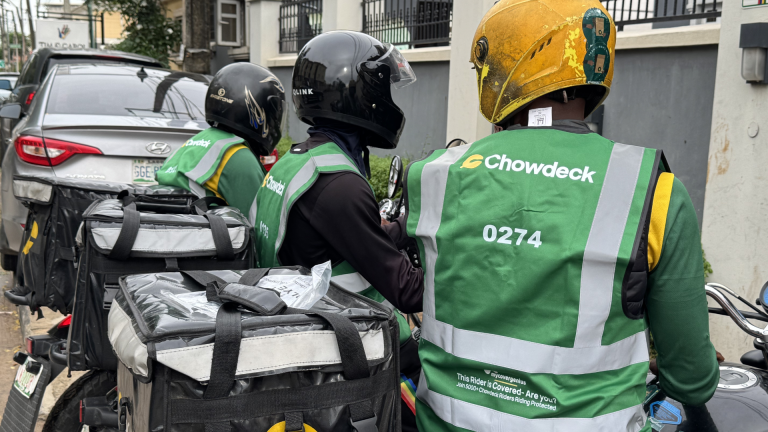

Chowdeck, the Nigerian on-demand delivery platform that has rapidly become one of the country’s most visible players in food and logistics, has introduced personal accident insurance for more than 20,000 of its active riders through a partnership with MyCoverGenius. The coverage, which took effect in November 2025 but was publicly detailed this week, automatically enrolls every qualifying rider, no forms, no opt-in, no deductions from their earnings.
The policy addresses the most immediate financial risks riders face on Nigerian roads: coverage for accidental medical expenses, including hospital bills from crash-related treatments, and compensation for temporary disability that could leave someone unable to work for weeks or longer. While specific payout caps, exact claim timelines, or premium structures weren’t disclosed in company statements, the plan is designed to offset lost income during recovery and provide a buffer against the kind of incidents that can wipe out months of gig earnings in one event.
Chowdeck has grown aggressively since its 2022 launch in Lagos, expanding to multiple cities and crossing significant milestones, more than two million customers served and consistent high daily order volumes. That scale means its rider network is now one of the largest in Nigeria’s delivery sector, with over 20,000 active couriers relying on motorcycles and bicycles to navigate traffic, potholes, and long shifts. Road accidents remain a persistent hazard; official statistics show motorcycles involved in a disproportionate share of trauma cases, and for gig workers without formal employment benefits, a serious injury often translates to immediate financial distress.
The partnership with MyCoverGenius fits into a broader pattern among African insurtechs: embedding simple, accessible coverage directly into high-volume platforms rather than selling standalone policies. MyCoverGenius aggregates products from licensed underwriters and focuses on digitizing distribution to reach underserved segments. Its role here is to power the backend—claims processing, policy administration, while Chowdeck handles enrollment and communication through its rider app and operations.
This isn’t the first time delivery companies in emerging markets have moved toward rider protections. Platforms in Latin America and Southeast Asia have rolled out similar accident or health covers, sometimes under regulatory pressure or after public incidents. In Nigeria, though, formal safety nets for informal workers remain thin, and most initiatives come from private players rather than government mandates. Competitors like Glovo (before its local challenges) and others have experimented with emergency funds or health tie-ups, but Chowdeck’s automatic enrollment at this fleet size marks one of the more comprehensive efforts locally.
The timing feels tied to Chowdeck’s maturation phase. After years of prioritizing rapid expansion and market share—fueled by Y Combinator backing and local investor support the company is shifting attention to retention and operational sustainability. High rider churn has long been a drag on unit economics in food delivery; offering meaningful welfare perks can help stabilize the workforce, reduce onboarding costs, and improve service reliability. Public reports from 2025 highlighted cases of injured riders struggling without support, adding reputational weight to the decision.
Adebowale Banjo, CEO of MyCoverGenius, framed the collaboration in terms of accessibility: the partnership extends protection to thousands of hardworking riders and shows how digital platforms can integrate insurance to directly improve lives. Chowdeck’s own messaging emphasizes setting a benchmark for rider welfare, positioning the move as both pragmatic business sense and a step toward more responsible scaling in the gig economy.
Execution will determine the real impact. Automatic enrollment removes barriers to adoption, but success hinges on how straightforward claims are whether riders can report incidents easily, get timely approvals, and receive payouts without excessive paperwork. Transparency around benefit limits and any exclusions will also matter, especially as more riders become aware of the coverage through word-of-mouth or app notifications.
In the wider African tech landscape, this kind of embedded finance move highlights a maturing ecosystem. Platforms that once chased growth at all costs are now layering in protections to build durability, whether through insurance, emergency funds, or better earnings models. For Chowdeck, insuring 20,000+ riders isn’t just a CSR checkbox; it’s an investment in the human infrastructure that keeps orders moving. As the company eyes further expansion, how well this safety net holds up could influence both rider loyalty and its standing among peers racing to balance speed with stability.






 English
  简体中文
简体中文  Čeština
  Deutsch (Sie)
  Français


