



Brookhaven National Laboratory has officially shuttered its Relativistic Heavy Ion Collider (RHIC), the U.S.’s sole particle collider and a powerhouse for probing the universe’s earliest moments, after a quarter-century run that yielded paradigm-shifting discoveries on quark-gluon plasma and proton spin, but the end signals a fresh start with plans for a cutting-edge successor.
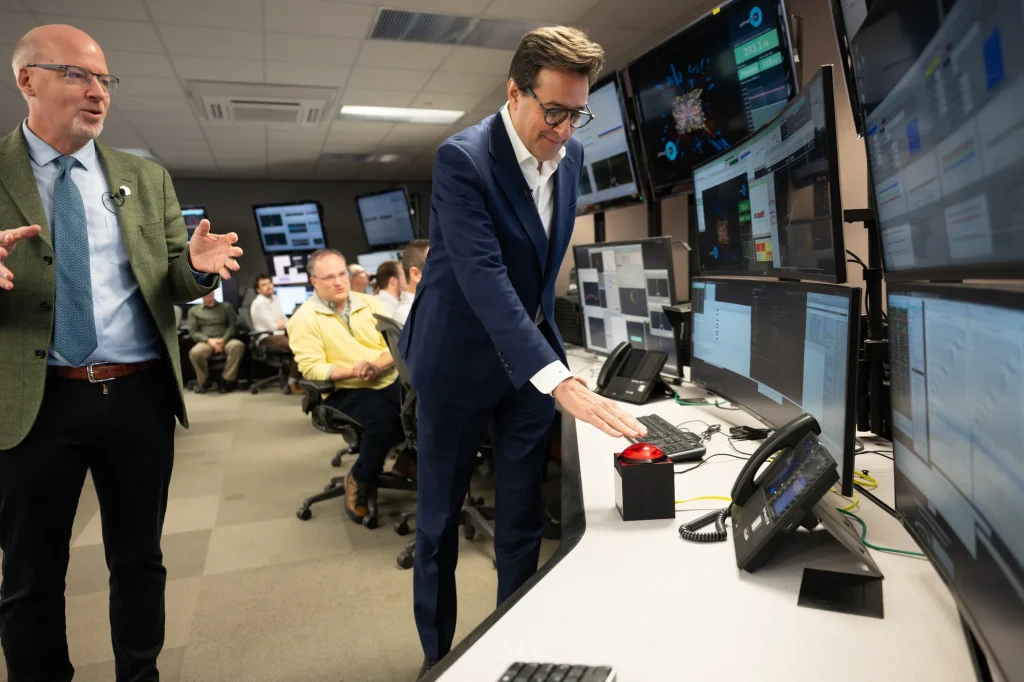
The shutdown ceremony unfolded on February 6, 2026, at the New York lab, where U.S. Department of Energy Under Secretary for Science Darío Gil pressed a symbolic red button to halt the final collisions, drawing applause from scientists, administrators, and observers amid a mix of nostalgia and anticipation. RHIC, operational since 2000, smashed atomic nuclei or protons at 99.995% the speed of light in its 2.4-mile-wide rings to recreate Big Bang conditions, focusing on the strong force binding quarks and gluons. By 2010, it confirmed the quark-gluon plasma, a primordial soup existing microseconds after the Big Bang, as a near-frictionless liquid with record vorticity, rather than a gas. It also produced the heaviest antimatter assemblages ever seen and advanced the proton spin puzzle, revealing quarks contribute just 1% of a proton’s mass, with gluons and interactions accounting for the rest, though a mysterious motion-related slice remains unexplained as of 2023 data.
The final run, spanning nearly a year and concluding with the sPHENIX detector (operational since 2023), generated hundreds of petabytes of data, exceeding all prior campaigns combined, and uncovered first direct evidence of “virtual particles” in quark-gluon plasma, probing the quantum vacuum. “Most of our scientific productivity sits ahead of us,” said David Morrison of the sPHENIX collaboration, emphasizing post-shutdown analysis. Emotions ran high: Accelerator physicist Angelika Drees lamented, “I wish I could go sit in a corner and cry… It was such a beautiful experiment and my research home for 27 years. But we’re going to put something even better there.” Final run coordinator Travis Shrey added a lighter note: “It’ll be good to sleep well for a while… I’m excited to reach the finish line.”
Related Stories: Apeiron Labs Raises $29M to Blanket Oceans With Autonomous Underwater Robots
RHIC’s closure clears the deck for the Electron-Ion Collider (EIC), a next-gen facility slated for construction over the next decade at the same site, reusing one of RHIC’s ion rings alongside a new electron ring to delve deeper into quarks and gluons via electron-ion collisions. DOE Office of Science interim director Linda Horton remarked, “The collider’s gone, but RHIC will live on through the data.” BNL associate laboratory director Abhay Deshpande highlighted EIC’s draw: “For at least 10 or 15 years, this will be the number one place in the world for [young physicists] to come.” The shift positions the U.S. to reclaim ground in particle physics after yielding to Europe’s Large Hadron Collider (LHC), with EIC marking the first new American collider since RHIC.
Planning for RHIC dates to the early 1980s, driven by quests to recreate quark-gluon plasma and resolve proton crises, culminating in its 2000 launch. No specific budget details were disclosed in the announcement, but the transition reflects strategic DOE priorities for advancing nuclear physics amid global competition.
Globally, particle colliders like the LHC continue high-energy pursuits, but RHIC’s unique focus on heavy ions leaves a specialized legacy; as EIC ramps up, it could attract talent and reinvigorate U.S. leadership in fundamental science, though funding battles loom in an era of tight budgets.






 English
  简体中文
简体中文  Čeština
  Deutsch (Sie)
  Français


