

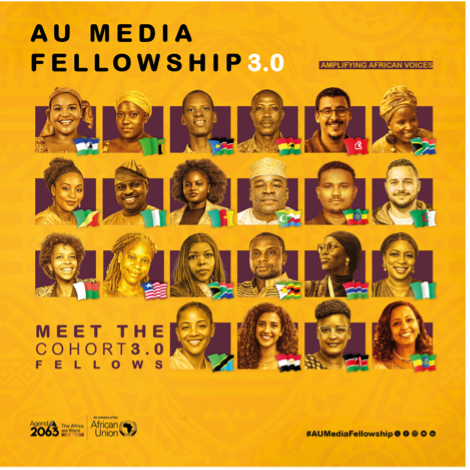

The African Union has unveiled the third cohort of its AU Media Fellowship, selecting 20 journalists, digital creators, photographers, podcasters and multimedia storytellers from across the continent. Announced in early March 2026, the group joins a growing network of media professionals the AU is deliberately cultivating to strengthen African-led narratives at a time when external framing of the continent remains narrow and often reductive.
The fellowship is not a conventional training programme. Over the next 12 months fellows will have structured access to AU institutions, high-level summits, specialised workshops on investigative techniques, data journalism, visual storytelling, podcast production and audience engagement. Each participant receives a modest grant to support an original project, mentorship from senior editors and producers, and the opportunity to showcase finished work at the AU headquarters in Addis Ababa.
What sets this cohort apart is its geographic and stylistic breadth. Fellows come from Algeria, Egypt, Ethiopia, Ghana, Kenya, Morocco, Nigeria, Rwanda, Senegal, South Africa, Tanzania, Uganda, Zimbabwe and several other countries. Their portfolios range from long-form investigative reporting on governance and climate justice to short-form video content that reaches millions on TikTok and Instagram, from data-driven health and education stories to cultural documentaries that center African agency.
A few members illustrate the range of voices now part of the initiative:
- Fatima Zahra El Mansouri (Morocco) — a multimedia journalist whose video essays on women’s rights, migration and urban change in North Africa have built a large following on YouTube and Instagram.
- Chidi Odinkalu (Nigeria) — an investigative reporter and legal analyst known for deep reporting on security, governance and human rights in West Africa.
- Aisha Salaudeen (Nigeria) — a BBC-trained visual storyteller who combines drone footage, interviews and archival material to document climate impacts on coastal communities and informal economies.
- Lina Ahmed (Egypt) — a data journalist and podcast host exploring youth unemployment, digital economies and social policy across the Arab world.
- Kwame Gyan (Ghana) — a broadcast and podcast journalist specializing in economic policy, regional integration and Pan-African themes.
The selection process deliberately looked beyond traditional media accolades. AU organisers say they prioritised potential, the ability to reach new audiences, challenge stereotypes and produce work that resonates both locally and globally. Unlike many international fellowships that pull journalists into Western newsrooms, this programme keeps fellows rooted in African media ecosystems while connecting them to continental decision-making spaces.
For Nigeria and Lagos-based creators the cohort’s representation carries particular weight. Multiple Nigerian fellows are already producing content that bridges hyper-local realities, from tech innovation in Yaba to climate adaptation in the Niger Delta, with broader African and diaspora audiences. In a city where digital storytelling is exploding on mobile-first platforms, their participation signals growing recognition of Lagos as one of the continent’s most dynamic narrative hubs.
The timing is significant. As algorithmic bias, foreign framing and misinformation continue to shape global perceptions of Africa, the AU is investing in homegrown capacity rather than relying on external campaigns. Previous cohorts have produced award-winning investigations, viral documentaries and youth-focused series that have reached tens of millions of views. Cohort 3.0 is positioned to build on that momentum.
The programme is not without challenges. Fellows must balance AU commitments with existing editorial roles or freelance work, and the grant amounts, while helpful, are modest compared with commercial opportunities. Yet the access, to policymakers, data, training and a peer network spanning the continent, is rare and valuable.
Over the coming year their stories will appear across platforms: AU channels, independent outlets, personal social feeds and international collaborations. If earlier cohorts are any guide, expect work that centres African perspectives, challenges lazy stereotypes, and forces difficult but necessary conversations. These are not just journalists or creators; they are a deliberate investment in narrative sovereignty.
The story of Africa continues. These 20 voices are helping to shape it.