


Boston Dynamics has entered a new chapter, and it’s not by choice.
Robert Playter, the CEO who guided the legendary robotics company through one of the most critical phases in its history, has stepped down effective immediately. His official departure date is February 27. The announcement landed without warning, just as Boston Dynamics was showcasing fresh demonstrations of its next-generation Atlas humanoid robot.
The timing is hard to ignore.
Playter spent more than three decades at Boston Dynamics. He joined as an early engineer, rose through the ranks, became COO, and then CEO in 2019. During his six-year run at the top, the company moved from being a viral robotics sensation to a serious commercial contender.
And he did it while navigating ownership turbulence that would shake most companies apart.
Boston Dynamics was sold by Alphabet to SoftBank in 2017. Then in 2021, Hyundai Motor Group acquired a controlling stake in a deal valued at about $1.1 billion. Playter became the bridge between Boston Dynamics’ research-heavy culture and Hyundai’s industrial ambitions.
Under his leadership, the company began focusing less on YouTube-ready robot backflips and more on selling real machines to real businesses.
Read more: The Robotics Market Map: Who’s Building the Future?
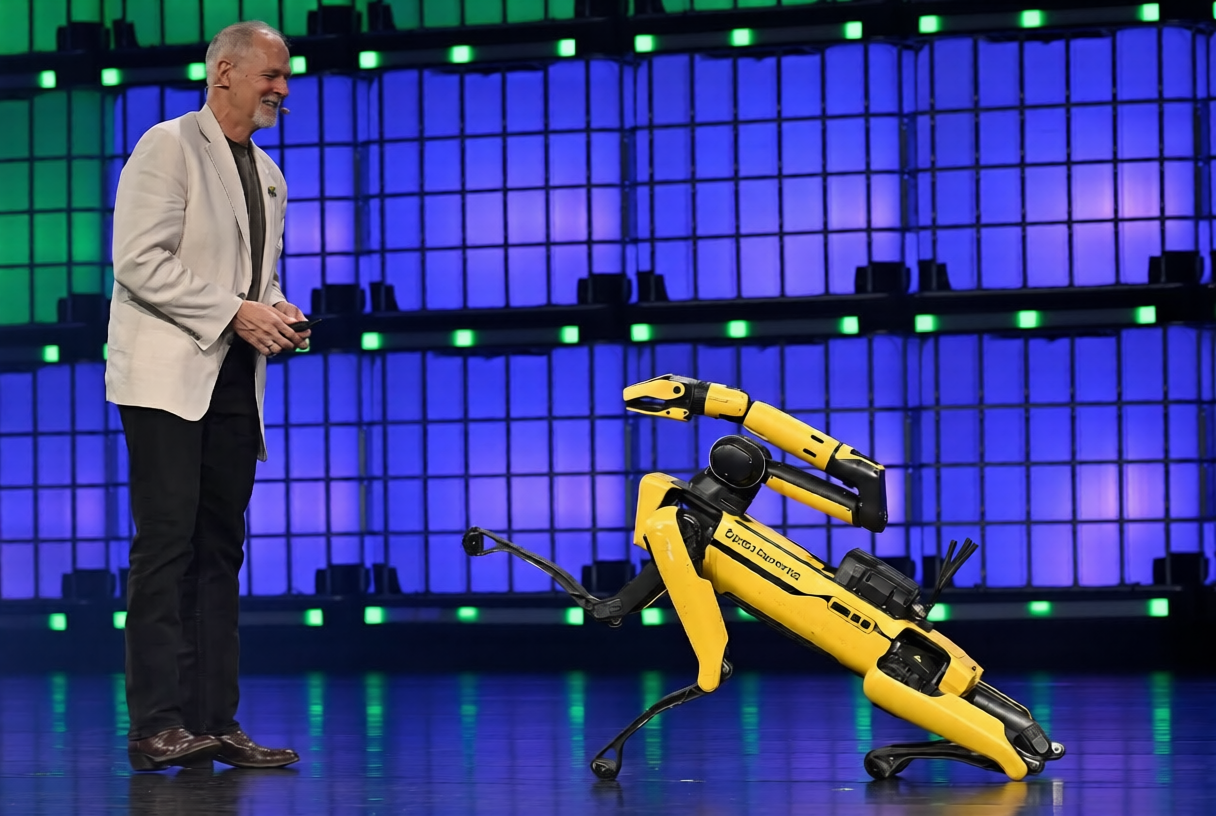
Spot, the four-legged robot dog, found steady demand in industrial inspection and public safety. Stretch, designed for warehouse automation, began rolling out to logistics operators. But the real shift came in 2024, when Boston Dynamics unveiled a completely redesigned electric version of Atlas.
That was not just a product update. It was a strategic reset.
The original Atlas ran on hydraulics and was known for jaw-dropping parkour moves. The new Atlas is fully electric and built with commercial use in mind. It signals Boston Dynamics’ move into the humanoid robot race – a race that has suddenly become crowded and aggressive.
Tesla is building Optimus. Figure AI has raised billions with backing from OpenAI. Amazon has invested in humanoid robotics through Agility Robotics. Chinese firms are pushing lower-cost alternatives into the market.
What was once science fiction is now a capital-fueled land grab.
Boston Dynamics still holds a technical edge in mobility, balance, and advanced control systems. Its robots move with a level of fluidity competitors struggle to match. But technical brilliance does not automatically translate into large-scale commercial success.
That’s where execution matters.
Playter was steering the company through that transition — from research lab icon to enterprise supplier. Hyundai’s acquisition was meant to accelerate that shift. The automaker sees robotics as part of its long-term future in mobility and manufacturing. Humanoid robots working in factories and warehouses are not side projects; they are strategic bets.
Just weeks ago, Boston Dynamics released new videos of Atlas running outdoors and performing dynamic movements. Executives have indicated that pilot deployments with commercial partners are expected soon.
And then the CEO exits.
No successor has been named. No detailed explanation has been given.
That silence leaves room for speculation. Was this planned? Was it strategic realignment under Hyundai? Or were there deeper disagreements about direction, pace, or integration?
What’s clear is that Boston Dynamics is no longer just a robotics lab building impressive prototypes. It is expected to become a revenue-generating robotics business at scale. That requires manufacturing efficiency, supply chain strength, enterprise sales discipline, and cost control — areas where Hyundai’s industrial muscle could help, but also where cultural friction can emerge.
Read also: Meta Android-Style Robotics Platform: How Meta Plans to Power the Future of Humanoid Robots
The humanoid robotics market is heating up fast. Investors are pouring billions into companies promising general-purpose robots that can work alongside humans. The expectations are enormous. The timelines are tight. The competition is well-funded.
Boston Dynamics carries unmatched brand recognition in robotics. But brand alone will not secure contracts or guarantee production at scale. The next phase demands operational precision.
Playter’s departure comes at a moment when momentum seemed to be building. The electric Atlas marked a clean break from the past. Pilot programs were on the horizon. The company was finally positioning itself not just as the most impressive robotics lab in the world, but as a real player in the automation economy.
Now leadership uncertainty enters the picture.
Hyundai’s influence will likely shape what happens next. The conglomerate did not spend over a billion dollars for viral videos. It invested for long-term strategic advantage. That means measurable returns, industrial integration, and clear commercial milestones.
Boston Dynamics stands at a turning point. The technology is strong. The market opportunity is real. But leadership transitions at critical moments can change trajectories.
The robotics world will be watching closely.
Whoever steps in next will inherit one of the most respected names in robotics — and one of its toughest challenges. The future of Boston Dynamics now depends not just on how well its robots move, but on how clearly its new leadership can move the company forward in an increasingly competitive AI-driven world.