


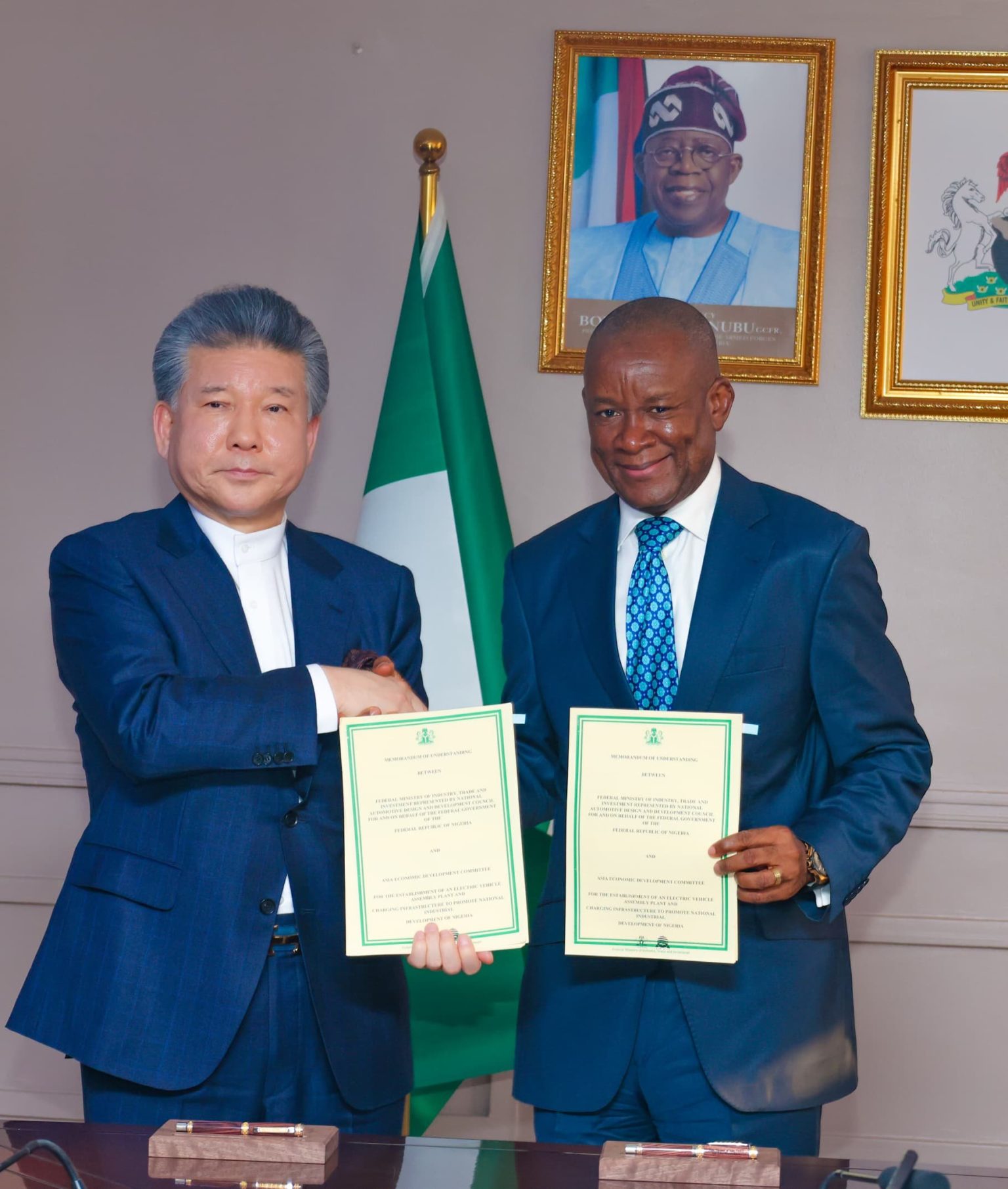
Nigeria has taken a deliberate step toward reshaping its automotive future. On January 30, 2026, the federal government signed a memorandum of understanding with South Korea’s Asia Economic Development Committee to establish an electric vehicle (EV) manufacturing plant in the country. On the surface, it is another industrial agreement. Beneath it, however, lies a strategic attempt to confront decades of structural weakness in Nigeria’s auto sector and redefine how mobility, jobs, and industrial capacity intersect. Before now, all that most citizens know about electric vehicles is the American EV manufacturing giant – Tesla.
The proposed project is ambitious by any standard. Planned to roll out in phases, the first stage will focus on assembling electric vehicles, allowing production to begin while skills, supply chains, and infrastructure are gradually developed. Subsequent phases are expected to move toward full-scale manufacturing, including deeper local integration of components. When fully operational, the plant is projected to produce up to 300,000 vehicles annually and generate about 10,000 direct jobs.
For Nigeria, the numbers matter, but the context matters more. The country’s automotive industry has long struggled with limited local content, high production costs, and weak economies of scale. Locally assembled vehicles often end up more expensive than imported alternatives, making them less attractive to consumers. As a result, Nigeria has become one of the world’s largest importers of used vehicles, bringing in more than 200,000 units every year, according to government data. This dependence drains foreign exchange, suppresses domestic manufacturing, and limits technology transfer.
The EV partnership with South Korea is designed to interrupt this cycle. Electric vehicles offer Nigeria a chance to leapfrog some of the constraints that have weighed down traditional auto manufacturing. With fewer moving parts, EVs can, in theory, lower long-term production and maintenance costs. They also align with global shifts in energy and transportation, positioning Nigeria to participate in emerging value chains rather than perpetually playing catch-up.
Read more: UK’s First Rapid-Charging Battery Train Hits the Tracks: Everything You Need to Know
Still, the government appears aware that manufacturing alone will not be enough. Demand-side support has become a central pillar of its approach. In December 2024, authorities launched a 20 billion naira consumer credit fund worth over $12 million to make locally assembled vehicles, tricycles, and motorcycles more affordable. The goal was clear: stimulate demand, support local producers, and begin nudging consumers away from imported used vehicles.
Infrastructure is another critical piece of the puzzle. In March 2025, the federal government approved a 151.9 billion naira plan to deploy electric mass transit solutions in Nigeria’s northeastern region. Beyond transportation, the initiative signals an effort to integrate electric mobility into public systems, not just private ownership. If executed effectively, such projects could help normalize EV usage and justify further private investment in charging networks and related services.
At the policy level, the South Korea partnership fits into a broader framework Nigeria has been building. The transition to electric mobility is anchored in the National Energy Transition Plan and reinforced by the National Automotive Industry Development Plan. Together, these policies aim to create regulatory clarity, attract investment, and guide Nigeria’s shift toward cleaner and more locally rooted transportation systems.
Yet, the challenges remain substantial. Power supply constraints, logistics bottlenecks, and limited local component manufacturing could slow progress. Without consistent policy execution, incentives risk becoming short-lived headlines rather than durable industrial tools. The success of the EV plant will depend not only on production targets but on whether Nigeria can build reliable supply chains, skilled labor pools, and supportive infrastructure around it.
What makes this moment significant is not that Nigeria is entering EV manufacturing—it is that the country is signaling a willingness to rethink its automotive model entirely. Moving from heavy reliance on imported used vehicles to locally assembled and eventually manufactured electric cars would mark a structural shift with implications for jobs, trade balances, and industrial capability.
The memorandum of understanding does not guarantee success. But it does represent a calculated bet: that Nigeria can use electric mobility as a lever to rebuild an industry that has long underperformed. If the phases materialize as planned and supporting policies hold, this project could become more than a factory. It could become a test case for how Nigeria industrializes in a changing global economy.