

Côte d’Ivoire is producing more rice than ever before. Yet, it is also importing more rice than at any point in its history.
This is the paradox shaping one of West Africa’s most important food markets: rising domestic output alongside surging imports, escalating costs, and deep structural pressure on the national food system. Rice is fast becoming the country’s most important staple, reshaping consumption patterns, trade balances, and agricultural priorities.
A Staple Transformed by Urban Life
Over the past two decades, rice has steadily replaced traditional staples such as cassava, yam, and taro especially in urban centers like Abidjan, Bouaké, Daloa, and Gagnoa. The shift is driven by population growth, urbanization, and changing lifestyles. Rice is easier to store, faster to prepare, and increasingly central to modern diets.
According to estimates from the U.S. Department of Agriculture (USDA), rice consumption in Côte d’Ivoire is growing at an annual rate of 3% to 4%. Per capita consumption has climbed sharply, from about 58 kilograms per person twenty years ago to roughly 84 kilograms today.
Rice now accounts for close to 60% of the country’s total cereal consumption, well ahead of maize, millet, and sorghum. In practical terms, rice has moved from being a complementary food to a daily necessity for millions of Ivorians.
Production Is Rising, But Not Fast Enough
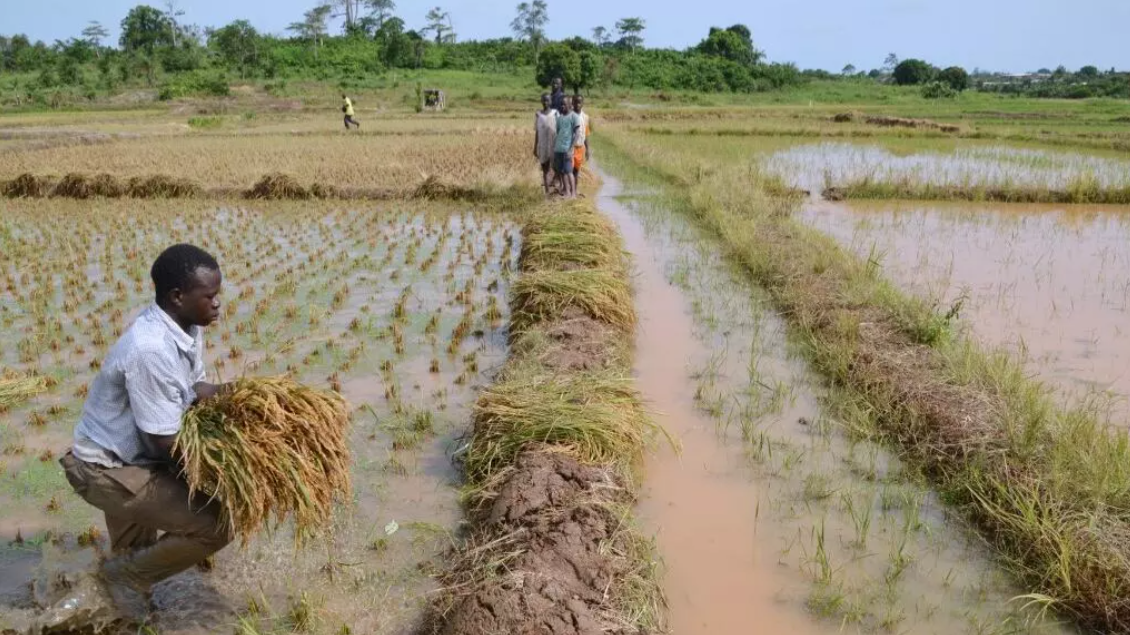
In response to this demand surge, Côte d’Ivoire has made sustained efforts to boost local rice production. These efforts include expanded cultivation areas, improved seed distribution, irrigation projects, and greater policy attention to food self-sufficiency.
The results are visible. Paddy rice production increased from about 1.8 million tonnes in the 2015/2016 season to nearly 2.3 million tonnes in 2024/2025. This represents a meaningful gain and reflects progress in domestic agriculture.
However, consumption growth has outpaced production growth. Annual demand for white rice is now approaching 3 million tonnes. The gap between what the country produces and what it consumes remains large and is widening. Milling losses, quality preferences, and supply chain inefficiencies further reduce the volume of locally produced rice that reaches urban markets in the form consumers demand.
Imports Fill the Gap At a Rising Cost
To bridge this shortfall, Côte d’Ivoire has increasingly turned to international markets. As a result, the country has become Africa’s second-largest rice importer, behind only Nigeria.
Rice imports primarily come from India, Pakistan, Vietnam, and Thailand – countries with large-scale, export-oriented rice industries capable of supplying consistent volumes at competitive prices.
Customs data illustrate how sharply imports have risen. Rice import volumes increased from about 1.14 million tonnes in 2015 to 1.62 million tonnes in 2024. But the more striking figure is the cost.
Over the same period, Côte d’Ivoire’s rice import bill more than doubled, rising from approximately 290.8 billion CFA francs to 609.6 billion CFA francs, according to the 2025 Statistical Yearbook of Ivorian Customs.
This means the country is paying significantly more for it, exposing the economy to global price volatility, currency pressure, and external supply shocks.
Why Local Rice Still Struggles
The persistence of imports despite rising domestic output highlights deeper structural issues. Local rice often struggles with inconsistent quality, limited processing capacity, and higher effective costs once transport, milling, and storage are factored in.
Imported rice, by contrast, arrives polished, standardized, and ready for urban retail markets. For many consumers, especially in cities, imported rice remains the default choice despite policy efforts to promote “made-in-Côte d’Ivoire” alternatives.
This is a systems challenge spanning logistics, finance, infrastructure, consumer trust, and value chain coordination.
Strategic Implications for Policy and Investment
The rice paradox matters because it sits at the intersection of food security, trade balance, and economic sovereignty.
With imports absorbing hundreds of billions of CFA francs annually, Côte d’Ivoire faces mounting pressure on foreign exchange reserves. At the same time, failure to close the production-consumption gap risks long-term dependence on global markets for a core staple.
For investors and policymakers, the opportunity lies not only in growing more rice, but in building resilient domestic rice ecosystems from irrigation and mechanization to milling, branding, and distribution.
Until those systems mature, Côte d’Ivoire’s rice paradox will persist: producing more at home, importing even more from abroad, and paying an increasingly high price for the difference.