


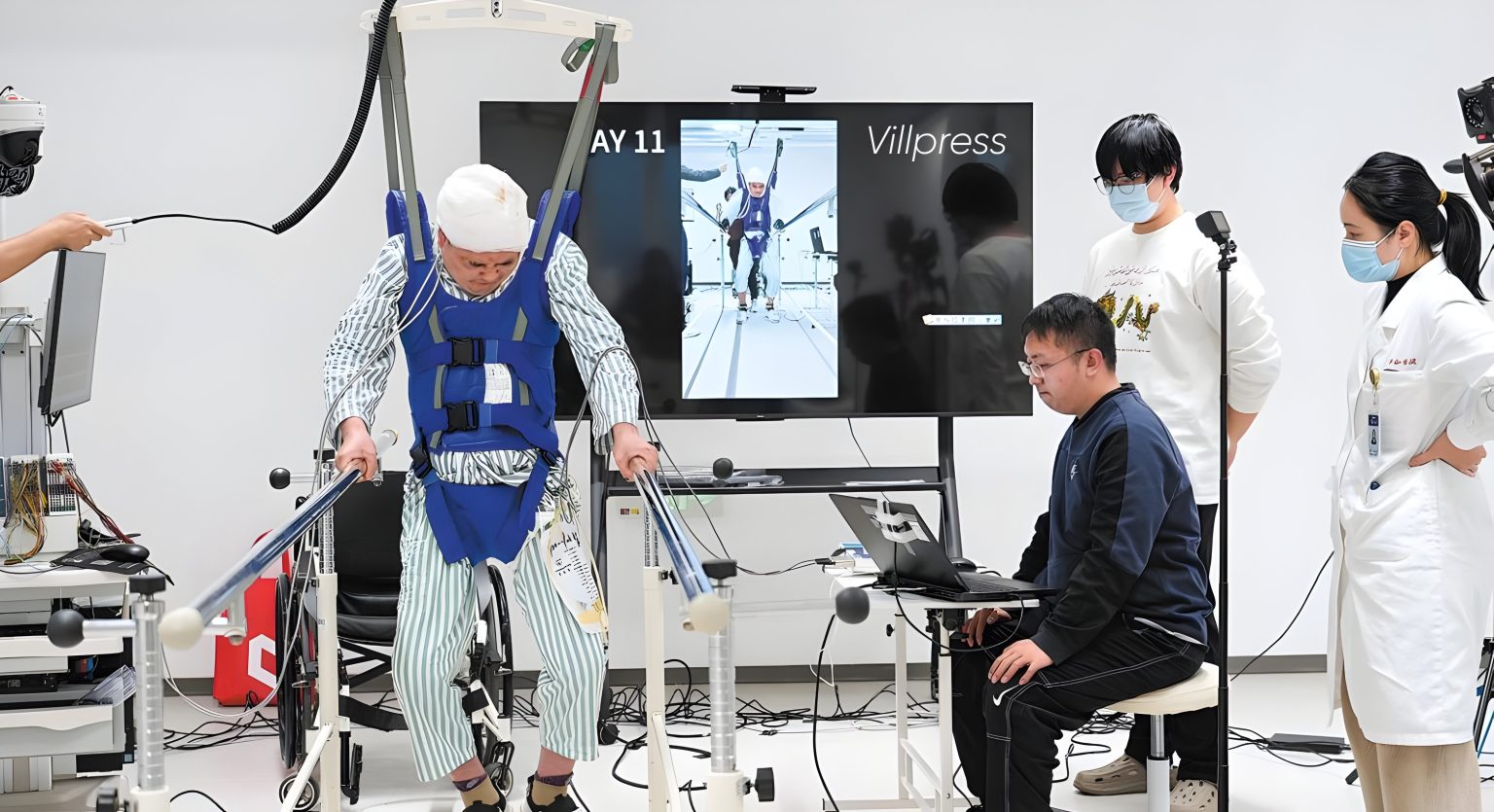
A quiet scientific breakthrough in China could reshape the future of assistive technology globally, and it carries urgent implications for Africa’s healthcare, mobility, and tech markets.
Researchers from Qingdao University and the Hong Kong University of Science and Technology have developed a self-powered eye-tracking device that allows paralysed patients to control machines using nothing more than their eye movements. No batteries. No cameras. Just a blink.
The technology, recently published in Cell Reports Physical Science, uses a nanogenerator to harvest energy from the tiny friction created when an eyelid moves across the eye. That energy powers the system itself, enabling users to interact with devices like wheelchairs, computers, and control panels even in total darkness.
For millions of people living with paralysis or severe mobility impairments, this is a potential giant leap. And for Africa, where access to advanced assistive devices is limited by cost, power infrastructure, and maintenance challenges, the implications are far bigger than a lab result.
A Device That Powers Itself And Why That Matters
The system, known as ET-TENG, relies on a triboelectric nanogenerator (TENG) that converts mechanical motion into electricity. Each blink generates enough energy to power the eye-tracking sensor, eliminating the need for external batteries or charging.
This design choice is elegant and strategic.
Battery dependence has long been one of the biggest barriers to deploying medical and assistive technologies in emerging markets. Devices fail when batteries degrade. Maintenance becomes expensive. Power outages render solutions useless.
By contrast, a self-powered interface built around the human body itself is inherently more scalable for markets like Nigeria, Kenya, Egypt, and South Africa, where reliable electricity cannot always be assumed.
According to the researchers, the device can detect eye movement as small as two degrees with 99% accuracy, outperforming many existing camera-based eye trackers. It also works in complete darkness, removing another major limitation of traditional systems.
From Medical Labs to Real-World Impact
The most immediate application is for people with conditions such as Amyotrophic Lateral Sclerosis (ALS) or spinal injuries – individuals who may lose motor control but retain eye movement.
With ET-TENG, a user could steer a wheelchair, type on a computer, or interact with digital systems using subtle eye gestures. For patients and families, that translates into independence, dignity, and participation in daily life.
But the researchers are clear: this technology goes far beyond healthcare.
Potential applications include:
- Driver fatigue monitoring in smart vehicles
- Hands-free control panels in space exploration and industrial environments
- Lighter, more energy-efficient VR headsets
- Advanced human-computer interaction systems powered by AI
This positions ET-TENG as a medical device, and as a platform technology, one that could underpin multiple industries.
Why Africa and Nigeria Cannot Ignore This
Africa is home to one of the world’s youngest populations, but it also carries a disproportionate burden of disability caused by road accidents, conflict, and limited access to early medical care.
Nigeria alone has millions of people living with mobility impairments, yet assistive technology remains largely imported, expensive, and inaccessible.
A self-powered, low-energy system like ET-TENG changes the equation.
It opens the door to:
- Local manufacturing partnerships
- Affordable assistive devices adapted to African contexts
- Healthtech startups building on open research
- Policy-driven adoption in public hospitals and rehabilitation centers
More importantly, it highlights a broader trend African policymakers and investors need to track closely: the convergence of AI, energy efficiency, and human-machine interfaces.
The Bigger Signal
This breakthrough reflects how quickly global innovation is moving toward systems that are:
- Energy-independent
- Highly sensitive
- AI-ready
- Designed for real-world constraints
For Africa, the risk is that these technologies will arrive without local participation if adaptation comes too late.
The opportunity is clear: engage early, adapt fast, and build ecosystems that turn global breakthroughs into African solutions. Because the next wave of impact technologies will not wait for infrastructure to catch up and neither should Africa.