


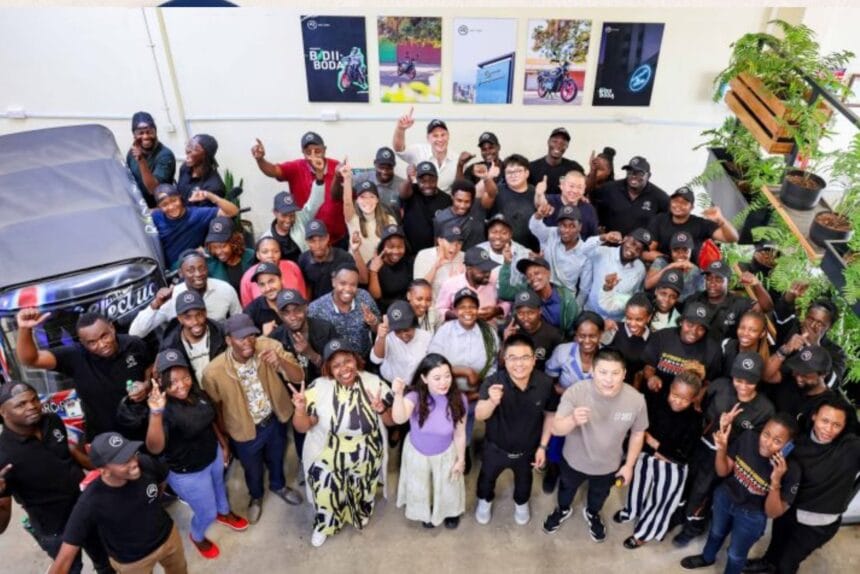
Kenyan electric mobility company ARC Ride has raised $33.3 million in new financing as it moves to expand its electric motorcycle fleet and battery-swapping network across sub-Saharan Africa.
The financing was led by Novastar Ventures and Norrsken22, with participation from the International Finance Corporation (IFC), British International Investment (BII) and Proparco. Existing investors Musashi Seimitsu, a Japanese automotive supplier, and African impact investor Talanton also participated.
The financing includes a debt facility through BII’s Kinetic programme and Mirova, giving the round a combination of equity and debt capital suited to a business that requires significant investment in physical infrastructure.
ARC Ride plans to use the capital to expand its operations across Kenya and enter or deepen its presence in Ghana, South Africa, Tanzania and Uganda. The company also plans to add 5,000 electric motorcycles to its fleet and invest in battery-swapping infrastructure, network reliability, automated swapping, smart charging and renewable-energy integration.
Beyond Electric Motorcycles
The bigger proposition behind ARC Ride is its Battery-as-a-Service model.
Instead of requiring riders to purchase and carry the cost of an expensive battery, ARC Ride allows users to exchange depleted batteries for fully charged ones at dedicated swapping stations. The approach is particularly relevant to commercial motorcycle riders, whose income depends on keeping their vehicles on the road rather than waiting for batteries to recharge.
That makes battery infrastructure as important as the motorcycle itself.
ARC Ride is therefore building a network designed to make electric mobility practical for riders who may otherwise face high upfront vehicle costs, charging downtime and concerns about battery range.
The company says its battery architecture is designed for interoperability, allowing its infrastructure to work with motorcycles from different manufacturers. It is also developing automated swapping and smart-charging capabilities as it scales.
Why the Funding Matters
Africa’s electric mobility market is moving beyond the question of whether electric vehicles can work on the continent. The more difficult question is whether the infrastructure required to operate them can scale economically.
For two-wheelers, battery swapping could provide one answer.
Motorcycles are a major component of commercial and urban transport across many African markets. But electrifying that segment requires more than producing electric motorcycles. Riders need access to affordable batteries, reliable energy and a sufficiently dense network of swapping stations.
ARC Ride is betting that controlling this infrastructure can become a significant part of the electric mobility value chain.
The company’s latest financing is notable for bringing venture investors together with development finance institutions and impact investors. That mix reflects the capital-intensive nature of building physical mobility and energy infrastructure compared with conventional software businesses.
The African Expansion Test
ARC Ride’s next challenge will be taking a model that has been developed in Kenya into markets with different transport systems, regulations, energy infrastructure and rider economics.
The company is targeting Ghana, South Africa, Tanzania and Uganda while continuing to expand in Kenya.
South Africa is already part of that expansion strategy. ARC Ride has piloted its electric motorcycles there and has been developing battery-swapping infrastructure and local assembly capabilities.
The question now is whether ARC Ride can create enough network density in each market for battery swapping to become a reliable alternative to conventional refuelling.
A swap station is valuable when riders can access it conveniently. A motorcycle is valuable when it can remain productive throughout the working day. The economics of the model therefore depend