

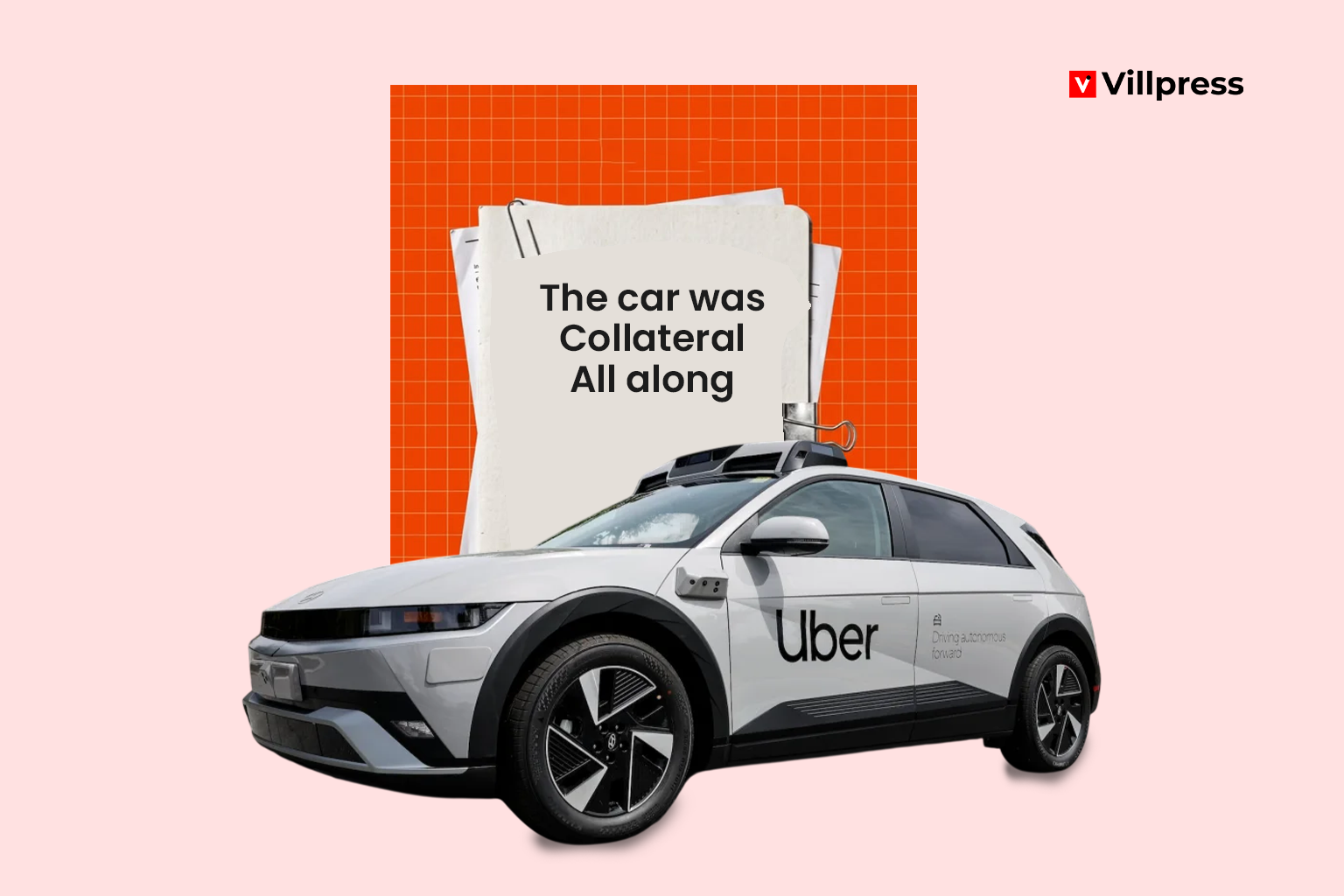
Uber said it was leaving a ride-hailing market. What it actually walked out on was a four-year-old lending scheme it never owned, built on driver-earnings data only its app could produce. The scramble that followed shows where Nigeria’s next mobility fortune will actually be made, and it isn’t inside anyone’s app.
Within hours of Uber shutting off its Nigerian app on September 2, 2026, a different company sent a message to a different set of people. Moove, the Lagos-born vehicle-financing firm that had spent five years putting new Suzukis on Lagos roads for drivers repaying loans against their daily Uber earnings, told those drivers something it had refused to tell them for years: go ahead, drive for Bolt or inDrive too. The instruction sounds like a kindness. It is better read as an admission. For as long as Moove could enforce exclusivity, it did, not out of loyalty to Uber, but because exclusivity was the collateral. Freeing drivers to earn elsewhere was not a courtesy extended once Uber left; it was the only option remaining once the thing Moove was actually lending against had disappeared.
That thing was never Uber’s app, and it was never really the car either. It was a verifiable weekly number, what a given driver earned on a platform only Uber controlled, clean enough for a financier to underwrite a 24-to-48-month loan against it. Nigeria’s papers, in the days since, have mostly asked who inherits Uber’s riders: Bolt, already the country’s largest platform; inDrive, the haggling upstart that beat Uber on price; LagRide, the state-government-linked electric fleet chasing a majority of the Lagos market. That is the correct question for a ride-hailing story. It is the wrong question for this one. The more interesting business Uber leaves behind was never matching riders to drivers. It was making a stranger’s income legible enough to lend against, and that business now has no data feed, no fleet buyer of last resort, and a financing partner reportedly already weighing whether to leave the country too.
What Uber Actually Announced
On September 2, 2026, Uber ended its Nigerian operations, twelve years after launching in Lagos in 2014. It framed the decision, in a notice to users, as the outcome of a review of its business, offered no specific operational reason, and kept a support channel open until September 23 to close out accounts. The same notice, issued to Ugandan users, ended Uber’s business there too. A company spokesperson later told Nigerian and international outlets that the decision was confined to the two markets, did not extend to Uber’s other African operations, and reflected where the company saw itself best able to add value for drivers, language that reads, more plainly, as a decision about where returns justify continued investment.
Nigeria was not a first move. Uber had already left Côte d’Ivoire in 2025 after six years, and Tanzania in February 2026. What remains of its African footprint after Nigeria and Uganda is four markets, Egypt, Ghana, Kenya and South Africa, chosen, on the evidence of which markets survived, for currency stability, sustainable fare levels, or both. The Nigerian exit also landed inside a larger corporate story: Uber has been cutting roughly 3,300 jobs, about a tenth of its global workforce, and one report ties the same week’s restructuring to capital being redirected toward autonomous-vehicle partnerships said to run past $10 billion, a bet placed almost entirely on markets with paved, mapped, regulator-approved roads for a driverless car. Nigeria is not one of them, now or on any visible timeline.
One thing the exit was not, despite the coincidence of timing, was a response to Nigeria’s aviation authority. Weeks earlier, the Federal Airports Authority of Nigeria had quietly ordered Uber and Bolt to stop picking up passengers at federally managed airports, pending new licensing agreements, a dispute over commercial concessions, not a ban, though it produced weeks of stranded travellers and higher taxi fares before FAAN restored Bolt’s access in late August. Uber told Nigerian outlets explicitly that its shutdown was unrelated to the airport dispute, and independent fact-checks corroborate the distinction: one was a fight over a commercial licence at a handful of terminals; the other was a strategic decision about an entire country. That the two arrived so close together, though, is a signal worth returning to.
The Fare That Never Balanced
Uber did not say fuel prices or the naira drove it out, and no internal document has surfaced to confirm that they did. But the market conditions are not in dispute. Nigeria removed its petrol subsidy in 2023; pump prices that year jumped by more than 300%, and by 2026 a litre that cost under ₦1,000 was trading above ₦1,200, with a further 50% spike inside a single fortnight in March, driven by a global energy shock. The naira, over the same period, moved from roughly ₦460 to over ₦1,700 to the dollar at its weakest. Against that backdrop, Uber’s roughly 25% commission was structurally hard to defend: raise it, and drivers who can freely compare take-home pay across four apps on one phone leave; lower it, and the platform’s Nigerian unit economics, never disclosed, and thin by every outside account, get thinner still.
One widely circulated illustration of a Lagos driver’s economics, offered by an industry commentator rather than any platform’s own disclosure, puts a ₦40,000 fare through ₦20,000 of fuel and a 20% commission before a driver sees ₦12,000, and that is before maintenance, insurance, or, for financed drivers, a daily loan repayment.
The number is anecdotal, not audited, but it matches the shape of everything drivers, unions and Bolt’s own commissioned research describe: an economy where roughly three million Nigerians work gig jobs, close to a quarter of them in ride-hailing, and where the industrial action drivers staged against Uber, Bolt and inDrive together in March 2026, logging off simultaneously across Lagos and Ogun State, monitoring compliance at the airport and major transport hubs, was less a labour dispute than a referendum on whether the fare math worked at all.
It is here that the platforms’ divergent bets already show a verdict. Bolt, which tolerates older cars and matches Uber’s commission rate, holds roughly two-thirds of the Nigerian ride-hailing market by one consultancy’s estimate. inDrive, which lets rider and driver haggle and takes a single-digit cut, grew fastest exactly when fuel spiked, and recent driver-preference polling puts it ahead of Uber. Uber tried to compete on service quality inside a market that was increasingly shopping on price. That is a strategy failure worth naming plainly. It is not, on its own, the story.
The Business Underneath the App
The story is what happens to a lending product when its collateral is a stranger’s promise to keep working for one company. Moove was founded in Lagos around 2019–2020 with a straightforward pitch: put drivers who could not get conventional auto loans into new cars, and collect repayment as a cut of what the ride-hailing app paid them each week. The International Finance Corporation, which backed the model with $20 million in 2021, described a product financing up to 95% of a vehicle’s cost over 24, 36 or 48 months.
95% the share of a Nigerian driver’s vehicle Moove’s financing product could cover, repaid through a weekly cut of earnings that only one platform, Uber, could verify.
Drivers, who called their small Suzukis “Uber Korope,” were confined to Uber’s cheapest tier, UberGo, for the length of the loan, not as an administrative rule but, as one financial publication put it in the days after the exit, as the business model itself. Exclusivity gave Moove a single, clean, third-party-verified income statement for every borrower: a genuinely hard thing to build in an economy where most drivers have no payslip, no tax return and no formal credit history. Uber’s app was, in effect, doing Moove’s underwriting for free, or rather, not for free: Uber held equity in Moove, led a $100 million Series B into it in March 2024, and watched it reach unicorn status the following year.
When Uber’s Nigerian app went dark, that underwriting data feed went dark with it. Within hours, Moove told its Nigerian customers they were free to drive for Bolt and inDrive, the flexibility drivers had been requesting for years, and had been refused, because granting it would have scattered a single verifiable revenue stream across three platforms with three different payout structures, three different fee schedules, and no shared reporting standard Moove could underwrite against. Reporting since the exit, citing a person familiar with the matter and a Lagos newsletter that first surfaced the plan, says Moove is now weighing whether to leave the Nigerian market altogether, a claim Moove has not confirmed, and which sits, for now, on the high-confidence-but-single-sourced rung rather than the verified one. What is not contested is the mechanism: a financing book built on exclusivity lost the thing that made it financeable the moment exclusivity ended, and Moove discloses nothing about how large that Nigerian book is or how exposed it now stands.
Where the Money Already Went
Moove’s answer to that exposure has already been visible for a year, and it runs in the opposite direction from Lagos. The same company that built its name financing ₦10-million Suzukis for Nigerian Uber drivers has spent its more recent capital, a $250 million Series C in August 2026, on top of the equity and debt that put its total raised past $460 million, expanding into fleet management for autonomous vehicles, including a partnership managing Waymo’s robotaxis in the United States. Uber’s own restructuring points the same direction: savings from cutting roughly a tenth of its global workforce are reported to be flowing toward autonomous-vehicle partnerships said to exceed $10 billion, aimed at markets with the mapped roads, stable regulation and dollar-denominated fares that make an unmanned fleet financeable.
This is the projection worth stating plainly, and marking as one: if the mobility economics that work best for global capital are increasingly the economics of a fleet nobody has to individually underwrite, an owned or leased vehicle, a predictable route, a controlled environment, no daily negotiation with a human borrower over how much of this week’s fares go to the loan, then Nigeria’s market, with its currency risk, its subsidy-shocked fuel price and its atomised, self-employed driver base, sits near the bottom of that list. Not because Nigerians won’t pay for rides, but because the underwriting problem Moove solved with exclusivity is precisely the problem autonomy is built to remove. Uber and its financing partner are not abandoning the economics of vehicle lending. They are following it to where it is easier to price.
A Moat Made of Paperwork
If the lending layer is retreating from Nigeria, the regulatory layer is becoming more, not less, important to whoever remains. FAAN’s late-July directive, instructing Bolt’s and Uber’s airport operators to halt commercial pickups at federally managed airports pending concession agreements, was not aimed at ending e-hailing. It was a demonstration that a government agency, not an app’s user base, decides who gets to serve the country’s highest-value pickup points, and on what commercial terms. The dispute cost Bolt weeks of airport access and cost travellers weeks of higher taxi fares before a licence was worked out; FAAN has since said, more than once, that it was never trying to ban the platforms, only to bring them inside a concession framework the authority controls.
That framework is a moat regardless of intent. A platform that can negotiate and hold a federal concession, register drivers through a state’s preferred digital system, and absorb the compliance overhead of doing so at every major Nigerian airport has an advantage no fare algorithm can replicate, and it is an advantage state-linked operators are structurally better placed to hold than a foreign platform managing the relationship from outside the country. LagRide, backed by the Lagos State government and automotive assembler CIG Motors, does not need to lobby a regulator it is partly aligned with.
The Fleets Betting the Old Model Is Over
LagRide’s answer to the underwriting problem is not to solve it with better data, as Moove tried. It is to remove the driver-as-borrower relationship altogether. The company says it has put more than $260 million of combined state and CIG Motors capital into a fleet it owns outright, reported at more than 6,000 vehicles, with a first tranche of electric cars now on the road claiming a 333-kilometre range and 30-minute fast-charge times, and leases access to drivers rather than selling them a loan to escape. It says it is targeting 70% of the Lagos e-hailing market and claims drivers can earn up to ₦240,000 a day, a company figure that, like Moove’s loan-book size, has not been independently audited. Whether or not that number holds up, the structural bet is coherent: if the daily-repayment relationship is what makes drivers vulnerable to a platform’s departure, own the fleet and remove the loan.
Shuttlers is running a different experiment against the same diagnosis. Rather than compete for the individual rider Uber left behind, the Lagos company, which has completed more than ten million scheduled journeys since 2016, running some 430 buses across three cities largely for corporate clients, used the same week Uber shut down to launch Shuttlers Pod, a scheduled, shared, door-to-door car service explicitly positioned against the volatility of on-demand pricing. Its chief executive framed the timing around Nigeria’s rising cost of living rather than Uber’s exit specifically, but the sequencing is hard to miss: a recurring-revenue, corporate-anchored operator moving into consumer mobility in the same week the country’s most prominent on-demand platform proved how quickly on-demand can disappear. Shuttlers has raised a comparatively modest $5.6 million across its history, a fraction of what Moove alone has borrowed and raised, which says something about how much less capital a scheduled, contract-backed model needs relative to one built on financing individual vehicles one driver at a time.
What the Rest of the Continent Is Telling Investors
Widen the lens past Nigeria and the same reallocation shows up in where African investors are actually writing cheques. Continent-wide funding into electric mobility more than doubled in the first half of 2026 alone, about $400 million, against $170.8 million for the whole of 2025, while broader logistics and transport-startup funding, the category that includes software-first, asset-light plays, fell from a $623 million peak in 2022 to roughly $113.7 million in the first half of 2025 before a partial recovery. One analysis of the disclosed 2025–2026 deals found capital clustering around five business models, charging infrastructure, battery-swapping networks, fleet electrification, vehicle financing and receivables-backed lending, and noted, pointedly, that no African EV software company offering routing, charging optimisation or fleet-management tools had raised a significant round in the same window. Investors, in other words, are paying for batteries, chargers, vehicles and the right to collect on a loan against them. They are not, at scale, paying for the app that coordinates any of it.
That is the same lesson Moove is relearning in real time, at Uber’s expense rather than its own choosing: in African mobility right now, the software layer is not where the moat lives. Owning the physical asset, or holding the paper on someone else’s ownership of it, is.
What to Watch
None of what follows is a forecast dressed as a fact. Whether Moove formally exits Nigeria, and how large a loan book it leaves exposed if it does, is the clearest test of whether exclusivity-based vehicle financing can survive without an exclusive platform behind it; if Moove instead restructures its Nigerian book around Bolt or inDrive data, that would be the strongest evidence the model can be rebuilt on a different foundation rather than only on Uber’s. Whether Bolt or a fleet-leasing partner such as South Africa’s MyNextCar, in which Bolt has already invested to help secure its own vehicle supply, moves further into owning or financing the cars its drivers use is worth watching as a hedge against exactly the dependency that just broke Moove’s Nigerian book. Whether LagRide’s claimed ₦240,000-a-day driver earnings and 70%-market-share target survive contact with Lagos traffic and grid-dependent charging infrastructure will say more about the EV bet than any pilot announcement. And whether FAAN’s airport concession framework, once finalised, becomes a template other state governments copy, turning regulatory relationships into a durable advantage independent of any single company’s app, would confirm that compliance, not commission structure, is where the next edge in Nigerian mobility gets built.
The Loan Nobody Underwrote Twice
Uber’s twelve years in Nigeria will be remembered, correctly, as a ride-hailing story: a market it helped build, a commission structure it could not defend, and two rivals who read the country’s fuel prices better than it did. But the more durable lesson sits one layer beneath the app, in a financing product built on a data-exclusivity clause that only ever worked because one company controlled the ledger. Nigeria did not lose a taxi service on September 2, 2026. It lost the entity willing to make a stranger’s earnings legible enough to lend against, and watched, within hours, the company that had built a multi-billion-dollar valuation on that legibility hand its own drivers the freedom that broke its model, then quietly keep financing robots in California instead.
The next fortune in Nigerian mobility will not go to whoever builds the best app to replace Uber’s. It will go to whoever works out how to lend against a Nigerian driver’s future earnings without needing a single foreign platform’s permission to read them.