



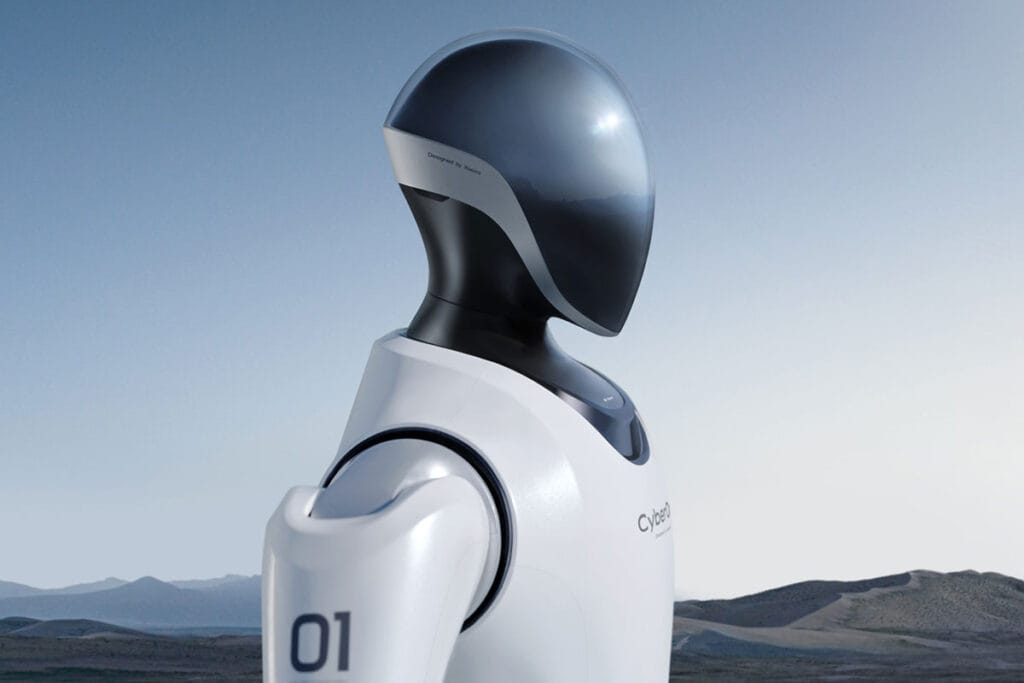

Xiaomi has begun trialing its self-developed humanoid robots in its electric vehicle production plant, with the company likening their current role to that of “interns” in a real manufacturing environment. The update, shared by Xiaomi President Lu Weibing in an interview with CNBC’s Arjun Kharpal at Mobile World Congress on March 4, 2026, follows CEO Lei Jun’s March 2 announcement that the robots had started autonomous operations at the factory.
In the trial, two humanoid robots completed 90% of the work at a self-tapping nut installation station over a continuous three-hour run, achieving a 90.2% success rate while meeting the production line’s fastest cycle time of 76 seconds. Tasks included installing nuts and moving materials, repetitive, precision-demanding jobs that remain among the few areas still requiring human intervention even in highly automated EV plants.
Lu described the deployment as early-stage: “The robots in our production lines weren’t doing an official job, more like the interns,” he told CNBC. The biggest challenge, he added, is maintaining the required pace without slowing the line. This “internship” framing signals supervised learning and limited scope, typical for introducing new automation on live floors, rather than full replacement of human workers.
Xiaomi first unveiled its general-purpose humanoid robot, CyberOne, in 2022, showcasing capabilities like emotion recognition, object handling, and bipedal walking. The current trial represents a key milestone in moving from lab demos to real-world industrial application. Lei Jun has projected that “large numbers of humanoid robots will enter Xiaomi factories to work within the next five years,” positioning the company to leverage embodied AI for smart manufacturing gains.
The move fits Xiaomi’s broader ambition in EVs and robotics. The company launched its SU7 electric vehicle in 2024 and has invested heavily in automation to compete with Tesla, BYD, and Nio. Humanoids could help close remaining productivity gaps in high-mix, low-volume tasks that traditional robotic arms struggle with due to flexibility needs.
For Lagos and African tech observers, Xiaomi’s progress is noteworthy. As Chinese firms like Xiaomi, Unitree, and Fourier Intelligence accelerate humanoid deployment, while Tesla’s Optimus and Figure AI push in the U.S., the race for industrial robotics could influence global supply chains, cost curves, and adoption in emerging markets. Africa, with its growing manufacturing ambitions (e.g., Nigeria’s auto assembly push), may benefit from cheaper, more adaptable robots in the coming years.
The trial also highlights practical hurdles: achieving consistent 99+% reliability (human-level on assembly lines), handling edge cases, and integrating with existing automation without disruptions. Xiaomi’s use of in-house vision-language-action models (Xiaomi-Robotics-0) and reinforcement learning shows a focus on fluid, predictive motion, key for factory readiness.
While still far from mass deployment, Xiaomi’s “intern” robots signal that humanoid robotics is transitioning from hype to incremental factory integration. If the company scales successfully, it could reshape productivity in EV manufacturing, and set a blueprint for other industries chasing automation in high-labor-cost or precision-heavy environments.


 English
  简体中文
简体中文  Čeština
  Deutsch (Sie)
  Français


