


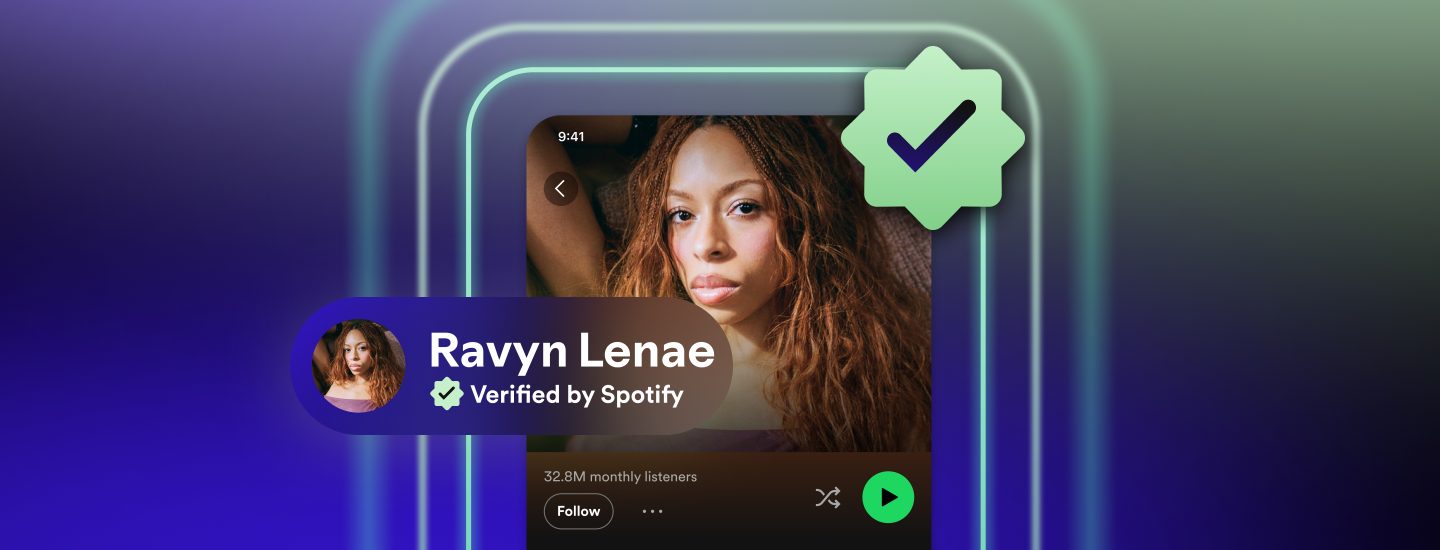

Spotify has introduced a new “Verified by Spotify” badge, a feature designed to clearly identify authentic human artists on its platform as artificial intelligence continues to reshape how music is created and distributed.The update, announced via Spotify’s official newsroom, places a visible verification marker on artist profiles, signaling that an account has been confirmed by the platform. While verification has existed in different forms before, this move comes at a time when AI-generated music and virtual artists are rapidly increasing, raising new questions about identity and authenticity.
The rise of AI in music has changed a fundamental assumption: that every voice belongs to a person.Today, songs can be generated at scale, voices cloned, lyrics written, and entire artist personas created without human involvement. For listeners, this creates a new kind of uncertainty. Not about quality, but about origin.Spotify’s verification badge responds directly to that shift. It introduces a simple but powerful layer of clarity: this artist is real, and has been confirmed as such.
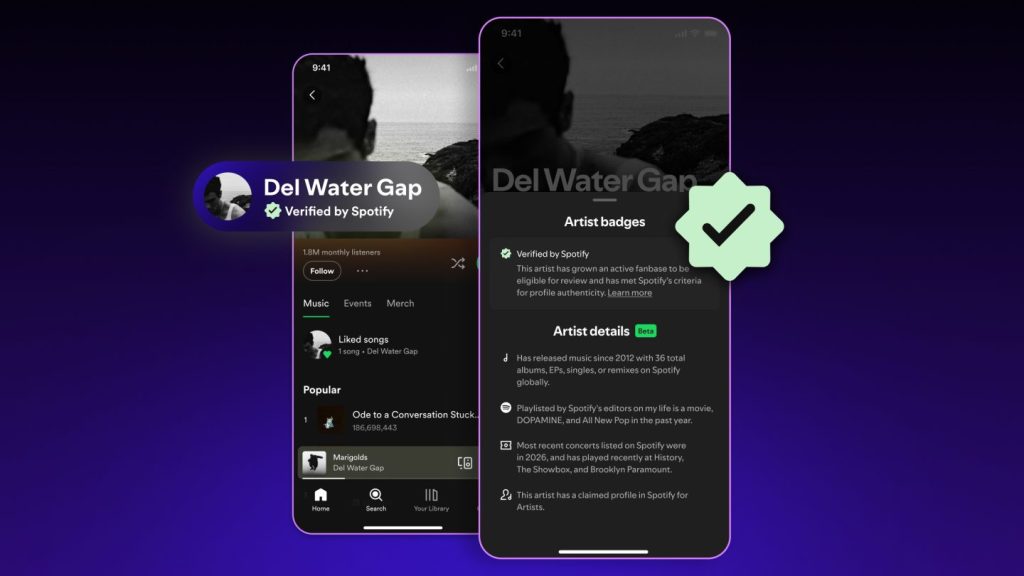
Spotify’s move is less about status, and more about structure
According to Spotify, the “Verified by Spotify” badge is intended to help users better understand who they are listening to, while reinforcing trust across the platform.
The feature:
- Confirms the authenticity of artist profiles
- Distinguishes verified human creators from unverified or potentially AI-driven accounts
- Provides a clearer identity layer within Spotify’s discovery ecosystem
Rather than positioning itself against AI, Spotify’s approach signals something more measured: the need for transparent labeling as both human and AI-generated content coexist.
When creation scales, clarity becomes necessary
AI has dramatically lowered the barrier to music creation. What once took weeks in a studio can now be generated in minutes. But scale introduces imbalance. Human artists create from experience, time, and emotion, factors that don’t scale in the same way algorithms do. Without clear labeling, AI-generated content could easily flood discovery systems, competing directly with human creators on unequal terms.
By introducing verification, Spotify is attempting to preserve a sense of context around creativity, not just what is being heard, but who is behind it.
The quiet risk of a blurred ecosystem
Without identification, the distinction between human and machine-made music doesn’t disappear, it simply becomes invisible.
That invisibility carries consequences:
- Listeners may unknowingly engage with synthetic content
- Human creators risk losing recognition in an oversaturated system
- Trust in platforms can erode if authenticity becomes unclear
The verification badge acts as a counterbalance, a small but visible intervention in a system that is rapidly becoming more complex.
Not a rejection of AI, but a call for transparency
Spotify’s decision does not limit or remove AI-generated music. Instead, it introduces structure in how content is understood.
As AI continues to evolve, platforms are increasingly faced with a new responsibility: not just to distribute content, but to contextualize it.
The “Verified by Spotify” badge reflects that shift. It acknowledges that the future of music will likely include both human and AI creators—but insists that the difference between them should remain visible.
A small badge, carrying larger Implications
What Spotify has introduced is technically simple, a verification marker.But culturally, it signals something much larger.In an era where technology can replicate voice, style, and identity, labeling is no longer optional. It becomes the foundation for trust, fairness, and informed choice.And as other platforms confront the same reality, Spotify’s move may prove to be less of a feature, and more of a precedent


 English
  简体中文
简体中文  Čeština
  Deutsch (Sie)
  Français


