


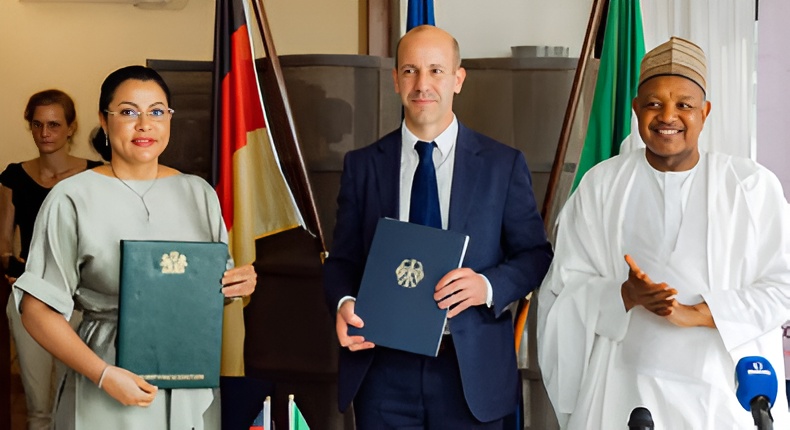

When Germany and Nigeria signed a €365 million development and investment partnership in Abuja last week, the headline figure immediately attracted attention.
At first glance, the agreement appeared to be another foreign funding announcement—a sizeable commitment from Europe’s largest economy to Africa’s most populous nation.
But beyond the headline figure lies a more strategic story: one about confidence, long-term positioning, and Nigeria’s place in the global investment landscape.
More Than a Financial Package
The partnership is structured around two key components.
The first is €65 million in development cooperation, targeting energy, agriculture, healthcare, skills development, and private sector growth.
The second—and larger—component is a €300 million export credit guarantee facility, designed to reduce risk for German companies and financial institutions investing in Nigeria.
In effect, the deal does not represent a direct cash transfer of €365 million. Instead, it establishes a financial framework that enables investment flows, encourages private sector participation, and lowers the barriers for cross-border commercial engagement.
That distinction is critical.
A Strategic Signal, Not Just Aid
International funding agreements are rarely driven by goodwill alone. They reflect calculated assessments of risk, opportunity, and long-term returns.
Germany’s decision to expand economic cooperation with Nigeria signals continued confidence in the country’s market potential, despite persistent challenges such as inflation, currency volatility, and infrastructure gaps.
With a population of more than 220 million people, a fast-growing digital economy, and significant opportunities in energy and agriculture, Nigeria remains one of Africa’s most strategically important markets.
The message embedded in the agreement is clear: Nigeria remains a country worth engaging with at scale.
Focus on Key Development Sectors
The partnership targets sectors central to Nigeria’s economic transformation.
Energy remains a priority, particularly efforts to expand electricity access and improve industrial productivity.
Agriculture continues to be critical for food security and export diversification.
Healthcare development is essential for strengthening public systems and improving outcomes.
Skills development is increasingly urgent, given Nigeria’s rapidly growing youth population and the demand for employable capabilities in a competitive global economy.
By concentrating on these areas, the agreement aligns with Nigeria’s broader development priorities.
Private Sector at the Centre
A notable feature of the deal is its emphasis on private sector participation.
Global development financing is increasingly shifting from traditional aid models to investment-driven frameworks that encourage commercial viability.
Germany’s export credit guarantee facility reflects this shift. By reducing financial risk, it encourages companies to finance and implement projects that are commercially sustainable.
For Nigeria, this model carries potential benefits: increased investment inflows, job creation, technology transfer, and industrial expansion.
However, outcomes will depend heavily on execution and regulatory stability.
Building on Existing Cooperation
Germany already plays a significant role in Nigeria’s power sector through the Presidential Power Initiative, implemented in partnership with Siemens.
That programme focuses on strengthening transmission infrastructure and improving electricity supply nationwide.
The new agreement expands this cooperation beyond energy into a wider range of economic sectors, signaling a deepening and broadening of bilateral relations.
What It Means for Nigeria
At its core, the partnership is less about the size of the financial package and more about what it represents.
It reflects growing international attention on Nigeria’s reform trajectory and its long-term economic potential.
It also reinforces Nigeria’s position as a key economic hub in Africa, both as a large consumer market and a gateway to regional trade.
Yet, the effectiveness of such agreements ultimately depends on domestic factors—policy consistency, governance quality, and the ability to translate commitments into real, functioning projects.
The Bigger Picture
In a global environment where capital is increasingly competitive, perception plays a powerful role.
Countries that attract structured, credible partnerships gain more than funding, they gain legitimacy in the eyes of global investors.
Germany’s €365 million engagement with Nigeria fits into this broader pattern.
It is both an investment framework and a strategic endorsement of Nigeria’s long-term potential.
While the financial figure is significant, the stronger message is symbolic: one of Europe’s most powerful economies is betting that Nigeria remains central to Africa’s economic future.


 English
  简体中文
简体中文  Čeština
  Deutsch (Sie)
  Français


