


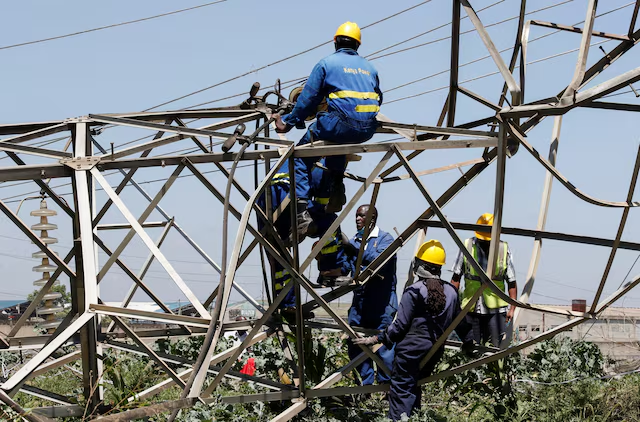

On the evening of December 9, 2025, a disturbance rippled through the regional Kenya-Uganda interconnected power network. Kenya Power traced the issue to an incident on the shared system, restoring electricity to most areas within roughly 30 minutes. Internet, however, lagged far behind. According to Cloudflare’s Q4 2025 Internet disruption summary, national traffic dropped as much as 18 percent, with the heaviest impacts in Nakuru and Kiambu counties. Connectivity remained erratic from about 19:15 to 23:00 local time, nearly four hours of degraded service.
For remote workers scattered across Nairobi’s suburbs and satellite towns, the timing could not have been worse. Video calls dropped mid-pitch. Code pushes to overseas repositories timed out. Collaborative tools like Slack and Google Workspace stalled. In a country where thousands earn through freelance platforms, outsourced development, or global customer support roles, those hours translated directly into lost billable time and strained client relationships.
This sequence, power flicker followed by prolonged internet recovery, has become depressingly familiar in Kenya.
The country benefits from a solid lineup of submarine landing points in Mombasa: TEAMS, SEACOM, EASSy, PEACE, and others provide theoretical redundancy. Yet real-world resilience remains limited. When terrestrial backhaul or power feeds to coastal stations falter, or when inland fiber routes concentrate risk, a single upstream failure cascades nationwide. Earlier examples illustrate the pattern. In May 2024, faults on SEACOM and EASSy off South Africa’s coast slowed East African traffic for days, with Kenya among the hardest hit.
Power-grid fragility amplifies every cable or routing issue. Telecom towers, exchange points, and data centers depend on stable electricity; when the grid trips, recovery involves sequential reboots and synchronization that stretch far beyond the utility’s restoration timeline. The December 9 event followed this script precisely. Kenya Power fixed the immediate disturbance quickly, but Cloudflare data showed internet traffic only gradually returning as infrastructure stabilized.
Demand keeps outpacing fixes. The Communications Authority of Kenya reported that available international bandwidth held steady around 22,154 Gbps through late 2024 into early 2025, but by Q2 2025 (April-June), it had dropped 12.5 percent to roughly 19,381 Gbps due to adjustments on major undersea cables like SEACOM and EASSy. Utilization climbed to a record 55 percent, raising risks of congestion despite rising demand.
Kenya’s digital economy has leaned heavily into this connectivity bet. Nairobi’s startup scene, fintech clusters, and outsourcing firms thrive partly because talent can plug into global markets from relatively low-cost bases. Post-pandemic, remote and hybrid models became entrenched. Developers, designers, writers, and support specialists now routinely bill clients in higher-currency economies while based in Kenya. Stable broadband is not a nice-to-have; it is the revenue pipeline.
Outages erode that edge. A freelancer on Upwork or Fiverr loses hourly earnings the instant the connection severs. A distributed engineering team misses syncs with U.S. or European counterparts. Cloud-reliant workflows, GitHub Actions, AWS consoles, API integrations, grind to a halt. Home setups rarely match corporate UPS redundancy; solar backups or small inverters deplete quickly during extended dips.
Alternatives exist but fall short for many. Starlink brought satellite relief, with latency dropping sharply, by as much as 87 percent in some metrics, from around 296 ms to 39 ms, after a Nairobi point-of-presence launched in January 2025. Yet high upfront equipment costs and monthly fees deter widespread adoption among mid-tier remote workers, limiting it mostly to higher-earning professionals or areas with poor terrestrial options.
Policy and investment conversations continue. Workshops highlight the need for deeper cable burial, better fishing-zone coordination, AI monitoring, and upgraded inland backhaul. New systems like 2Africa expansions promise more capacity. Yet as 2026 progresses, the core vulnerabilities, shallow coastal segments, grid interdependencies, concentrated landing infrastructure, remain unaddressed at scale.
The December 2025 incident slipped into the rearview as another data point rather than a catalyst for systemic overhaul. Bandwidth demand shows no sign of plateauing. Remote talent pools keep growing, drawn by Kenya’s blend of affordability, English proficiency, and lifestyle appeal.
Without accelerated redundancy across sea, land, and power layers, the interruptions will recur. Another grid disturbance will arrive, routers will struggle back online, and screens across thousands of home offices will go dark mid-sentence. The economic drag is quiet but cumulative, lost productivity, eroded trust from international partners, and a subtle shift in where companies choose to source remote labor. Kenya’s ambition to remain East Africa’s digital hub hangs, in part, on threads and transformers that have yet to prove fully dependable.


 English
  简体中文
简体中文  Čeština
  Deutsch (Sie)
  Français


