


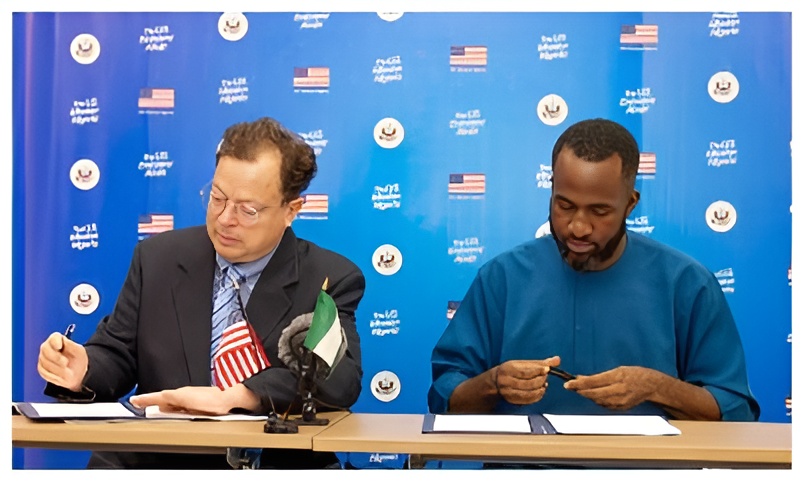

The U.S. Embassy in Abuja has made a move that signals something quietly significant about how Washington is thinking about Nigeria’s technology future. The Embassy announced the signing of a three-year Memorandum of Understanding with the Ilorin Innovation Hub, marking its first public-private partnership outside the American Spaces Network. It is a modest announcement on the surface, but the choice of Ilorin as the first partner of this kind carries more strategic weight than the press release lets on.
The collaboration will expand U.S. engagement in Kwara State’s growing technology sector and deliver programming focused on artificial intelligence, STEM education, and professional development. Through the agreement, the Embassy and the Ilorin Innovation Hub will deliver programs that highlight American leadership in technology and innovation, provide business English and STEM training, and equip Nigerian professionals with skills aligned to U.S. industry needs.
Speaking at the signing ceremony, U.S. Embassy Public Diplomacy Counselor Lee McManis described the agreement as “an important milestone” that advances innovation-driven trade and investment opportunities between the United States and Nigeria, adding that Kwara State is developing as a tech innovation center and that American companies are already seeking opportunities to compete and collaborate in this growing market.
That last point is worth sitting with. American companies scouting opportunities in Ilorin is not the kind of sentence anyone would have written five years ago. Lagos dominates nearly every conversation about Nigerian tech, and for understandable reasons. The concentration of capital, talent, and infrastructure there has made it the continent’s most visible startup city. But the ecosystem is beginning to spread, and Ilorin is one of the more credible bets on where it goes next.
The Ilorin Innovation Hub officially commenced operations in early 2025, launching incubation and acceleration programmes aimed at nurturing digital talents and catalysing economic empowerment in Kwara State. The hub is a state-of-the-art facility developed as an initiative of the Kwara State Government in partnership with IHS Nigeria. Its structured programs, delivered in partnership with Co-creation Hub (CcHub) and Future Africa, concentrate on areas including artificial intelligence, agricultural technology, energy innovation, and entrepreneurship.
Since its launch, the hub has positioned itself as both an incubation centre and a regional ecosystem builder, having supported 23 startups to venture readiness within 10 months, according to the hub’s programme lead. That is a meaningful output for a facility barely a year into operations, and it helps explain why the U.S. Embassy looked here rather than defaulting to an established Lagos-based organisation.
Managing Director Temi Kolawole, who helped bring the hub to life, has described it as a government-backed initiative designed to drive the growth of innovation and technology in the state, one that grew out of a conversation with the Kwara State governor shortly after he took office. That origin story matters because it illustrates a model increasingly common in emerging African tech ecosystems: government as initiator and convener, with private sector partners brought in to operationalise and scale. It is distinct from the Lagos model, where most hub activity has been driven from the bottom up by founders and investors.
At the hub’s Demo Day held on April 17, venture capitalists, corporate executives, policymakers, and founders gathered in Kwara State’s capital, a gathering that would have seemed aspirational not long ago. Kolawole noted at the event that innovation is not just a Lagos or Abuja conversation but a Nigeria conversation, and that the hub is designed not only to support startups but also to attract investors who may have previously focused exclusively on Nigeria’s commercial capital.
The American Spaces Network, against which this partnership is being framed as a departure, is itself an extensive operation. There are 29 American Spaces across Nigeria, serving as hubs for cultural exchange, information access, and skills development. The decision to extend the Embassy’s programmatic reach beyond that network to partner directly with a private innovation facility is a structural shift, not just a symbolic one. It suggests Washington sees value in attaching its brand and programming to locally grown institutions that have already earned credibility in their regions.
For the Ilorin Innovation Hub, the partnership brings something no amount of government funding alone can provide: international legitimacy and, potentially, a pipeline to U.S. companies, institutions, and grant-making bodies. For the U.S. Embassy, it extends soft power infrastructure into a region where American presence has historically been thinner, and it does so without the overhead of building a new American Space from scratch.
Nigeria’s broader tech funding environment remains challenging. The wave of venture capital that washed over Lagos-based startups in 2021 and 2022 has receded significantly, and founders across the country are navigating a harder fundraising climate alongside currency volatility and persistent infrastructure gaps. In that context, partnerships that offer training pipelines, professional networks, and access to international markets carry real weight. They are not a substitute for capital, but they are not nothing either.
What the three-year MOU does not do is specify the kind of dollar figures or programmatic targets that would allow anyone to hold either party accountable for outcomes. The Embassy has not disclosed funding commitments, and the agreement as announced is light on measurables. That is a common limitation of diplomatic MOUs, which tend to function more as frameworks for goodwill than binding contracts. The value of this one will ultimately be determined by the quality of programming that follows, and whether the skills and connections it promises actually translate into opportunity for the Kwara State professionals it is meant to serve.
Still, the geography of the decision is hard to ignore. Ilorin is a city long associated with academia and religious scholarship, not startup culture. The fact that a U.S. Embassy chose it as the first site for a new class of partnership says something about how the map of Nigerian tech ambition is being redrawn, and who is paying attention.


 English
  简体中文
简体中文  Čeština
  Deutsch (Sie)
  Français


