


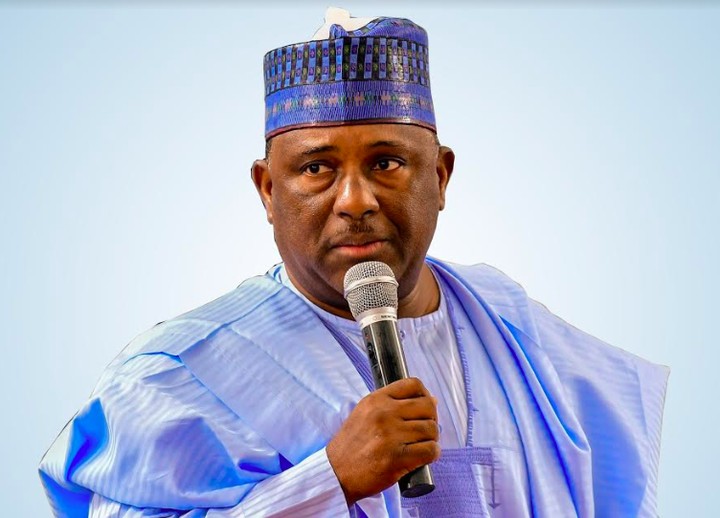

Nigerian billionaire Abdul Samad Rabiu is preparing to collect approximately N806 billion ($574 million) in dividend payouts from his two flagship listed companies, BUA Foods and BUA Cement, in what represents one of the largest single-year cash extractions by an individual from Nigerian equities in recent memory.
The payouts stem directly from strong 2025 results posted by both companies. BUA Foods proposed a final dividend of N28 per share, resulting in a total distribution of N504 billion ($364 million). BUA Cement recommended N10 per share, amounting to N338.6 billion ($248.2 million). With Rabiu owning 92.64% of BUA Foods and 95.78% of BUA Cement, the overwhelming majority of these funds, roughly N467 billion from foods and N324 billion from cement, will flow to him and entities under his control.
This is not sudden wealth creation through a sale or new investment. It is the harvesting of years of retained earnings built through heavy industrial investment, operational scaling, and resilience in one of Africa’s toughest macroeconomic environments. Rabiu founded BUA Group in 1988 as a modest trading outfit. Over nearly four decades, he transformed it into a diversified industrial powerhouse spanning cement manufacturing, sugar refining, flour milling, pasta production, and edible oils.
BUA Foods delivered impressive numbers for the year ended December 2025: revenue reached N1.77 trillion, up 16% year-on-year, while profit after tax almost doubled to N518.4 billion. The proposed N28 per share dividend is more than double the N13 paid in 2024, reflecting confidence in the company’s expanded capacity across key food categories. BUA Cement’s turnaround was even sharper. Profit after tax surged over 380% in 2025, helped by higher volumes, improved pricing, and a significant reduction in foreign exchange losses that had previously dragged on earnings. The N10 per share dividend marks a nearly four-fold increase from the prior year.
For Rabiu, these dividends provide substantial liquidity at a time when his estimated net worth has climbed toward the $12 billion mark. They also highlight a core philosophy that has defined his business approach: build at scale, operate efficiently, and return capital when the numbers justify it. Unlike some conglomerates that prioritize endless reinvestment or aggressive debt-funded expansion, BUA has maintained a disciplined rhythm of growth alongside meaningful shareholder distributions.
The structure of ownership means minority investors also benefit, though on a much smaller scale. Rabiu’s son, Khalifa Rabiu, who holds a 2.63% stake in BUA Foods, stands to receive around N13.2 billion — still a life-changing sum for most, but a fraction of the founder’s haul. This concentration of rewards is typical in Nigeria’s listed industrial sector, where founder-led models often deliver strong long-term performance precisely because of aligned incentives and decisive execution.
From a broader market perspective, the scale of these payouts is notable. Nigeria’s equity market has seen renewed interest in fundamentally strong industrial and consumer stocks that can generate real cash flows despite inflation, currency volatility, and infrastructure deficits. BUA’s ability to nearly double food profits and deliver triple-digit growth in cement earnings demonstrates that large-scale domestic manufacturing can still produce attractive returns when managed with operational excellence.
Rabiu’s strategy has leaned heavily on vertical integration. BUA Foods sources significant raw materials locally where possible, while BUA Cement has invested in captive power generation and logistics to reduce reliance on the national grid and imported inputs. These moves have helped cushion the businesses against some of the worst effects of naira devaluation and energy shortages that continue to challenge Nigerian manufacturers.
The cash extraction comes as both companies continue to expand capacity. BUA Foods is targeting leadership in domestic food production by the end of 2026, while BUA Cement maintains ambitions to grow its market share in a sector still dominated by Dangote Cement. The dividends therefore represent a balanced approach: rewarding shareholders today while preserving capital for continued industrial investment tomorrow.
Payment timelines are already set in motion. BUA Cement’s dividend is scheduled for electronic credit on May 21, 2026, to shareholders on record as of May 8. BUA Foods’ final dividend still requires formal approval at its upcoming annual general meeting, but market expectation is that it will follow a similar path.
Critics sometimes question the governance implications of such high ownership concentration in Nigerian listed companies. However, in Rabiu’s case, the track record of consistent value creation, from the successful 2022 listing of BUA Foods to the strong post-listing performance of both entities, has largely muted those concerns among long-term investors.
For Rabiu personally, the N806 billion inflow offers flexibility. It can be reinvested back into the group’s diversification efforts, directed toward infrastructure projects, or used for philanthropic initiatives, areas where the BUA Foundation has maintained a relatively low but steady profile over the years.
In Nigeria’s economic context, stories like this carry symbolic weight. While many businesses continue to struggle with the post-subsidy and floating exchange rate realities, BUA’s performance shows that disciplined industrial operators can still generate substantial cash flows and return meaningful value to owners. The dividends also serve as a quiet reminder that patient capital deployed in real-economy sectors can compound powerfully over decades.
As the funds begin moving into Rabiu’s accounts in the coming weeks, the focus will naturally shift to what comes next. Will BUA accelerate expansion into new food categories or geographic markets? Will the group pursue larger infrastructure plays? Or will Rabiu use part of the liquidity to explore opportunities beyond Nigeria?
For now, the N806 billion dividend haul stands as concrete evidence of what Nigeria’s leading industrialists can achieve when scale, operational focus, and favorable industry cycles align. In an economy still searching for consistent large-scale success stories, Abdul Samad Rabiu’s BUA empire is delivering one of the clearest examples of sustained value creation, and cashing out a significant portion of it in the process.


 English
  简体中文
简体中文  Čeština
  Deutsch (Sie)
  Français


