



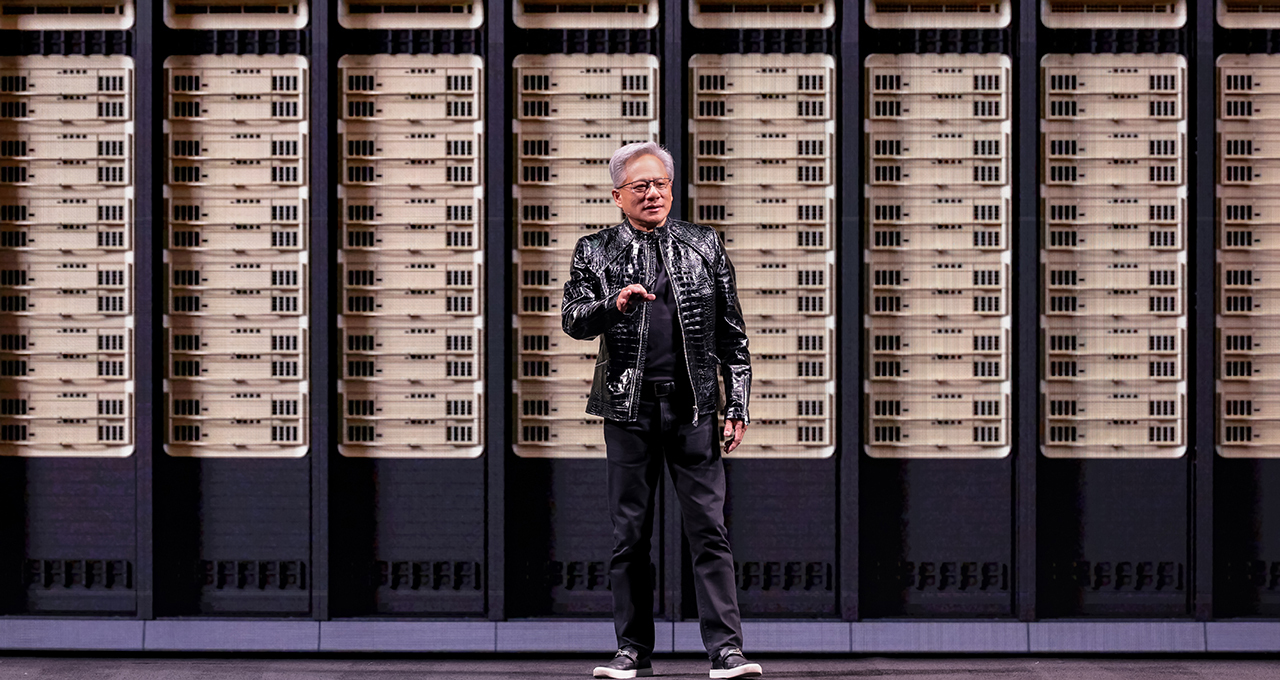

The Consumer Electronics Show (CES) 2026 in Las Vegas concluded on January 8, following four days packed with AI buzz. Big names like Nvidia, AMD, and Razer stole the show with game-changing reveals focused on artificial intelligence. From massive AI supercomputers to everyday PCs and gaming gadgets, these announcements signal AI’s deep dive into computing and entertainment. Here’s a breakdown of the highlights, all fact-checked from official sources and keynotes.
Nvidia founder and CEO Jensen Huang opened CES on January 5 with a bang, unveiling the Rubin platform – its first “extreme-codesigned” AI platform after Blackwell. Named after astronomer Vera Rubin, it packs six new chips for building the world’s biggest AI systems at lower costs: the Rubin GPU, Vera CPU, NVLink 6 Switch, ConnectX-9 SuperNIC, BlueField-4 DPU, and Spectrum-6 Ethernet Switch.
Key specs shine for AI factories:
- Rubin GPU: 50 petaflops of NVFP4 compute for inference, with a third-gen Transformer Engine.
- Vera CPU: 88 custom Olympus Armv9.2 cores, super-efficient for large-scale AI.
- Vera Rubin NVL72 rack: 72 Rubin GPUs + 36 Vera CPUs, 260TB/s bandwidth via NVLink 6 – more than the entire internet’s traffic.
Performance claims? Up to 10x lower inference token costs and 4x fewer GPUs for training Mixture-of-Experts (MoE) models vs. Blackwell. It adds confidential computing, RAS Engine for fault tolerance, and AI-native storage for 5x better efficiency. Rubin is in full production now, with products from partners hitting in H2 2026. Cloud giants like AWS, Google Cloud, Microsoft Azure, and OCI plan Vera Rubin instances this year.
Huang said: “Rubin arrives at exactly the right moment, as AI computing demand… is going through the roof.” Nvidia also teased open models for healthcare (Clara), climate (Earth-2), robotics (Cosmos, GR00T), and autonomous driving (Alpamayo), plus DRIVE Hyperion for Level 4 self-driving cars in Mercedes-Benz CLA this year.
AMD CEO Lisa Su’s January 5 keynote drove home “AI Everywhere, for Everyone.” The star? Ryzen AI 400 Series and Ryzen AI PRO 400 Series processors for AI PCs, packing a whopping 60 TOPS NPU (neural processing unit) – the highest for any Ryzen chip. First systems ship January 2026, wider availability Q1.
These chips promise faster content creation, smoother multitasking, and better gaming. Standouts:
- Ryzen AI Max+ 392/388: Up to 128GB unified memory for 128-billion-parameter models in thin laptops and mini PCs.
- Ryzen AI Halo Developer Platform: Compact desktop for local AI dev, Q2 2026.
- Ryzen AI Embedded P100/X100: For edge AI in cars, healthcare, robots.
Partners like ASUS (ExpertCenter PN55 mini PC), MINISFORUM (AI X1 Pro-470), and GMKtec showed prototypes. AMD also previewed data center beasts: Instinct MI455X GPUs in “Helios” racks (up to 3 exaflops), EPYC “Venice” CPUs, and MI500 Series for 2027 (1,000x faster than MI300X).
Su noted: “We are entering the era of yotta-scale computing… AMD is building the compute foundation.” Plus, Ryzen 7 9850X3D as the fastest consumer desktop CPU for gaming.
Razer turned heads with an “AI Gaming Ecosystem.” Top reveals:
- Project AVA: Evolved AI companion in a 5.5-inch cylindrical device with animated avatar, adaptive personality, and PC Vision Mode. Handles gaming coaching, work, life – reservations open now in the US.
- Project Motoko: Wearable AI headset with dual first-person cameras, Snapdragon chip, far/near-field mics. Gives AI “human POV” for gaming, productivity, robotics training. Universal AI platform support.
- Tenstorrent Partnership: First compact AI accelerator (Wormhole tech) for Thunderbolt 5 PCs. Daisy-chain up to 4 for LLMs, image gen. Open-source software.
Razer’s Forge AI Dev Workstation and AIKit (GitHub open-source) round out tools for local AI tuning. Other goodies: Iskur V2 chair, Wolverine V3 controller.
CES 2026 screamed AI dominance: Nvidia scales data centers, AMD powers your laptop, Razer gamifies it. With Rubin slashing costs, 60 TOPS PCs arriving soon, and AI headsets/holograms, 2026 looks like the year AI goes mainstream. Expect Rubin systems H2, Ryzen AI Q1, Razer concepts evolving. These moves keep Nvidia/AMD in the AI race while Razer bets big on fun tech. Stay tuned – the future’s computing fast.

 English
  简体中文
简体中文  Čeština
  Deutsch (Sie)
  Français


