
When President Bola Ahmed Tinubu hosted leaders of Nigeria’s media industry at the State House on Friday, the meeting carried the familiar symbolism of government and press breaking bread during Ramadan. But beneath the ceremonial tone was a far more serious conversation, one that reflects a growing economic crisis inside Nigeria’s media business.
The issue raised during that meeting was simple but profound: tariffs. Specifically, tariffs on newsprint and broadcasting equipmen, the basic materials that keep newspapers printing and broadcasters on air. Speaking on behalf of the industry, Frank Aigbogun, who heads the Nigeria Press Organisation, asked the government to intervene. The request was straightforward: reduce or review import tariffs that are steadily increasing the cost of running media organizations in Nigeria.
President Tinubu’s response was cautious but notable.
“We discussed issues of tariffs this afternoon,” the president said. “What I cannot report back here is whether I took action in the areas that affect you. But if I missed that, I will go back to rectifying whatever was necessary.”
For an industry that has been quietly struggling for years, that statement may sound like a small diplomatic remark. But it also reflects a larger truth: Nigeria’s media sector is under economic pressure that few outside the industry fully understand. And tariffs are becoming one of its biggest headaches.
The hidden economics of journalism
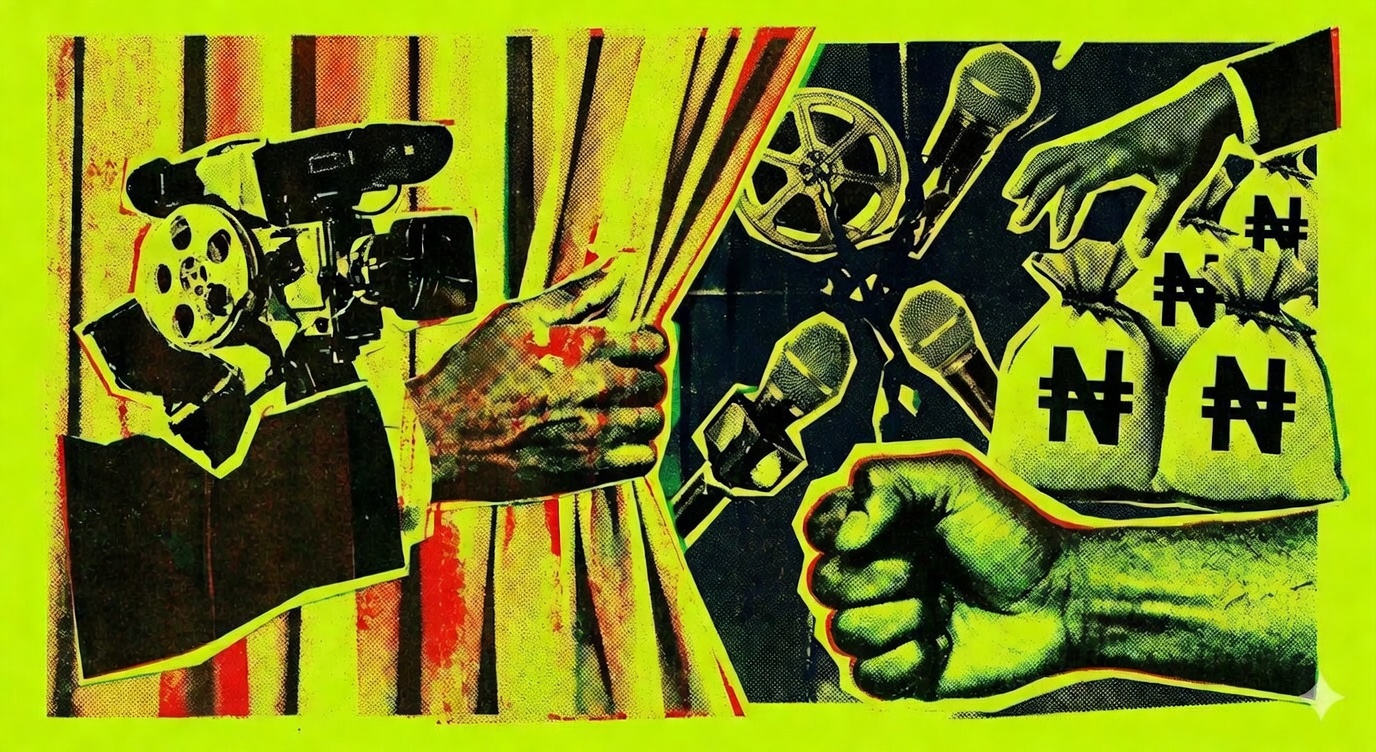
To most people, journalism looks like an intellectual profession, reporters writing stories, editors shaping narratives, broadcasters delivering news. But behind that public-facing work is a complex and expensive industrial system. Newspapers depend on imported newsprint, printing plates, ink, and heavy machinery. Broadcasters rely on transmitters, studio equipment, cameras, satellites, and increasingly sophisticated digital infrastructure. Much of this equipment is imported. Which means tariffs matter.
Every increase in import duty on newsprint or broadcast equipment adds another layer of cost to an industry that is already operating on thin margins. And that cost pressure arrives at a time when media revenues are already shrinking. Advertising, historically the backbone of media funding, has steadily migrated to global technology platforms like Google, Meta Platforms, and TikTok. Those platforms distribute news content widely, but they capture the bulk of digital advertising revenue.
In other words, media companies produce the journalism, while global platforms increasingly capture the profits. That imbalance was also raised at the meeting. Aigbogun urged the federal government to help protect the industry from the growing dominance of large technology companies that use editorial content sourced from Nigerian media without compensation. It is a concern now echoing across newsrooms worldwide.
The policy dilemma
From the government’s perspective, tariffs serve a fiscal purpose. They generate revenue and, in some cases, protect domestic industries. But the media industry occupies an unusual position in the economy. It is both a business and a democratic institution. President Tinubu acknowledged this reality during the gathering, praising media owners, editors and journalists for informing citizens, creating employment and holding public institutions accountable. At the same time, he defended the difficult economic decisions taken by his administration, noting that the government had to make tough reforms to stabilise the country’s finances.
“Leadership must, as a matter of responsibility, make decisions at the best time,” the president said, reflecting on the difficult economic situation his administration inherited. In that context, tariffs on imported materials may appear to be a technical economic issue. But for the media industry, they are becoming an existential one.
A shrinking industry with a growing responsibility
Nigeria’s media sector employs thousands of journalists, editors, producers, photographers, technicians, printers and support staff. Yet many news organizations are already operating under financial strain.
Rising electricity costs, currency volatility, inflation, and declining advertising revenues have forced several outlets to reduce staff, cut operations or scale down print runs. Adding higher tariffs on critical materials only intensifies that pressure. The irony is that the demands on the media are growing at the same time.
In an era of misinformation, deepfakes and algorithm-driven news feeds, credible journalism has arguably never been more important. But credible journalism also requires sustainable business models.
If the cost of producing news continues to rise faster than the revenue that supports it, the consequences will not just affect media companies. They will affect the quality of public information in Nigeria.
Why this conversation matters now
The presence of organisations like the Newspaper Proprietors Association of Nigeria, the Broadcasting Organisation of Nigeria, the Nigerian Guild of Editors, and the Nigeria Union of Journalists at the State House meeting suggests the industry understands the scale of the challenge.
These are not groups that typically make alarmist appeals.
Their request for tariff intervention reflects a shared concern that the economics of journalism in Nigeria are becoming increasingly difficult to sustain. President Tinubu did not announce a specific policy change during the meeting. But his acknowledgement that the issue would be revisited suggests the conversation is far from over.
The larger question
At its core, this debate raises a broader policy question: should journalism be treated purely as a market activity, or as a sector that deserves strategic protection?
Many countries are now grappling with that same question as news organizations struggle against global platforms and shifting economic realities.
Nigeria is entering that debate as well.
And if the conversation at the State House revealed anything, it is this:
Tariffs may look like technical fiscal policy.
But for Nigeria’s media industry, they are increasingly shaping the future of journalism itself.