



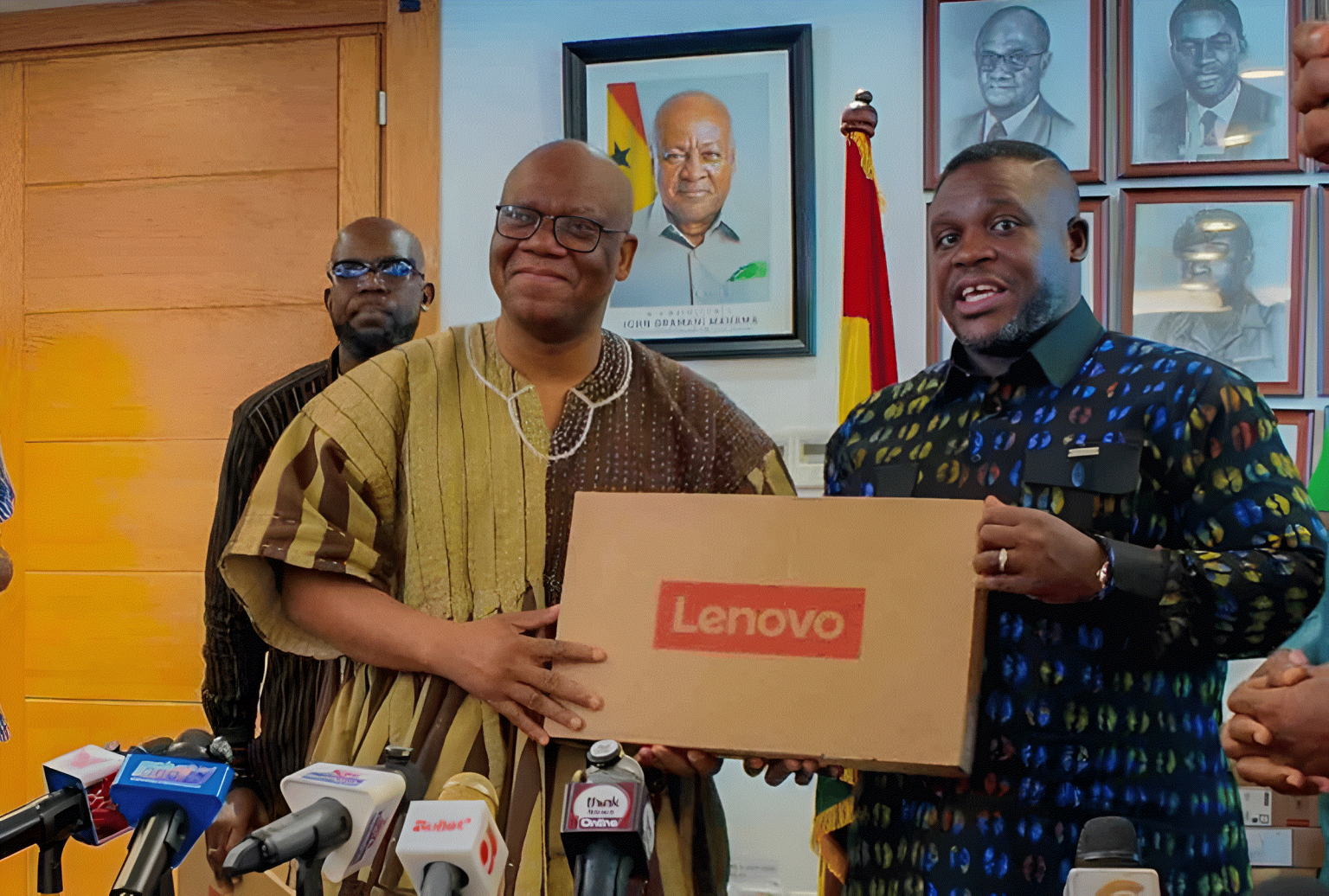

The Ghanaian government has officially kicked off its ambitious One Million Coders Programme (OMCP), aiming to equip one million young Ghanaians with essential coding, digital, and AI skills to prepare them for opportunities in the global digital economy.
On April 10, 2026, the Ministry of Communication, Digital Technology and Innovations distributed 8,500 laptops to kick-start Phase One of the initiative. Minister Samuel Nartey George presented 6,500 Lenovo laptops to regional managers of the Ghana Investment Fund for Electronic Communications (GIFEC) and another 2,000 laptops to 12 universities in Accra.
Under Phase One, the programme will activate 130 learning centres across all 16 regions of the country. Each centre will be equipped with 50 customised laptops specifically configured for coding training, creating immediate access to hands-on digital skills development at the community level.
The initiative comes at a critical time. Youth unemployment in Ghana remains high, and the government sees digital skills as a pathway to job creation, remote work opportunities, and broader economic competitiveness. The programme focuses on practical training in coding, software development, artificial intelligence, and other in-demand digital competencies.
The strong public response during the pilot phase which reportedly attracted 94,000 applications within 48 hours, encouraged authorities to accelerate the nationwide rollout. The full activation of the 130 learning centres is expected by May 1, 2026.
This laptop distribution forms part of a larger digital transformation agenda under President John Dramani Mahama’s administration. By providing both hardware and structured training, the programme seeks to bridge the digital divide, especially in underserved communities outside major cities.
For many young Ghanaians, access to a reliable laptop has been a major barrier to learning coding and digital skills. The government’s move to supply thousands of devices directly to training centres aims to remove that obstacle and make the programme truly inclusive.
The One Million Coders Programme is positioned as a long-term investment in human capital. If successful, it could help position Ghana as a rising digital talent hub in West Africa, supporting local tech startups, attracting foreign investment in IT services, and enabling more citizens to participate in the global freelance and remote work economy.
Challenges remain, including ensuring consistent electricity and internet connectivity at the learning centres, maintaining training quality across regions, and creating actual job pathways once participants complete the courses.
Still, the launch represents a concrete step by the government to move beyond policy documents into tangible action on digital skills development. With the first batch of laptops now in place and centres preparing to open, thousands of young Ghanaians will soon have the opportunity to learn skills that were previously out of reach for many.
As the programme scales toward its one-million target, its success will be measured not just by the number of people trained, but by how effectively those skills translate into employment, entrepreneurship, and innovation within Ghana’s economy. For now, the distribution of laptops marks a visible and practical beginning to what could become one of the country’s most significant youth digital empowerment initiatives.

 English
  简体中文
简体中文  Čeština
  Deutsch (Sie)
  Français


