



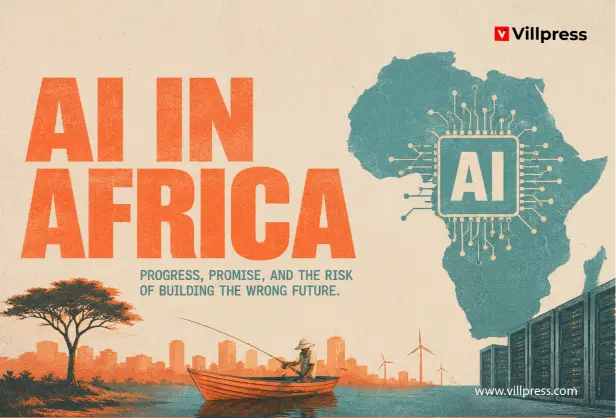

Africa is in the middle of an artificial intelligence moment. Startups are multiplying. Investors are writing cheques. Governments are publishing strategies. Conferences are packed with founders, policymakers, and researchers speaking the language of a continent on the cusp of a technological transformation.
But underneath the optimism, a more uncomfortable story is unfolding, one that this special investigation spent months piecing together from policy documents, venture data, academic research, and expert testimony across the African AI ecosystem.
The finding is stark: Africa, with few notable exceptions, is not building artificial intelligence. It is consuming it. And the difference between those two things may determine the continent’s economic and strategic future for a generation.
The Number Behind the Buzz
The headline figures are real. Africa has approximately 2,400 active AI companies. Its AI market, currently valued at around $4.5 billion, is projected to reach $16.5 billion by 2030, an annual growth rate of 27.4 percent. In 2025, AI-focused startups on the continent raised $803 million across 159 companies.
But read past the headlines, and the picture shifts.
Over 83 percent of all AI startup funding in the first quarter of 2025 went to just four countries: Kenya, Nigeria, South Africa, and Egypt. The remaining fifty-plus nations divided whatever was left. Not a single country in sub-Saharan Africa scores above 56 out of 100 on the Oxford Insights Government AI Readiness Index, compared to 89 for the United States and 76 for China. Africa holds less than one percent of global data centre capacity. Only five percent of the continent’s AI practitioners have access to meaningful computational power.
“There is a big buzz and hype about AI,” said Natalie Jabangwe, Executive Secretary of the Timbuktoo Foundation, at the 2024 African Economic Conference, “but do we have the technological infrastructure to support it? Africa is not ready in terms of infrastructure.”
That is, arguably, the most important sentence anyone has said about African AI in recent years.
Building on Someone Else’s Foundation
To understand the structural problem, you need to understand what foundation models are and why they matter.
Foundation models, large pre-trained systems like GPT-4, Gemini, Llama, and Claude, are the underlying engines of nearly every modern AI application. They require three things at scale: vast, high-quality datasets; enormous computing power; and research teams capable of conducting frontier science. Africa has nascent versions of all three. It has none of them at the scale required to build competitive foundation models.
The result is what the industry bluntly calls a “wrapper economy.” The overwhelming majority of Africa’s 2,400 AI companies are building applications on top of models owned and operated by companies headquartered in San Francisco, London, and Beijing. A Nigerian fintech chatbot powered by OpenAI’s API is renting intelligence from California, subject to American corporate decisions, pricing changes, and terms of service, with zero control over what the model knows, how it was aligned, or whether it will be available tomorrow.
A TechCabal analysis of 207 African AI startups found that the 2024-to-2025 class of companies clusters in software development, business intelligence, finance, and education, precisely the sectors where foundation models have lowered the barrier to entry for wrapper-style products. This is rational individual behaviour. Aggregated across thousands of companies, it produces a structural dependency that no single actor chose but all collectively created.
The rest of the world’s reporting from May 2026 stated it plainly: “The continent’s biggest tech economies want to own their AI future. The infrastructure they need still belongs to Big Tech.”
The Compute Crisis
The physical constraint at the heart of everything else is compute, the high-performance hardware required to train, fine-tune, and run AI models.
A UNDP analysis of 11,000 African AI practitioners on Zindi, the continent’s largest data science network, found that only five percent have access to sufficient computational power for meaningful research or innovation. Within that five percent, just one percent have hardware on their own premises. The rest depend on cloud credits, often provided by international programmes with uncertain longevity.
The practical consequence for African researchers is staggering. While a researcher in a G7 country can iterate on a model training run every 30 minutes, their African counterpart may wait up to six days before making the next change. Six days versus 30 minutes is not a talent gap. It is a physical infrastructure gap that compounds over time: slower iteration, fewer experiments, less learning, weaker models, weaker research.
The World Economic Forum estimates 7 million GPU hours of unmet demand across Africa over the next three years. “Without accessible and affordable computing infrastructure,” the WEF wrote in December 2025, “Africa risks being locked out of the AI economy, becoming a consumer of imported solutions rather than a producer of homegrown innovation.”
The power problem makes everything worse. The International Energy Agency estimates that approximately 600 million people across Africa still lack access to electricity. Training AI models is an energy-intensive process. Without reliable power, even the most talented researcher with a GPU cannot work consistently.
2,000 Languages, Most Of Them Are Invisible
If there is a single issue that concentrates Africa’s AI challenge into its sharpest form, it is language.
Africa is home to more than 2,000 languages across approximately 200 language families, roughly one-third of the world’s total linguistic diversity. Despite this, African languages are catastrophically underrepresented in the datasets that train AI systems. The dominant AI languages, English, Mandarin, Spanish, French, German, have training datasets measured in hundreds of billions of tokens. Most African languages have datasets measured in millions. Some in thousands.
The consequences are not abstract. An AI-powered clinical decision support tool that does not understand Hausa is useless to a doctor in Kano. An agricultural advisory chatbot that cannot respond in Amharic cannot serve an Ethiopian smallholder farmer. A fraud detection system trained on European conversational patterns will systematically misclassify transactions in multilingual African markets where code-switching is the norm.
Language is the interface through which ordinary people interact with AI. The absence of African languages from that interface is not a quality-of-life issue. It is a structural exclusion from the digital economy.
The most consequential response has come not from governments but from a grassroots research organisation called Masakhane, founded in 2019 at the Deep Learning Indaba conference. Masakhane brings together speakers, linguists, dataset builders, and technologists to develop NLP tools for African languages through participatory, community-driven research. Its contributions, including named entity recognition datasets, sentiment analysis benchmarks, translation evaluation frameworks, and multilingual pre-trained models, have shifted the global NLP research agenda and produced award-winning academic work.
But Masakhane is doing the work of essential national infrastructure on what is essentially volunteer effort and international grant funding. It is not funded like the strategic asset it is.
The private sector’s most significant response came in August 2024, when Johannesburg-based startup Lelapa AI released InkubaLM, Africa’s first multilingual large language model, covering Swahili, Yoruba, isiXhosa, Hausa, and isiZulu. InkubaLM is built on proprietary datasets and supported by $2.5 million from Mozilla Ventures, Atlantica Ventures, and Google AI chief Jeff Dean. It is also a proof of concept that African companies can build foundational AI, not merely deploy it.
But InkubaLM covers five languages out of more than 2,000. It is a beginning.
The Data Flowing Out
Africa is generating data at enormous scale. Nigeria alone had over 107 million internet users as of February 2025. Mobile money transactions, social media activity, agricultural sensor data, health records, financial behaviour, it is being produced, constantly, at every level of African society.
The vast majority of it flows outward, into server farms in Europe and North America, processed and monetised by companies headquartered far outside Africa’s jurisdictions, used to train AI systems that rarely reflect or benefit the regions where the data originated.
Critics call this data colonialism. The term is contested, but it captures something measurable. As an academic analysis published in late 2025 documented, global technology companies have entrenched themselves in the African AI ecosystem through visible investments in research, skills, and talent, while running invisible business models built on surveillance, data scraping, recommendation algorithms, and labour extraction through proxies.
The surveillance dimension cannot be separated from the AI governance discussion. During Kenya’s 2024 Gen Z protests, the Kenya Human Rights Commission documented that Safaricom unlawfully shared customer location data with security forces. Human Rights Watch documented at least 82 enforced disappearances. This happened in Nairobi, the same city where data workers moderate content for global platforms, and the same city that styles itself the Silicon Savannah of Africa.
The continent that faces the greatest risk from data colonialism is also the continent with the least mature protections against the domestic misuse of the same technologies.
Where AI is Actually Working
To be clear: Africa is building genuinely impressive things.
In fintech, the continent’s most mature AI domain, companies are using alternative data to extend credit to populations with no formal credit history. Mobile money transaction patterns, airtime purchase behaviour, and social graph data are powering credit assessments for people who traditional banks cannot reach. The sector produced eight of Africa’s nine tech unicorns and processed $59 billion in cryptocurrency transactions in Nigeria alone over twelve months through mid-2024.
In agriculture, Cape Town’s Aerobotics uses aerial imagery and machine learning to detect pests and diseases in orchards, delivering precision agriculture analytics that are globally competitive. Ghana’s Farmerline built Darli AI, a multilingual WhatsApp-accessible chatbot that reached over 100,000 smallholder farmers with real-time crop management advice, in local languages, through a platform they already use, requiring no smartphone or English literacy.
Nairobi-based Amini is solving Africa’s data scarcity problem by making it a business opportunity. Founded to bridge the continent’s environmental data gap using AI and satellite imagery, Amini built a platform that enabled insurance giant Aon to cut farmer premiums across East Africa by 30 percent. Revenue rose 300 percent in 2024 and 500 percent in 2025.
InstaDeep, the AI company founded in Tunis and Nairobi, was acquired by German pharmaceutical firm BioNTech for $682 million in 2023, the largest exit in African AI history, and permanent proof that African AI companies can achieve world-class valuations.
These are not small achievements. They demonstrate that African researchers and founders can produce world-class technology under severe structural constraints. The question is whether the next decade produces ten more InstaDeeps or ten thousand more chatbot wrappers built on foreign models.
Six Countries, Six Diiferent Stories
Africa’s AI story is not one story.
Nigeria has the largest talent pool and the most active startup scene, over 400 AI companies, 107 million internet users, a 2025 National AI Strategy, and the newly launched N-ATLAS open-source language model covering Yoruba, Hausa, Igbo, and Nigerian-accented English. It also has chronic power instability, high emigration rates among its best AI talent, and governance gaps that undercut institutional trust.
Kenya earned the Silicon Savannah title through M-Pesa and a dynamic private sector. Its ChatGPT adoption rate, over 42 percent of the working-age population using the product daily in 2025, is the highest in the world. But the collapse of a planned Microsoft-G42 data centre deal has left the country without the cloud infrastructure its AI ambitions require.
South Africa tops the continent’s AI infrastructure rankings, hosts over 600 AI companies, and is home to Lelapa AI and Aerobotics. McKinsey found 65 percent of South African businesses now use generative AI. But South Africa’s AI capabilities are concentrated in Cape Town and Johannesburg, among a small educated and connected population. The developmental promise of AI has not reached the majority.
Rwanda is Africa’s most instructive governance case study, a country of 15 million that has punched far above its weight through policy clarity, hosting the Global AI Summit on Africa in 2025 and producing Africa’s first national AI policy in 2022. Its limitation is scale: Rwanda is a laboratory, not a production facility, and its authoritarian governance record raises uncomfortable questions about the civil liberties conditions for trustworthy AI.
Egypt has the continent’s highest AI adoption rate at 13.4 percent of the working-age population, a detailed and legally substantive national AI strategy updated in 2025, and a major data centre hub. Its AI strengths, however, are concentrated in Arabic-language applications that may not transfer directly to sub-Saharan Africa’s linguistic and institutional contexts.
Ghana is building serious agritech innovation and has passed an Emerging Technologies Bill. Its infrastructure, however, lags its policy ambition.
The Strategic Moment
Here is what most AI optimism in Africa avoids saying directly: the window for building foundational AI capacity before dependency patterns become structural and irreversible is probably five to ten years. Not twenty.
The good news is that the political moment is, for the first time in a generation, genuinely open. As of April 2026, at least 21 African countries have formal AI strategies. The African Union adopted a Continental AI Strategy in July 2024. Over 50 African states have signed the Africa Declaration on Responsible AI. An April 2025 summit in Kigali announced a $60 billion Africa AI Fund targeting infrastructure, talent, and startups.
The bad news is that political intent and structural investment are not the same thing. Language infrastructure is still not funded as strategic infrastructure. Compute access for African researchers remains catastrophically constrained. Data governance frameworks are multiplying faster than enforcement capacity. The talent Africa trains continues to leave at alarming rates, to Silicon Valley, London, Toronto, and Paris, where salaries are ten to twenty times higher.
The corrective, as this investigation documents, is not anti-technology nationalism. It is not a refusal to use OpenAI, Google, or Meta’s tools while local alternatives remain insufficient. It is a simultaneous investment in the foundations, compute, language infrastructure, data governance, talent retention, that would make genuine technological sovereignty possible, even while engaging pragmatically with the global AI ecosystem that already exists.
It is also, critically, collective action. African governments negotiating individually with Big Tech have little leverage. A bloc representing 1.4 billion people, insisting on data localisation requirements, local procurement commitments, and open-source data provisions as conditions for market access, has enormous leverage. It has not been used.
The Intelligence Question
Can Africa produce intelligence rather than merely consume intelligence built elsewhere?
The evidence assembled in this investigation suggests: not yet, and not without deliberate intervention at a scale and speed that African political and institutional systems have not yet demonstrated.
What the continent has demonstrated, through Masakhane, InkubaLM, Amini, Aerobotics, and InstaDeep, is that the talent and the ambition exist. That African researchers can produce world-class work against significant constraints. That African-specific problems, approached from African-specific starting conditions, can yield solutions that are globally competitive.
What it has not yet demonstrated is the ability to build the foundational layers, infrastructure, language, data governance, that would allow those solutions to achieve continental scale without depending on the goodwill of foreign corporations and the continuity of foreign cloud services.
“The next generation of AI architects must be African,” said H.E. Lerato D. Mataboge, the African Union Commissioner for Infrastructure and Energy, in Addis Ababa in May 2025, “educated in Africa, and working to solve African problems.”
The question the next decade will answer is whether Africa builds the conditions to make that possible — or whether it produces ten thousand more chatbot wrappers, adding no structural depth to its technological sovereignty, while the economic surplus and strategic leverage flows, as it always has, outward.
The choice is not inevitable. It is political. And it is, finally, urgent.
This report draws on research conducted across academic journals, institutional reports, policy documents, and journalism from the African AI ecosystem, including sources from the UNDP, Oxford Insights, the African Union, World Economic Forum, OECD, AfricaNLP, Masakhane, TechCabal, Rest of World, African Business, and the ODI. Villpress | Investigative & Analytical Journalism | June 2026

 English
  简体中文
简体中文  Čeština
  Deutsch (Sie)
  Français


