



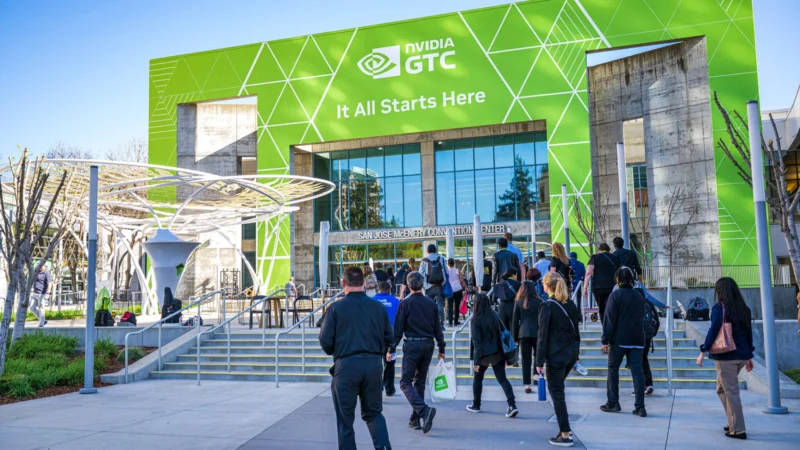

NVIDIA’s flagship AI conference wrapped up today in San Jose after four intense days that left little doubt about the company’s trajectory: it’s all-in on building the full infrastructure stack for the next era of AI, from inference factories to agentic systems and even space-based data centers.
The event, which ran March 16–19 at the San Jose McEnery Convention Center, drew tens of thousands in person and millions more online. CEO Jensen Huang’s Monday keynote set the tone with a bold projection of at least $1 trillion in cumulative revenue from Blackwell and Vera Rubin systems through 2027, double the previous outlook, and a clear pivot toward inference as the new center of gravity in AI economics. The full keynote replay is now available on NVIDIA’s official site and YouTube channel or via the dedicated keynote page
Huang framed 2026 as the year inference overtakes training in importance, with agentic AI (systems that reason, plan, and act autonomously) and physical AI (robots and embodied intelligence) moving from labs into production. The keynote itself was a two-hour-plus showcase of that vision, blending hardware reveals, software platforms, and ecosystem partnerships.
Among the headline announcements:
The Vera Rubin platform emerged as the star of the show: a vertically integrated stack including new Rubin GPUs, Vera CPUs optimized for agentic workloads, and the Feynman architecture roadmap. Huang positioned it as the foundation for massive AI factories, with early deployments already running at scale on partners like Microsoft Azure. NVIDIA detailed the full Vera Rubin announcement in its official newsroom post.
Read more: NVIDIA GTC 2026 Keynote: Everything Jensen Huang Announced
Inference hardware got a major boost with the debut of the Groq 3 Language Processing Unit (LPU) following NVIDIA’s $20 billion acquisition of Groq assets late last year. The chip promises dramatic efficiency gains for real-time AI queries.
On the consumer side, DLSS 5 arrived with a neural rendering model that goes beyond upscaling to generate photorealistic lighting, materials, and details in real time. Early demos in titles like Resident Evil Requiem and Starfield drew strong reactions, some praising the visual leap, others criticizing the “over-smoothed” look on faces. NVIDIA’s official announcement on DLSS 5 is live here, with the feature targeted for fall 2026 rollout.
Agentic AI took center stage with the NemoClaw open-source platform and partnerships like OpenClaw, alongside physical AI demos including Disney’s lifelike Olaf robot and new Uber autonomous vehicle collaborations.
The conference featured over 1,000 sessions, 2,000 speakers, and 450+ sponsors, covering everything from agentic AI and trustworthy systems to robotics, simulation, and edge computing.
With the in-person event now complete, NVIDIA has made the majority of content available on demand. Registered attendees (including free virtual pass holders) can access recordings, slides, and materials through the official GTC session catalog . Sessions are organized by topic, agentic AI, generative AI, data center/cloud, robotics, simulation, and many include live Q&A archives or text-based follow-ups.
The full keynote replay is streaming on NVIDIA’s YouTube channel and the GTC site, offering a front-row seat to Huang’s vision of AI as the “new industrial revolution.” Virtual access remains open indefinitely for most technical sessions, making this one of the most accessible ways to catch up on the infrastructure buildout shaping 2026 and beyond.
For developers, enterprises, and researchers, the real work starts now: turning the blueprints and platforms unveiled this week into production systems. NVIDIA’s message from San Jose was unmistakable, the AI infrastructure race is accelerating, and the company intends to supply the engines, factories, and software layers that power it all. Whether that’s sustainable at the projected scale will be the story to watch in the quarters ahead. For now, the on-demand library is open, dive in while the momentum is fresh.
Also read: NVIDIA GTC 2026 Is Underway: Jensen Huang Bets $1 Trillion on the Next Wave of AI


 English
  简体中文
简体中文  Čeština
  Deutsch (Sie)
  Français


