


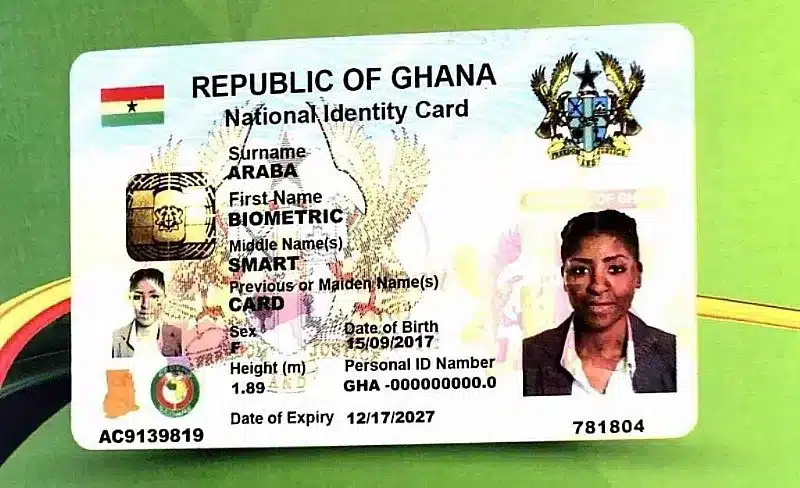

Ghana has taken a significant step toward a fully integrated digital economy by enabling its national ID cards to be used directly for payment transactions.
The announcement, made by the Ghana Cards Limited and the Bank of Ghana, allows holders of the Ghana Card (the country’s biometric national identification document) to link their cards to bank accounts and mobile money wallets for seamless payments at point-of-sale terminals, online platforms, and ATMs.
This integration transforms the Ghana Card from a simple identity document into a functional payment instrument, reducing the need for separate bank cards or mobile money tokens in many daily transactions. Users can now tap or insert their physical Ghana Card at supported merchants or authenticate transactions using its embedded chip and biometric features.
The move builds on Ghana’s long-standing leadership in digital identity. The country was one of the first in Africa to roll out a robust, chip-based biometric national ID system at scale. With over 17 million Ghana Cards already issued, the new payment functionality instantly gives millions of citizens, including the previously unbanked or underbanked, a secure and convenient way to transact without relying solely on smartphones.
Why This Matters for Ghana’s Digital Economy
- Financial Inclusion: Many Ghanaians already carry their national ID daily. Turning it into a payment tool removes friction for informal sector workers, students, and rural populations.
- Interoperability: The system connects the national ID database with banking and mobile money infrastructure, promoting seamless movement between different payment rails.
- Security: Biometric authentication and chip technology are expected to lower fraud rates compared to traditional PIN-only cards or USSD mobile money transactions.
- Infrastructure Leverage: It capitalizes on existing investments in the Ghana Card ecosystem rather than building an entirely new payments network.
The Bank of Ghana and Ghana Cards Limited have confirmed that the service will roll out progressively, starting with selected banks and mobile money providers. Full nationwide adoption is targeted within the coming months, with merchants encouraged to update their POS terminals to accept Ghana Card payments.
This development aligns with Ghana’s broader digital agenda, including its Digital Ghana strategy and efforts to create a cash-lite economy. It also complements recent fintech innovations in the country, such as stablecoin experiments, cross-border payment platforms, and embedded finance solutions.
For the wider African payments landscape, Ghana’s move sets a potential template. Several countries are watching how national digital ID systems can double as payment instruments, potentially accelerating inclusion while reducing reliance on multiple cards and apps.
Challenges remain, however. Merchant adoption of new POS capabilities, public education on the new functionality, and ensuring robust data privacy protections will be critical for success. Network reliability in rural areas and interoperability across all banks and mobile money operators will also determine how quickly the system gains traction.
Still, the announcement represents meaningful progress. By linking identity and payments on a single, widely held document, Ghana is making digital transactions more accessible and inclusive for its 33 million citizens.
The integration of national ID with payments could become one of the most practical examples yet of how digital public infrastructure can directly improve everyday financial lives across Africa.






 English
  简体中文
简体中文  Čeština
  Deutsch (Sie)
  Français


