


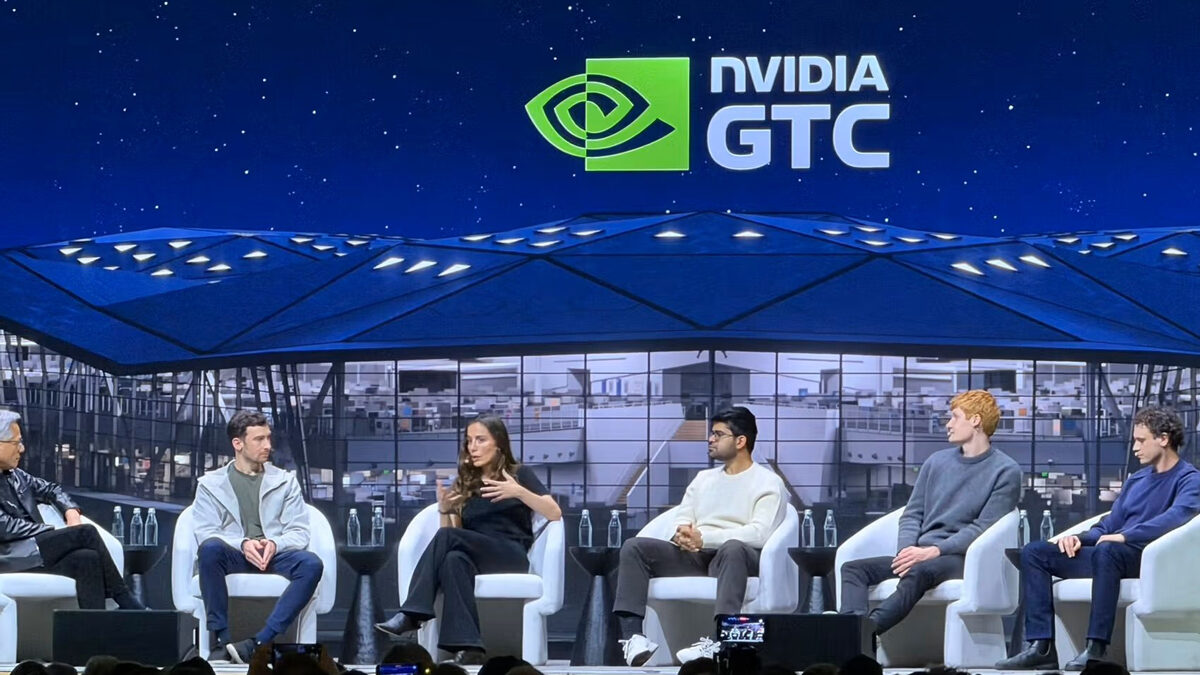

The ground shifted noticeably last week in San Jose. NVIDIA’s GTC conference, spanning March 16 to 19, delivered more than incremental updates, it outlined a comprehensive vision where AI stops being a passive assistant and starts running factories, driving cars, assisting in surgeries, and even operating from orbit. Jensen Huang’s extended keynote on the opening day captured the momentum: inference workloads have exploded, agentic systems are scaling fast, and physical AI is transitioning from lab demos to production deployments.
Huang opened with a striking projection: NVIDIA anticipates at least $1 trillion in cumulative purchase orders for Blackwell and the newly introduced Vera Rubin platforms through 2027. This doubled the earlier estimate and reflects surging demand from hyperscalers and enterprises racing to deploy agent-driven inference at scale. “Tokens are the new commodity,” he emphasized, signaling that the economics of AI have flipped toward constant, real-time execution rather than one-time training runs. For the full keynote replay, see NVIDIA’s official video.
Central to this shift is the Vera Rubin platform, NVIDIA’s first fully integrated system designed from the silicon up for agentic AI. It combines seven new chips now entering full production: the Vera CPU (tailored for long-horizon reasoning, delivering twice the efficiency and 50% higher performance than traditional CPUs in those workloads), Rubin GPU, NVLink 6 Switch, ConnectX-9 SuperNIC, BlueField-4 DPU with STX storage, Spectrum-6 Ethernet switch, and the Groq 3 LPU (integrated via NVIDIA’s recent Groq asset acquisition for high-speed inference). The flagship Vera Rubin NVL72 rack merges 72 Rubin GPUs and 36 Vera CPUs, achieving up to 10× better inference throughput per watt, training large mixture-of-experts models with a quarter of the GPUs required on Blackwell, and reducing cost per token dramatically.
Also read: NVIDIA GTC 2026 Keynote: Everything Jensen Huang Announced
The platform extends to five specialized rack-scale configurations and a complete supercomputer reference design, unified under the DSX AI Factory blueprint and Omniverse DSX digital-twin tools for simulation-before-build. Partners including AWS, Google Cloud, Microsoft Azure, Dell, Supermicro, and over 80 MGX builders plan shipments starting in the second half of 2026. Full platform details are available in NVIDIA’s official Vera Rubin announcement.
Agentic AI dominated the narrative. Huang spotlighted OpenClaw, the open-source framework launched in January by developer Peter Steinberger, calling it “the most popular open-source project in the history of humanity,” outpacing Linux’s early adoption curve. He positioned it as the foundational “operating system” for agentic computers, enabling persistent, tool-using agents with a single command-line install. NVIDIA responded with NemoClaw, an enterprise-grade extension that adds policy enforcement, privacy routing, network guardrails, and seamless connectors to Salesforce, SAP, ServiceNow, and Microsoft 365. A live demo zone let attendees build and deploy custom agents on DGX Spark or RTX laptops in minutes. “Every company needs an OpenClaw strategy,” Huang stated, framing it as essential infrastructure for the agent era. See NVIDIA’s GTC 2026 live updates blog for more on the agent ecosystem.
Physical AI gained serious traction. Disney’s interactive robotic Olaf, powered by NVIDIA Jetson, Omniverse simulation, and the Newton physics engine, joined Huang onstage, showcasing adaptive movement and environmental awareness ahead of its Disneyland Paris debut. New Isaac GR00T models, Cosmos world-generation tools, and an open Physical AI Data Factory blueprint leverage synthetic data at massive scale to overcome robotics data shortages. Collaborations span industrial leaders like ABB, FANUC, KUKA, and Universal Robots; humanoid developers including Figure and Agility Robotics; and automotive players such as BYD, Hyundai, Nissan, Geely, and Uber for Level 4 autonomy. Edge deployments advanced with IGX Thor now generally available for real-time applications in Caterpillar assistants, Hitachi Rail predictive maintenance, KION warehouse safety, and Johnson & Johnson surgical systems. NVIDIA detailed the robotics partnerships in this press release.
Additional announcements reinforced the breadth:
- DLSS 5 introduces 3D-guided neural rendering for photorealistic local gaming on GeForce hardware later this year.
- The cuEST library speeds quantum-chemistry simulations up to 30×, drawing immediate interest from Applied Materials, Samsung, and TSMC for chip design.
- Expanded cuDF and cuVS integrations with IBM watsonx.data, Dell, Google BigQuery, and Oracle accelerate data-to-AI pipelines.
- Orbital computing emerged with Vera Rubin Space-1 modules promising 25× inference performance over H100 in space-based data centers, alongside quantum NVQLink APIs.
For mainstream perspective on the keynote’s scale and the $1 trillion forecast, CNBC’s coverage provides solid context: CNBC GTC 2026 report.
For builders in Lagos and other emerging hubs, the implications are practical: OpenClaw and NemoClaw lower the threshold for deploying secure, local agents on accessible NVIDIA hardware, potentially transforming fintech automation, health diagnostics, agritech monitoring, or mobility logistics without heavy cloud reliance. The $1 trillion demand wave also points to sustained capex in inference and edge, creating ripple opportunities in regional data centers, talent development, and ecosystem partnerships.
This isn’t incremental progress; it’s a redefinition of computing’s foundation. AI is no longer confined to servers, it’s embedding into the physical economy. The tools are here; the next phase belongs to those who deploy them fastest and smartest.
Read more: NVIDIA GTC 2026 Is Underway: Jensen Huang Bets $1 Trillion on the Next Wave of AI
Read more: NVIDIA DLSS 5: Release Date, Features, Supported Games and RTX 50-Series Details.
Read more : NVIDIA GTC 2026: Concludes Today in San Jose






 English
  简体中文
简体中文  Čeština
  Deutsch (Sie)
  Français


