


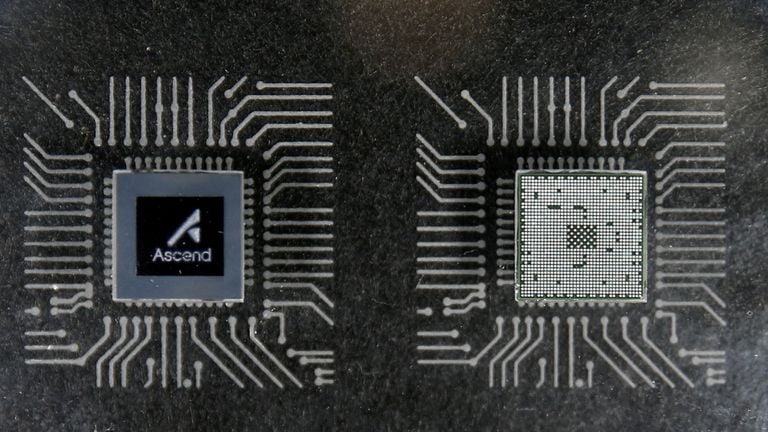

Chinese GPU and AI chip vendors captured 41% of the country’s AI accelerator server market in 2025, according to fresh data from IDC reviewed by Reuters and released Tuesday. The figure marks a sharp acceleration in domestic substitution and a measurable erosion of Nvidia’s once-overwhelming position in what had been one of its largest overseas markets.
Nvidia still led overall, shipping roughly 2.2 million cards for a 55% share. AMD held a smaller slice at about 4%, with roughly 160,000 units. But the collective Chinese contingent shipped 1.65 million cards, closing in on half the total volume. Huawei Technologies stood out as the clearest domestic winner, dispatching around 812,000 AI chips, nearly half of all locally branded shipments.
The numbers reflect the cumulative impact of repeated U.S. export controls on advanced AI accelerators, Beijing’s explicit push for technological self-reliance, and the rapid scaling of Chinese alternatives. While Nvidia’s H20 and H200 chips, modified versions intended to skirt restrictions, have seen intermittent licensing and restarts in production, the flow has been inconsistent and often curtailed by regulatory friction on both sides of the Pacific.
Huawei’s Ascend series, particularly the 910B and newer variants, has benefited from aggressive deployment in hyperscale data centers and government-backed intelligent computing projects. Other players, including Cambricon, Moore Threads, Biren Technology, and MetaX, have posted eye-catching revenue growth and attracted heavy domestic investment, even if their individual market shares remain smaller for now. Several of these firms went public or prepared listings in late 2025, riding a wave of enthusiasm for “China’s Nvidia” narratives despite still-modest absolute volumes compared with the established leaders.
The shift is not uniform. In inference-heavy workloads, where efficiency and cost matter more than peak training performance, domestic chips have found quicker acceptance. Training large models at the absolute frontier remains more challenging for Chinese vendors, constrained by manufacturing maturity at SMIC and the ecosystem gaps in software tooling and interconnects. Yet the gap is narrowing in clusters, where sheer volume and domestic supply chains can compensate for per-chip performance shortfalls.
For Nvidia, the China story has grown complicated. CEO Jensen Huang has acknowledged that U.S. restrictions sliced the company’s share dramatically from earlier highs near 90-95%. Recent quarters showed China (including Hong Kong) revenue declining sharply as a percentage of total business, even as global demand for Blackwell and upcoming platforms kept overall growth robust. The company has redirected some capacity toward less restricted markets and next-generation architectures, while still pursuing limited H200 shipments under license.
Also read: NVIDIA GTC 2026 Is Underway: Jensen Huang Bets $1 Trillion on the Next Wave of AI
Analysts have floated even more dramatic projections. Bernstein Research, cited in earlier reports, anticipated Nvidia’s China AI chip share could fall toward single digits in 2026 if controls tighten further and domestic supply hits 80% of demand. IDC’s 2025 snapshot, 41% domestic, sits between the optimistic localization forecasts and the reality that foreign chips, led by Nvidia, still command the majority.
The broader context is geopolitical as much as technological. China’s “Made in China 2025” ambitions, supercharged by export curbs, have funneled state support and private capital into semiconductors. Hyperscalers like Alibaba, Tencent, and ByteDance have diversified procurement aggressively. Government guidance has discouraged reliance on foreign chips in certain public-sector projects. At the same time, Chinese AI labs have demonstrated impressive model performance with relatively constrained compute, suggesting that algorithmic efficiency can partially offset hardware gaps.
Still, limitations persist. Advanced packaging, high-bandwidth memory, and the full software stack around CUDA remain areas where Nvidia’s ecosystem advantage endures globally. Chinese firms are investing heavily in alternatives, Huawei’s CANN framework, for instance, but porting and optimizing large-scale workloads takes time and money. Yield rates and scaling at leading-edge nodes also trail TSMC’s benchmarks.
For the global AI supply chain, this fragmentation is becoming structural. What was once a largely unified market for cutting-edge accelerators is splitting into parallel tracks: one dominated by Nvidia’s full-stack offerings in the U.S., Europe, and allied markets; another driven by domestic champions inside China. The result is duplicated R&D effort, higher costs for everyone, and a slower convergence on standards.
Nvidia’s response has been pragmatic, deepening partnerships elsewhere, accelerating its own roadmap with Vera and Rubin platforms, and maintaining selective access to China where regulations permit. But the company can no longer count on China as the reliable growth engine it once was. Meanwhile, Chinese chipmakers are moving beyond survival mode into genuine competition in their home market, even if true technological parity at the highest end remains years away.
The IDC data underscores a quiet milestone: nearly half the AI accelerators deployed in Chinese servers last year carried a domestic label. That number will almost certainly rise in 2026. Whether it stabilizes near 50% or pushes higher depends on how aggressively Beijing enforces localization, how effectively Chinese firms close the remaining performance gaps, and whether U.S. policy eases or hardens under the current administration.
For now, the trend is clear. Nvidia’s dominance in China is no longer absolute. In its place is a more contested, geopolitically charged market where homegrown chips have claimed a substantial and growing seat at the table. The AI race, long viewed through a single-vendor lens, is becoming multipolar, at least within the world’s second-largest economy.






 English
  简体中文
简体中文  Čeština
  Deutsch (Sie)
  Français


