





What started as a go-to-market in Ikotun Market experiment has evolved into a fintech product aimed at one of the most overlooked layers of Nigeria’s economy: group-based finance.
FinSquare, a startup focused on digitizing cooperative and community-driven financial systems, traces its origins to a three-week market activation in Ikotun, Lagos. At the time, the team was selling ecommerce software to small businesses and partnered with an FMCG warehouse alongside the market’s wholesalers association to drive adoption.
The strategy was practical, meet traders where they are.
During the activation, the team introduced a group buying model, educating traders on how to pool funds and purchase inventory directly from warehouses or manufacturers. By aggregating demand, traders could meet minimum order quantities and access lower wholesale prices typically unavailable to them individually.
Group buying itself isn’t new. Variations of it have existed for decades across Nigerian markets. What FinSquare did differently was structure and formalize the process within a program tied to digital onboarding.
According to the company, the pilot saw strong participation and was fully subscribed, surpassing expectations. While no figures were disclosed, the outcome revealed something more important than early traction, it highlighted how deeply embedded collective financial behavior is within these communities.
That insight shaped what came next.
Beyond inventory purchases, traders and associations already run complex financial systems. These include dues collection, rotational savings schemes like ajo (also known as esusu), cooperative loans, and group investments. Despite their scale and importance, these systems largely operate offline, relying on manual coordination and trust.
FinSquare’s product is designed to bring these activities into a digital environment.
The app allows associations, cooperatives, unions, and informal groups to set up and manage shared financial structures, from pooled savings to coordinated purchasing, with built-in transparency and record-keeping. Users can create both individual and group wallets, enabling a more structured way to manage collective funds.
To support this, the company has partnered with 9 Payment Service Bank (9PSB), leveraging its wallet infrastructure to power transactions on the platform.
The introduction of group wallets is a notable move in a market where most fintech products are designed for individuals, despite the prevalence of collective financial behavior. FinSquare is effectively building for how money already moves in these communities, rather than trying to change it.
The long-term ambition is larger. The company says it plans to secure a banking license by 2028, which would allow it to expand its services and operate more independently within the financial ecosystem.
That goal comes with challenges. Nigeria’s regulatory environment for fintechs has tightened in recent years, and moving from a product layer to a licensed financial institution is a significant leap. But it also reflects a broader trend, startups looking beyond payments and lending to build deeper financial infrastructure.
FinSquare’s team, made up of former banking and fintech professionals, believes the opportunity lies in recognizing communities as economic units, not just social ones.
In markets like Ikotun, where trust networks often replace formal systems, financial coordination already happens at scale, just without the tools to make it efficient, transparent, or easily expandable. The question now is whether digitization can enhance these systems without disrupting the trust they depend on.
FinSquare’s early experiment suggests there is demand. Turning that into sustained adoption across Nigeria’s diverse network of cooperatives and informal groups will determine whether the startup can move from a promising concept to a foundational layer in the country’s financial ecosyst
About Finsquare
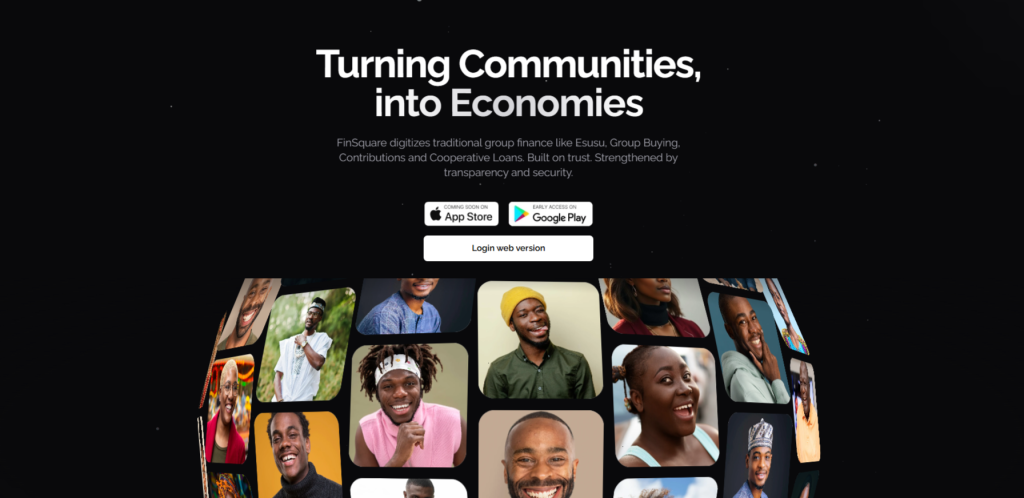
FinSquare is a fintech platform designed to digitize traditional group finance systems like Esusu, thrift contributions, cooperatives, and group buying. Instead of running these systems manually or through WhatsApp coordination, FinSquare gives communities a structured, secure, and transparent way to manage money together.
Contact
Email: info@finsquare.app
Phone: +234 913 115 9698
Website: www.finsquare.app


 English
  简体中文
简体中文  Čeština
  Deutsch (Sie)
  Français


