


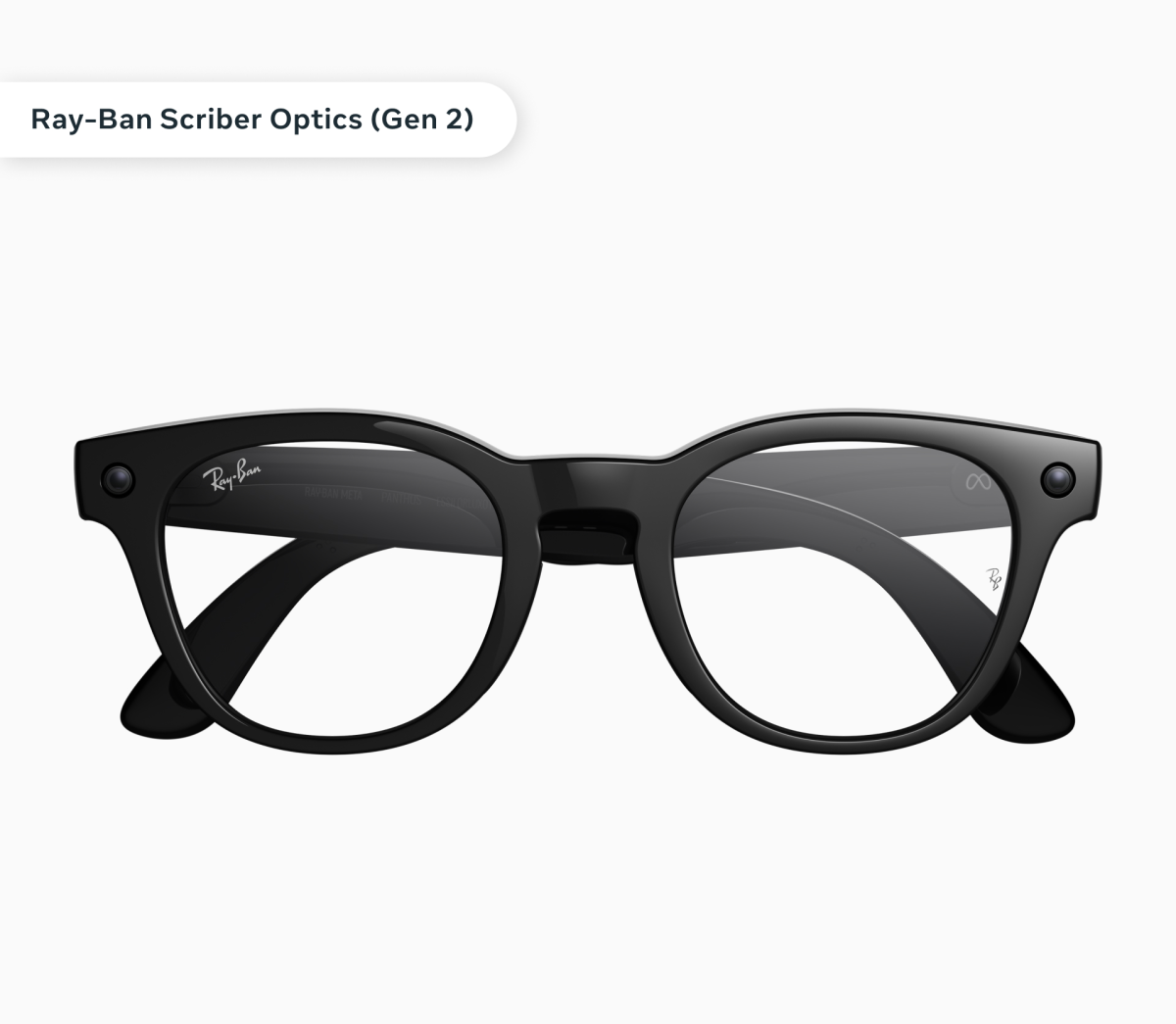

Meta Platforms has officially launched two new Ray-Ban smart glasses models explicitly designed for prescription lens wearers, marking a notable step in making its AI-powered eyewear more accessible to the roughly 1.5 billion people globally who need corrective vision.
The new models, codenamed Scriber and Blazer during development, were unveiled Tuesday and will be available primarily through traditional optical retailers and prescription eyewear channels rather than just consumer electronics stores. They come in rectangular and rounded styles, with Blazer offered in regular and large sizes.
Unlike the more experimental Ray-Ban Meta Display glasses that arrived late last year with a heads-up display, these are non-display AI glasses in the vein of the existing popular Ray-Ban Meta lineup. They pack the same core features: a built-in camera for photos and video, microphones, open-ear speakers, and deep integration with Meta AI for voice-assisted queries, real-time translation hints, and contextual information.
The glasses also include upgraded Wi-Fi 6 support with the UNII-4 band and ship with charging cases. They do not introduce major new hardware leaps, this is more about form factor and distribution than a generational technology jump.
Previous Ray-Ban Meta models have supported aftermarket or custom prescription lenses, but these new frames were engineered from the ground up with prescription users in mind. The shift allows for a more seamless buying experience at opticians, where customers can get properly fitted frames with their exact prescription in one go, rather than retrofitting existing smart glasses.
The move is widely seen as a distribution play. By partnering more closely with EssilorLuxottica, Ray-Ban’s parent, and tapping into the massive global eyewear retail network, Meta aims to reach everyday glasses wearers who might never walk into a Best Buy. Analysts note this could significantly expand the addressable market for smart glasses beyond tech enthusiasts.
Meta has raced to an early lead in the consumer AI wearables category. Demand for the current Ray-Ban Meta Gen 2 has reportedly outstripped supply at times, and the company has been aggressive in scaling production. These prescription-focused models arrive as competition heats up, with Google exploring partnerships like its work with Warby Parker on AI glasses concepts.
For users, the practical upside is straightforward: AI assistance without sacrificing the everyday utility and comfort of proper prescription eyewear. Voice commands, hands-free capture, and Meta AI’s growing capabilities could prove useful for navigation, quick lookups, or even assisting with tasks while keeping eyes on the road or workspace.
That said, the launch underscores where the smart glasses category stands in early 2026. Hardware remains largely iterative, cameras, audio, and lightweight AI compute, while the real differentiation increasingly comes from software polish, ecosystem integration, and, crucially, how naturally the devices fit into daily life.
Pricing and exact availability details were not immediately detailed in the announcement, though existing Ray-Ban Meta models typically start in the $300 range before prescription add-ons. Sales through optical channels may also include bundle discounts on lenses, similar to current promotions.
The timing feels strategic. With Meta continuing to pour resources into AI across its portfolio, turning its most successful consumer hardware experiment into something closer to mainstream eyewear could help normalize wearable AI assistants. Whether it moves the needle on broader adoption will depend on how comfortable people feel wearing always-on cameras and microphones in social and professional settings and how well Meta handles the inevitable privacy conversations.
For now, the company is betting that making its glasses work better for the people who actually need glasses every day is the clearest path forward. In a category still searching for its iPhone moment, this feels like a pragmatic, if incremental, evolution.






 English
  简体中文
简体中文  Čeština
  Deutsch (Sie)
  Français


