


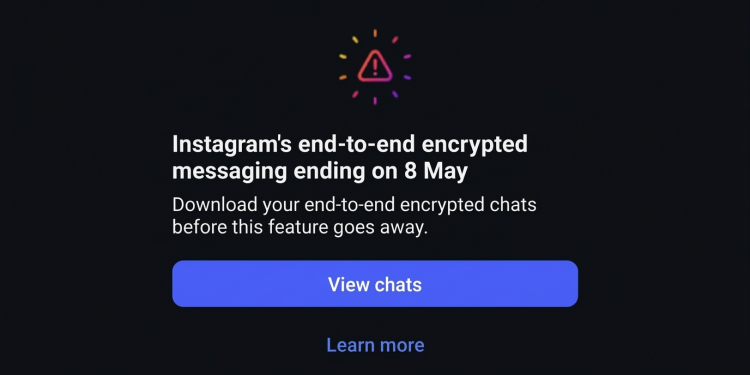
Meta is ending support for end-to-end encryption (E2EE) in Instagram direct messages starting May 8, 2026, a move that reverses part of the company’s years-long push toward stronger privacy in its messaging ecosystem.
The change, detailed in an updated Instagram help page, means that after that date, users will no longer be able to initiate or continue chats with E2EE enabled on a per-conversation basis. Instagram has begun notifying affected users in-app and is advising them to download any encrypted messages or shared media they want to preserve before the cutoff.
Unlike WhatsApp, where E2EE has been the default for years, Instagram’s version was never rolled out universally. It launched as an opt-in feature in late 2023, available only in select regions and requiring both parties to manually enable it for individual chats. Adoption remained minimal, which is the core reason Meta cited for the discontinuation.
A Meta spokesperson told multiple outlets, including The Verge and Engadget, that “very few people were opting in to end-to-end encrypted messaging in DMs,” prompting the company to remove the option entirely in the coming months. The spokesperson added that users seeking E2EE can simply switch to WhatsApp, another Meta-owned app where the feature remains standard and widely used.
The decision marks a notable pivot from Meta’s 2019 vision, when CEO Mark Zuckerberg outlined plans to unify messaging across Facebook Messenger, Instagram, and WhatsApp under a privacy-focused, encrypted framework. While WhatsApp and parts of Messenger have kept or expanded default E2EE, Instagram’s implementation stayed limited and experimental, never becoming a core product expectation for most of its 2 billion-plus monthly users.
What changes for users?
- Existing encrypted chats will lose E2EE protection after May 8, 2026. Messages sent or received before that date in E2EE mode will remain readable only by the participants until the feature is fully decommissioned, but new messages in those threads (or any new threads) will use standard, non-end-to-end encrypted transport.
- Meta (and potentially law enforcement with valid requests) will regain the ability to access message content for moderation, safety, or legal compliance purposes, capabilities that E2EE deliberately blocked.
- Regular Instagram DMs have always been encrypted in transit (between device and servers) but not end-to-end, meaning Meta could technically view them if needed. The opt-in E2EE layer was an extra safeguard for sensitive conversations.
Privacy advocates have expressed disappointment, viewing the move as a step back from Meta’s earlier commitments to user-controlled encryption. Critics argue it prioritizes platform control, easier content moderation, ad targeting signals from metadata, and cooperation with regulators, over maximum privacy. Some reports note the timing coincides with ongoing global debates about encrypted messaging and law-enforcement access.
Meta has not signaled any similar rollback for Messenger, where default E2EE has been expanding, and the company continues to position WhatsApp as its flagship for secure, private communication.
For most Instagram users, who treat DMs as casual extensions of the feed rather than ultra-secure channels, practical impact may be limited. But for those who relied on the feature for confidential exchanges (business negotiations, personal matters, or activism in restrictive regions), the change narrows options within Meta’s family of apps.
The broader takeaway: Meta appears to be streamlining its privacy strategy around its strongest performers. WhatsApp handles the heavy lifting on E2EE, while Instagram focuses on features that drive engagement over niche security toggles. Whether this satisfies privacy-conscious users or fuels calls for stronger independent alternatives remains an open question as the May deadline approaches.