
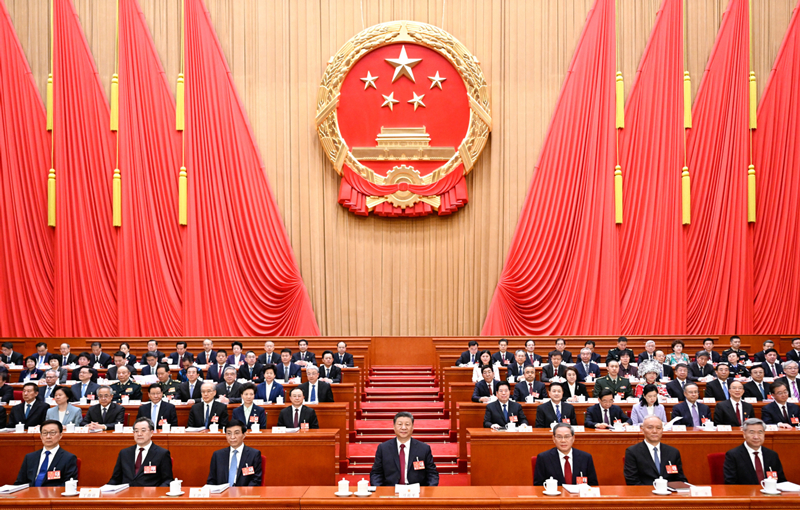
China has laid out its most ambitious technology roadmap in years. The 15th Five-Year Plan (2026–2030), formally adopted this week during the National People’s Congress session in Beijing, positions artificial intelligence, quantum technologies, and full technological self-reliance as the central pillars of the country’s next phase of development. The document repeatedly frames these areas as strategic imperatives, with AI referenced more than 50 times and a dedicated “AI+ action plan” aimed at embedding the technology across every major sector of the economy.
The plan calls for breakthroughs in scalable quantum computers, integrated space-earth quantum communication networks, embodied intelligence for humanoid robots, 6G infrastructure, brain-computer interfaces, and hyper-scale computing clusters. It also sets explicit goals for nuclear fusion research, reusable heavy-lift rockets, and advanced manufacturing systems. R&D spending is targeted to grow at least 7 percent annually through 2030, while the core digital economy is expected to account for 12.5 percent of GDP by the end of the period.
This is not a subtle shift. Beijing is responding directly to years of U.S. export controls on advanced chips, equipment, and software. The plan explicitly calls for “extraordinary measures” to achieve independence in critical technologies, including semiconductors, high-end manufacturing tools, and foundational AI models. State-owned enterprises will be mobilized as major buyers of domestic innovations, and government procurement rules will favor Chinese-made alternatives wherever possible.
Defense spending will rise 7 percent in 2026 to roughly 1.91 trillion yuan ($276.9 billion). While that is the slowest increase since 2021, it still outpaces overall GDP growth targets and ties directly into the technology push. Quantum and AI are described as foundational to “advanced combat capabilities,” signaling that military modernization remains tightly linked to civilian tech development.
For companies inside China, the message is clear: the state will provide both carrots and sticks. Massive public investment, preferential financing, and guaranteed demand from government and SOEs will reward those who deliver on the plan’s priorities. The risk for those who fall behind is equally obvious, marginalization in a system that increasingly rewards alignment with national goals.
The global implications are already being felt. Hyperscalers in the United States and Europe have been racing to secure AI chip supply, partly because they anticipate tighter restrictions and higher prices for advanced semiconductors as China accelerates domestic alternatives. African markets, including Nigeria, may eventually benefit from cheaper Chinese AI hardware and open-source models, but they could also face longer-term pressure on access to cutting-edge GPUs and specialized chips if global supply chains fragment further along geopolitical lines.
China has tried similar top-down technology drives before, most notably with Made in China 2025. Some goals from that earlier plan were met; others fell short amid inefficiencies and international pushback. This time the approach feels more focused and better resourced. The combination of explicit self-reliance targets, sustained R&D funding, and a clear external adversary has created unusual political momentum.
The 15th Five-Year Plan does not guarantee success. Execution risks remain high, from talent shortages in certain frontier fields to the potential for wasteful duplication across provinces. Yet it removes any doubt about Beijing’s strategic direction: for the next five years, China will treat leadership in AI, quantum, and related technologies as non-negotiable elements of national power.
The rest of the world now has a clearer timetable for how Beijing intends to compete. Whether that competition drives faster global innovation or deeper fragmentation will depend on how other governments and companies respond to the signal sent this week in Beijing.