


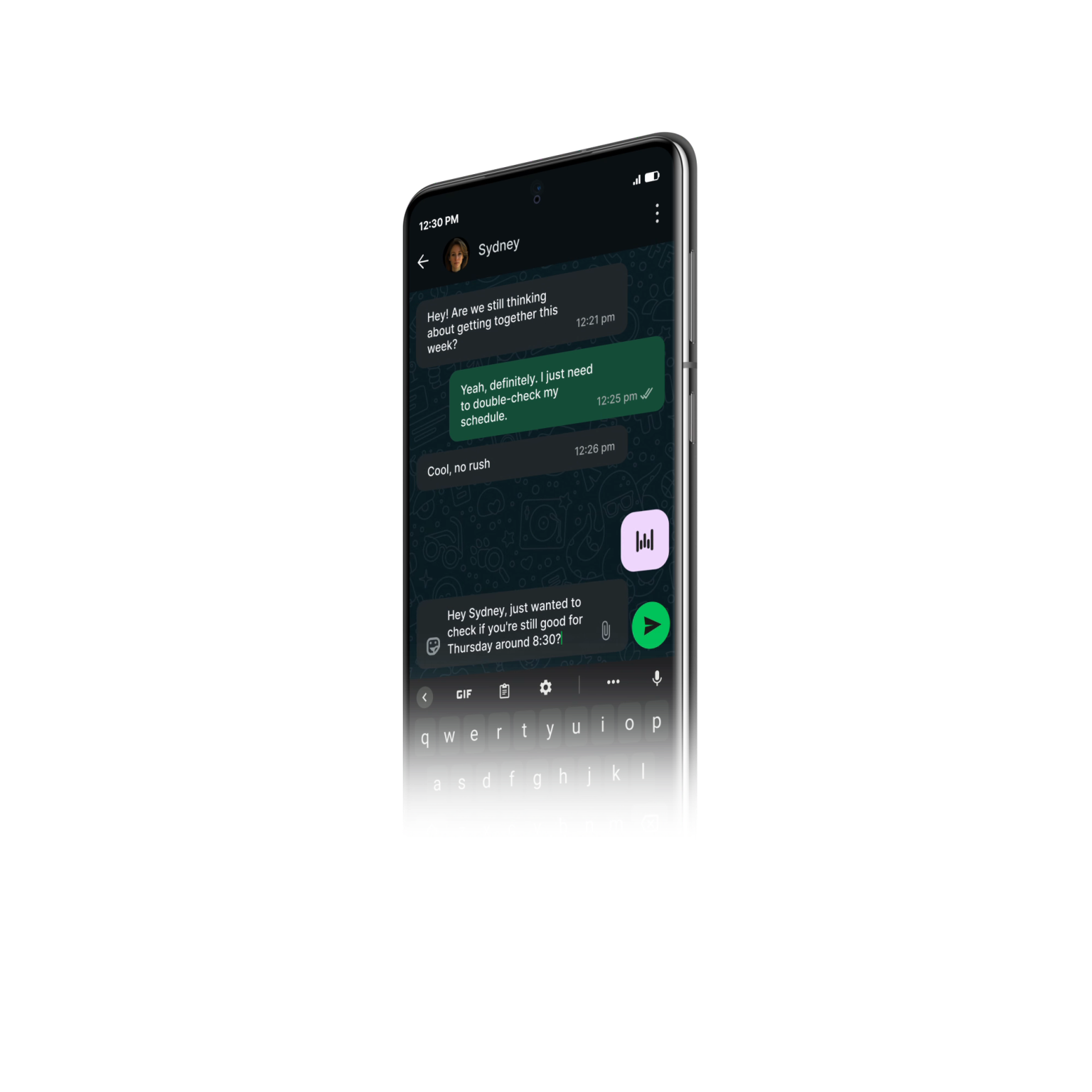
The AI dictation race just got more interesting. Wispr Flow, one of the fastest-rising startups in the AI productivity space, has officially launched its 30% faster Android voice app, marking a major expansion beyond its Mac, Windows, and iOS footprint. For a company betting that voice will eventually replace typing on mobile, Android was the missing piece. Now it’s in play.
Wispr Flow first made its name on desktop. It later rolled out on iOS in mid-2025 using a dedicated keyboard integration, a necessary workaround within Apple’s ecosystem. Android, however, offered something different. Instead of embedding itself as a keyboard, Wispr Flow appears as a floating bubble that works across apps. Users can press once to start dictating, hold to speak continuously, and tap close to end the session. The app then processes the spoken input removing filler words, correcting grammar, and formatting the output to match the context of the app being used.
In short, it doesn’t just transcribe. It rewrites in real time. “Android finally gave us the freedom to build the voice experience we always wanted,” said Tanay Kothari, co-founder and CEO of Wispr Flow. “Only when the platform gets out of the way can we truly expect voice to replace typing on mobile.” That line signals something bigger: Wispr Flow isn’t positioning itself as just another dictation app. It’s positioning itself as the interface layer for voice-first computing.
Alongside the Android launch, Wispr Flow announced a major infrastructure rewrite. The result: dictation is now 30% faster. In the AI productivity race, latency is everything. Users abandon tools that feel slow. By reducing the delay between speech and output, Wispr Flow is trying to make voice input feel natural.
The startup also supports translation in more than 100 languages and works across third-party apps. That cross-app functionality could be critical in markets where users switch between messaging apps, note-taking tools, and productivity software throughout the day.
Early traction suggests strong demand. Even in a limited Android rollout, users dictated over 1.3 million words in English within days of launch. For a productivity tool, that’s meaningful engagement.
One of the most notable additions is a dedicated Hinglish model built specifically for users who mix Hindi and English in daily speech. Code-switching is common across India’s urban population, but most voice tools struggle to process hybrid language patterns accurately. Wispr Flow’s new model is designed to transcribe Hinglish conversationally rather than defaulting to formal Hindi script.
“If you’re someone like me, English and Hindi weave together when I’m chatting with family and colleagues back home,” Kothari said. “This is one of those times when I just had to build something for me.” It’s a personal motivation but also a sharp market strategy.
India is one of the fastest-growing AI adoption markets globally. By localizing voice models beyond standard language datasets, Wispr Flow is targeting a behaviour, and behaviour tends to scale.
AI-powered dictation tools are everywhere on desktop and iOS. But Android remains less saturated. Outside of Typeless, which entered the platform last month, there are relatively few serious AI-native dictation players built specifically for Android workflows. Wispr Flow is stepping into that gap early. That timing matters. Android accounts for the majority of the global smartphone market share, particularly across emerging markets. If voice truly replaces typing, Android users represent the largest frontier.
Wispr Flow’s expansion is backed by deep capital. In June, the startup raised $30 million in a funding round led by Menlo Ventures. Just months later, it secured another $25 million from Notable Capital. The company has raised a total of $81 million to date, with sources indicating its most recent valuation sits around $700 million.
For a company still defining its category, that valuation signals investor belief that voice productivity could become foundational infrastructure. The bet isn’t just about transcription. It’s about owning the input layer of AI computing.
In the bigger picture, voice has long been framed as the future of mobile interaction. Yet adoption has lagged behind expectations. Early voice assistants struggled with context, formatting, and real-world usability. AI-native tools are trying to fix that. Wispr Flow’s approach: contextual formatting, filler-word cleanup, cross-app compatibility, and multilingual translation aims to reduce friction between thought and text.
The question now is whether users are ready to trust voice as a primary input method. With Android finally unlocked, Wispr Flow is betting the answer is yes. And if it’s right, typing may slowly become optional.