



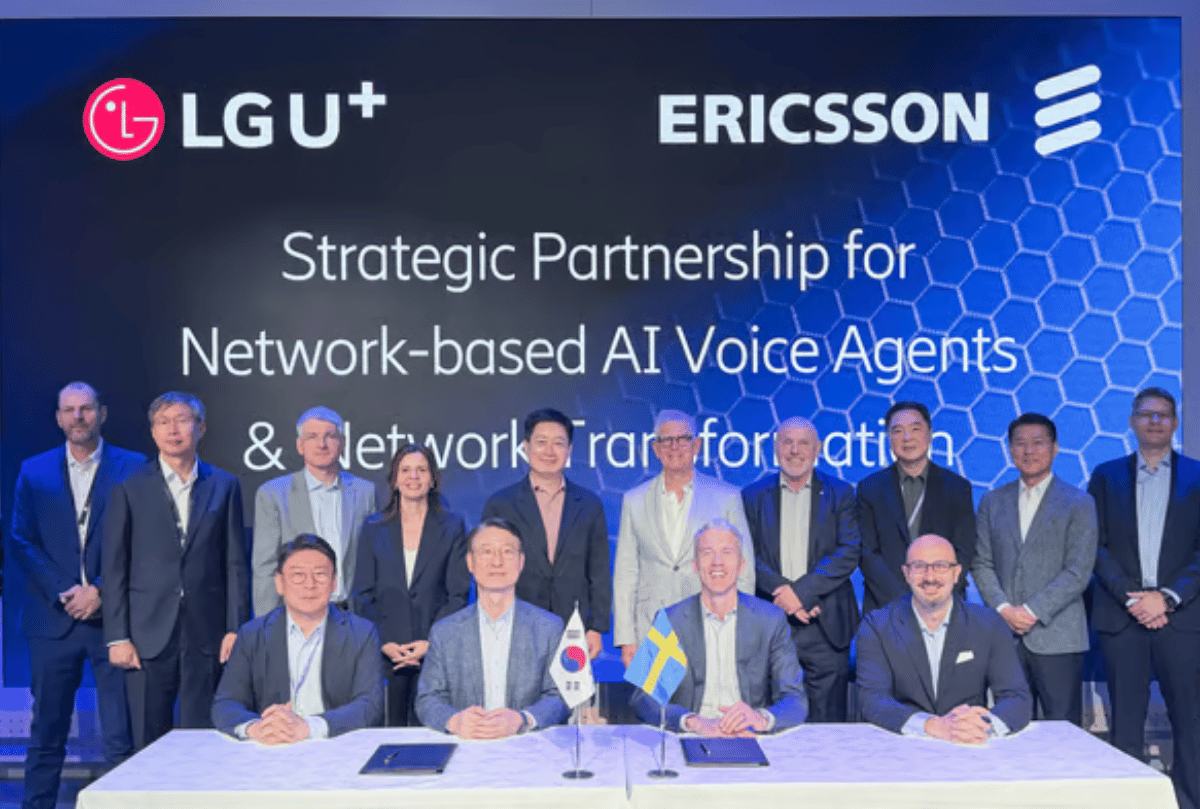

Swedish telecom equipment giant Ericsson and South Korean operator LG Uplus have expanded their partnership to accelerate the development of AI-driven network technologies, with a focus on cloud RAN architecture and advanced voice AI capabilities. The collaboration builds on years of joint work in 5G and aims to position both companies for the demands of more intelligent, automated networks heading into the 6G era.
At the core of the latest efforts is the verification of key Cloud RAN technologies. By shifting signal processing to general-purpose cloud infrastructure, operators can gain greater flexibility in resource allocation, automate optimization and fault detection through AI, and deploy software updates more rapidly. LG Uplus and Ericsson successfully tested intelligent RAN applications integrated with orchestration tools, enabling automated installation, upgrades, and management of base station software. They also validated performance of centralized/distributed unit (CU/DU) integrated cloud-based stations a configuration aligned with emerging 6G trends.
These advancements support the transition to AI-native networks, where intelligence is embedded directly into the radio access network (RAN) for real-time decision-making on scheduling, beamforming, and resource management. Ericsson has been pushing software-based AI models that run efficiently on existing hardware, promising gains in spectral efficiency, throughput, and energy savings without major new capital expenditure.
The partnership extends into voice services, where AI is enhancing call experiences and network security. LG Uplus has been vocal about leveraging its massive call data volumes to train sophisticated voice AI agents, such as its ixi O platform, which is evolving toward context-aware assistants capable of analyzing tone, intent, and emotion. Ericsson’s work in IMS-based AI voice and network-native fraud protection complements this, offering operators new monetization opportunities while safeguarding against deepfakes and AI-generated threats.
For LG Uplus, the move is part of a strategic shift beyond traditional connectivity toward AI-powered software services. The operator sees voice AI as a foundation for more personalized, proactive customer experiences and potential expansion into global markets. Ericsson, meanwhile, benefits from real-world deployment insights in one of the world’s most advanced mobile markets.
Cloud RAN and embedded AI represent a significant evolution in network design. Traditional RAN relies on specialized hardware; the cloud-native approach promises easier scaling, multi-vendor flexibility, and the ability to run diverse workloads on shared infrastructure. AI integration further enables predictive maintenance, traffic optimization, and autonomous operations reducing human intervention and improving service quality.
The timing is notable as operators worldwide prepare for 6G, where sensing, intelligence, and extreme automation will be table stakes. LG Uplus and Ericsson’s joint demonstrations of AI/ML-based fault prediction using NWDAF (Network Data Analytics Function) highlight how these technologies can preempt issues and maintain quality under surging data demands.
This deepened alliance strengthens Ericsson’s footprint in South Korea while giving LG Uplus access to cutting-edge tools to differentiate its network. As competition intensifies and AI expectations rise, such partnerships illustrate how vendors and operators are co-developing the intelligent infrastructure layer that will underpin future digital services. Early results from trials suggest measurable improvements in efficiency and user experience, setting a benchmark for broader industry adoption.

 English
  简体中文
简体中文  Čeština
  Deutsch (Sie)
  Français


